
What this calculator does
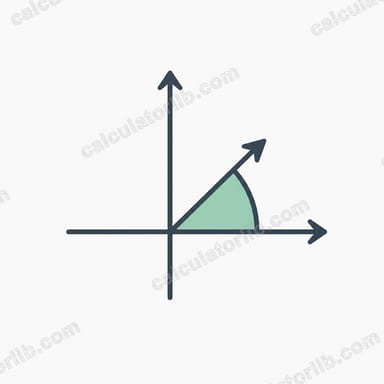
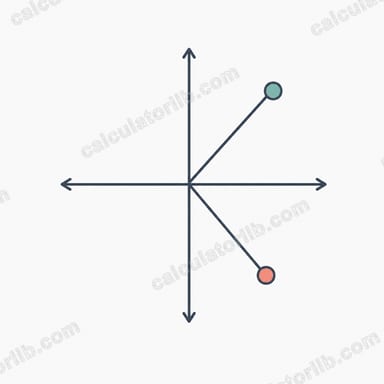
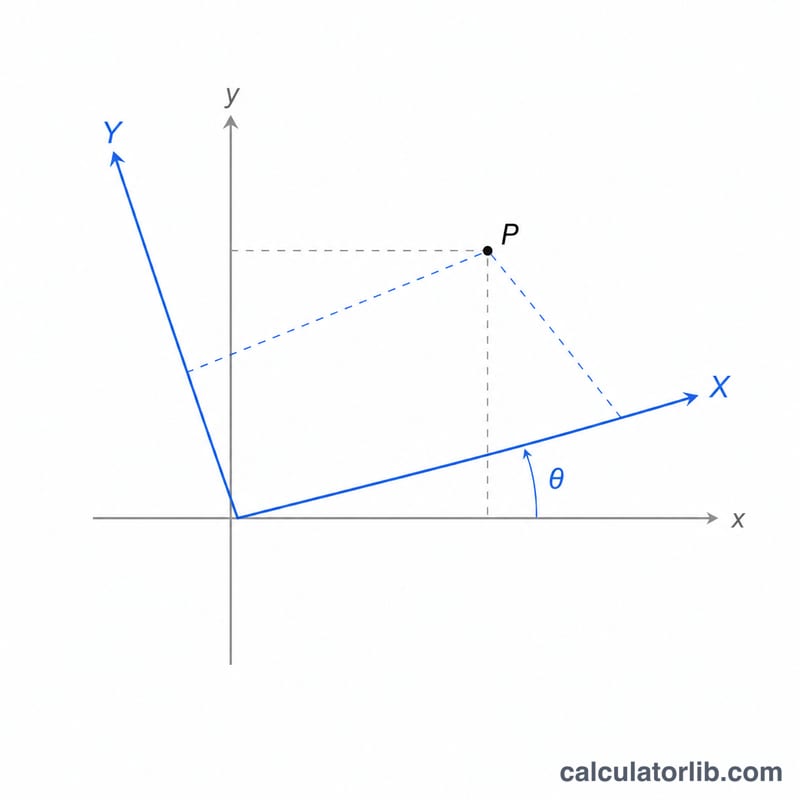
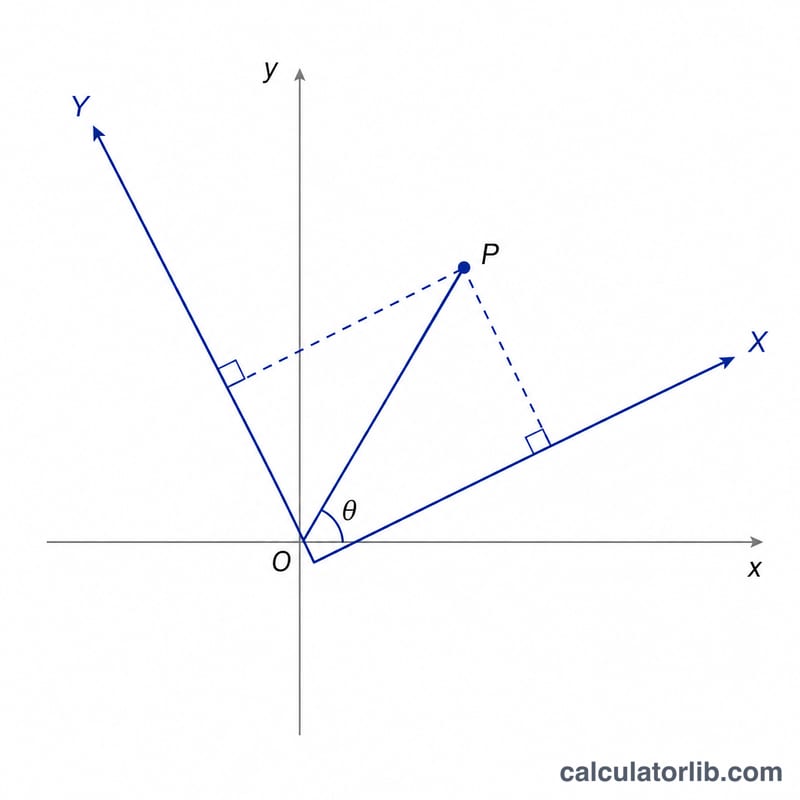
This tool performs the classic rotation of axes transformation from plane analytic geometry. You provide a point with coordinates (x, y) measured in the original axes, and an angle theta by which the coordinate axes are rotated counterclockwise about the origin. The calculator returns the coordinates (X, Y) of the same fixed point as seen in the new, rotated axes. This is a passive transformation: the point stays put while the axes turn.
How to use it
Enter the original x and y values, type the rotation angle theta, and choose whether theta is in degrees or radians. A positive angle rotates the axes counterclockwise; enter a negative number for a clockwise rotation. Press calculate to get the new coordinates X and Y, along with the angle expressed in radians.
The formula explained
The transformation is $$\begin{aligned} X &= x\cos\theta + y\sin\theta \\ Y &= -x\sin\theta + y\cos\theta \end{aligned}$$ In matrix form this is the rotation matrix with \(\cos\theta\) on the diagonal and \(\sin\theta\)/\(-\sin\theta\) off the diagonal. Because it is an orthogonal matrix, distance from the origin is preserved: \(X^2 + Y^2\) always equals \(x^2 + y^2\), which is a handy sanity check.
Worked example
Take \(x = 3\), \(y = 4\), \(\theta = 30\) degrees. Then \(\cos 30^\circ = 0.8660254\) and \(\sin 30^\circ = 0.5\). So $$X = 3(0.8660254) + 4(0.5) = 4.59807621$$ $$Y = -3(0.5) + 4(0.8660254) = 1.96410162$$ Checking: \(4.59807621^2 + 1.96410162^2 = 25 = 3^2 + 4^2\), confirming the distance is preserved.
FAQ
What is the difference between rotating the axes and rotating the point? Rotating the axes (this tool) is a passive transformation. Rotating the point itself is the active version and uses the transposed sign convention: \(X = x\cos\theta - y\sin\theta\), \(Y = x\sin\theta + y\cos\theta\).
Can I enter angles larger than 360 degrees? Yes. Any real angle works because the trig functions wrap naturally; values outside the 0 to 360 range give equivalent results.
Why is distance from the origin unchanged? A rotation is an isometry: it preserves lengths and angles, so the radial distance of the point from the origin is identical in both coordinate systems.