
What This Calculator Does
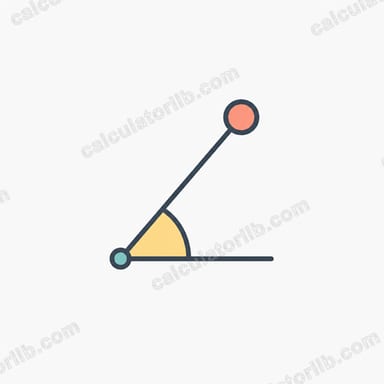
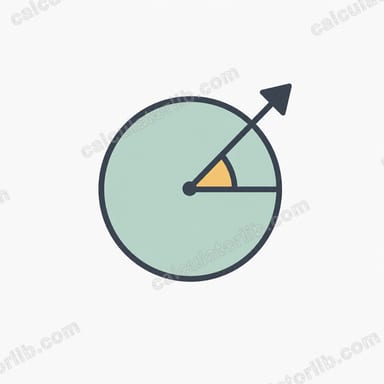
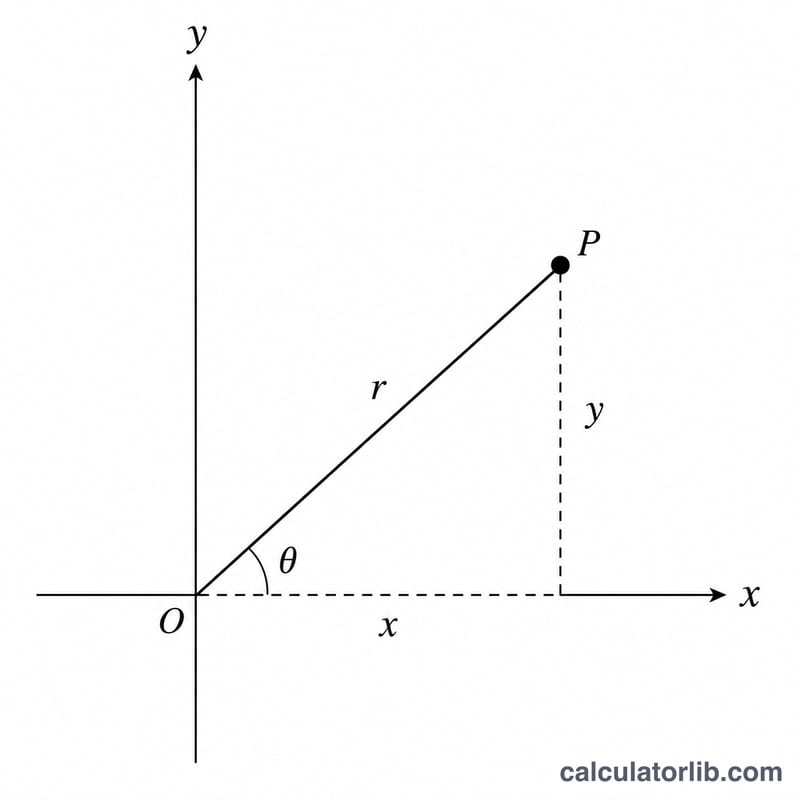
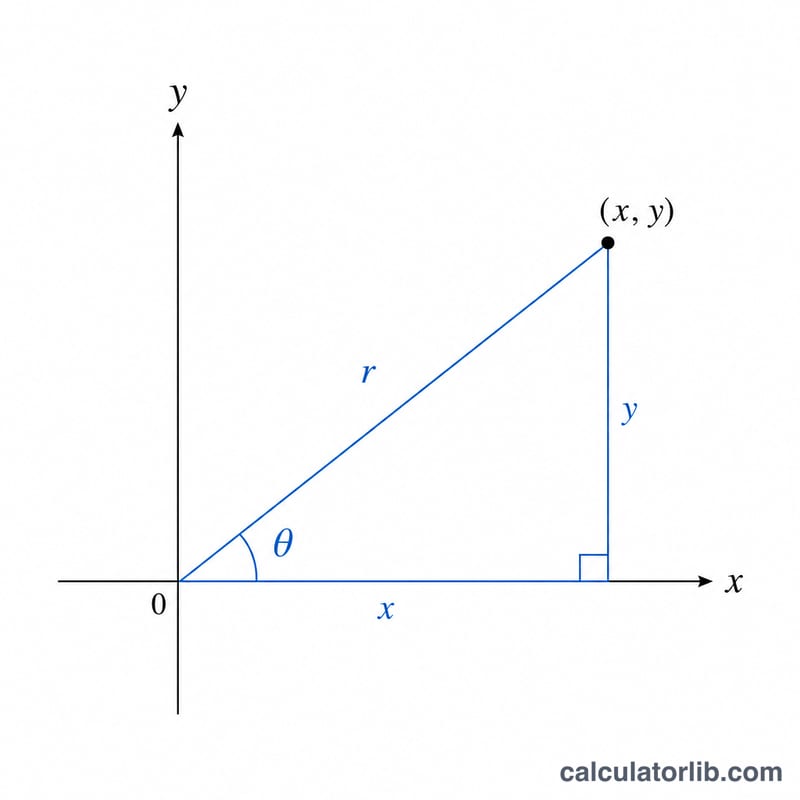
The Polar Coordinates Calculator converts a point given in Cartesian form (x, y) into polar form (r, θ). You enter two values — the X Coordinate and the Y Coordinate — and the tool returns the radius r (the distance from the origin) and the angle θ (the direction). The angle is reported in both radians and degrees, so you get magnitude and direction in one step.
The Formula It Uses
Two standard equations drive the result:
- Radius: \( r = \sqrt{x^{2} + y^{2}} \) — the straight-line distance from the origin to your point.
- Angle: \( \theta = \operatorname{arctan2}(y, x) \) — the two-argument arctangent, which correctly accounts for the quadrant your point lies in.
Using arctan2 rather than a plain arctan(y/x) matters: plain arctan can't tell the difference between, say, the second and fourth quadrants. The calculator computes \(\theta\) in radians, then converts it to degrees using \( \theta° = \theta \times \frac{180}{\pi} \). Results range from −180° to +180° (or −π to π radians).
How to Use It
- Type your horizontal value into X Coordinate.
- Type your vertical value into Y Coordinate.
- Read off r, θ in radians, and θ in degrees.
Negative values are fine and place the point in the correct quadrant automatically.
Worked Example
Suppose x = 3 and y = 4.
- $$ r = \sqrt{3^{2} + 4^{2}} = \sqrt{9 + 16} = \sqrt{25} = \mathbf{5} $$
- $$ \theta = \operatorname{arctan2}(4, 3) \approx 0.927 \text{ radians} $$
- In degrees: $$ 0.927 \times \frac{180}{\pi} \approx \mathbf{53.13°} $$
So the point (3, 4) becomes (5, 53.13°) in polar coordinates.
Frequently Asked Questions
Why is my angle negative? When y is negative (point below the x-axis), arctan2 returns a negative angle between 0° and −180°. To express it as a positive angle from 0° to 360°, just add 360°.
What happens if I enter x = 0 and y = 0? The radius is 0 and the angle is conventionally 0 — the point sits exactly at the origin, where direction is undefined.
Are the radians and degrees the same angle? Yes. They are two representations of the identical direction; the calculator simply converts radians to degrees for convenience.