
What Are Cylindrical Coordinates?
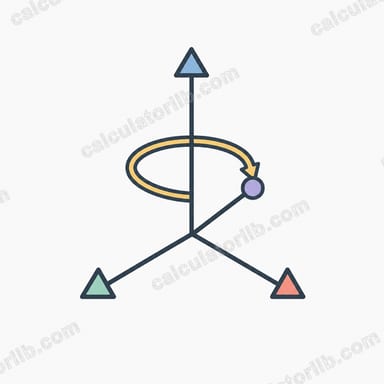
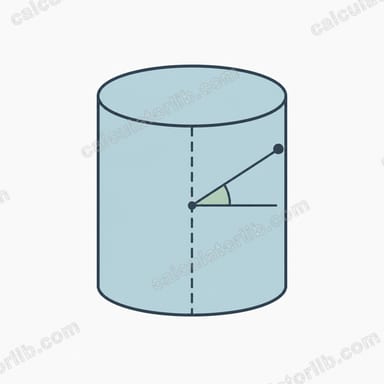
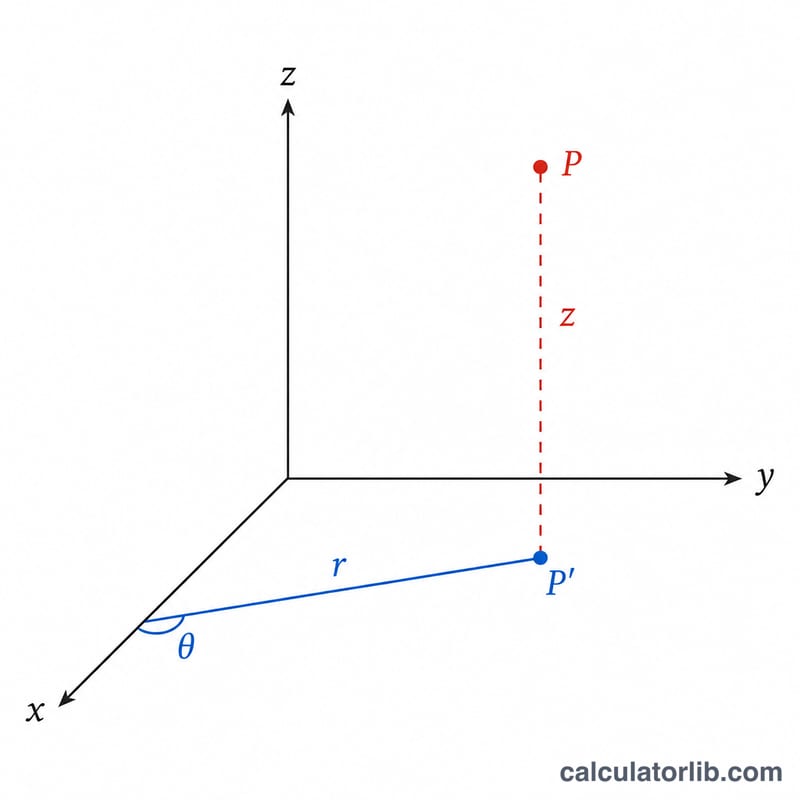
Cylindrical coordinates describe a point in 3D space using a radius r, an angle θ, and a height z. They extend 2D polar coordinates by simply keeping the Cartesian z-axis. This system is ideal for problems with rotational symmetry around an axis — pipes, cylinders, electromagnetic fields, and fluid flow.
How to Use This Calculator
Pick a conversion direction. For Cartesian → Cylindrical, enter the x, y, and z values; the tool returns r, θ (in degrees), and z. For Cylindrical → Cartesian, enter r, θ (degrees), and z to get x, y, and z. The angle is computed with the two-argument arctangent (atan2) so the correct quadrant is always chosen.
The Formula Explained
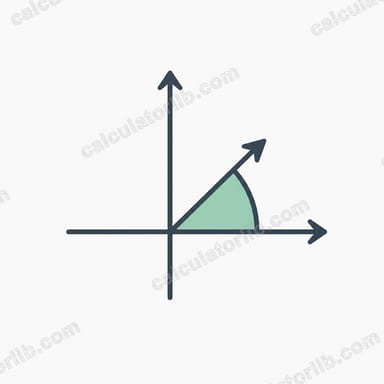
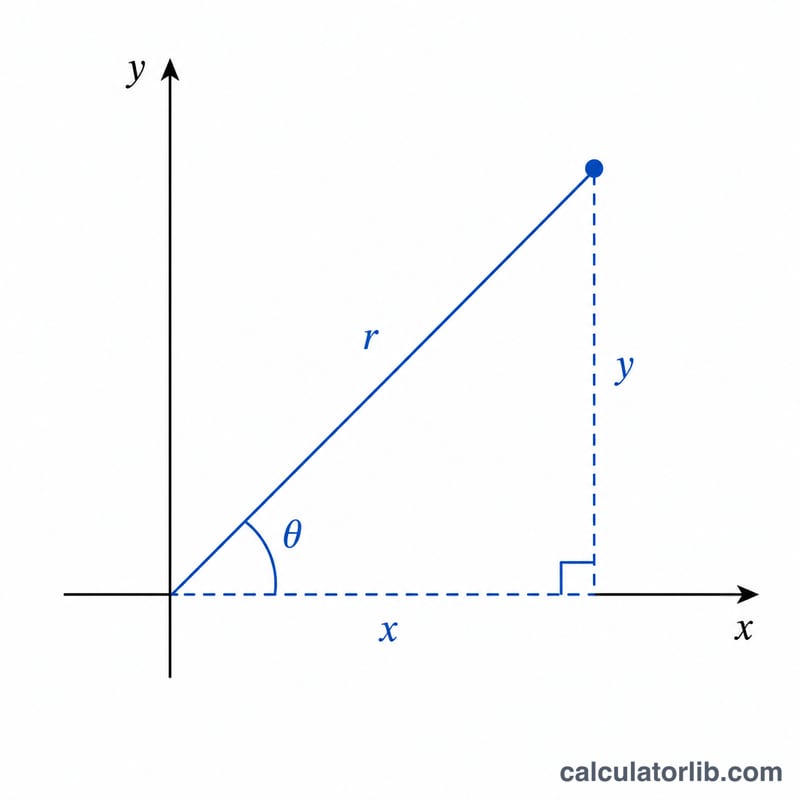
The radius is the straight-line distance from the z-axis: $$r = \sqrt{x^{2} + y^{2}}$$ The angle uses $$\theta = \operatorname{atan2}(y,\ x)$$ which returns a value between −180° and 180°, handling all four quadrants and the axes correctly. The height \(z\) is identical in both systems. The inverse is $$x = r\cos\theta \qquad y = r\sin\theta$$
Worked Example
Convert the Cartesian point (3, 4, 5). The radius is $$\sqrt{3^{2} + 4^{2}} = \sqrt{25} = 5$$ The angle is \(\operatorname{atan2}(4, 3) \approx 53.13°\). The height stays 5. So the cylindrical coordinates are (5, 53.13°, 5).
FAQ
Why use atan2 instead of arctan(y/x)? Plain arctan loses quadrant information and is undefined when x = 0. atan2 handles every case correctly.
Are angles in degrees or radians? This calculator displays and accepts θ in degrees for convenience; internally it converts to radians for the trig functions.
What if x and y are both zero? The point is on the z-axis, so r = 0 and θ is conventionally 0°.