
What this calculator does
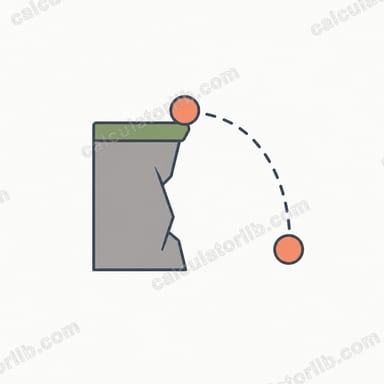
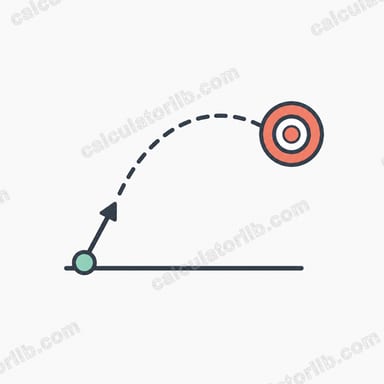
This tool models ideal projectile motion: an object launched from ground level at a given initial speed and angle, moving under constant gravity with no air resistance. It tabulates the trajectory — the height and horizontal distance — across a sequence of times (or across a sequence of horizontal distances) and reports the headline quantities: time of flight, maximum height and maximum range. The physics is universal Newtonian mechanics, identical everywhere.
How to use it
Enter the initial speed v and choose its unit (m/s or km/h). Set the launch angle θ in degrees (0 to 90) and the gravitational acceleration g (default 9.80665 m/s² for Earth standard gravity). Pick the sweep variable: Time generates rows at \(t = \text{start} + n \times \text{increment}\), while Distance generates rows at \(l = \text{start} + n \times \text{increment}\) and solves for the time and height at each distance. Adjust the start value, increment and repeat count to control table resolution.
The formula explained
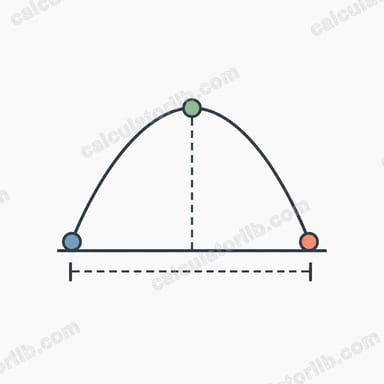
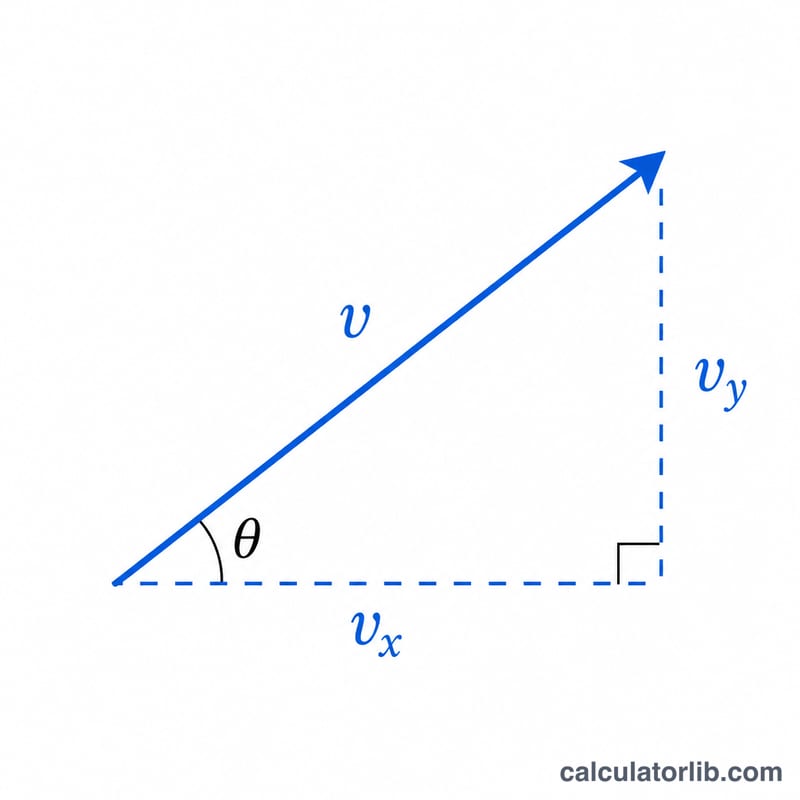
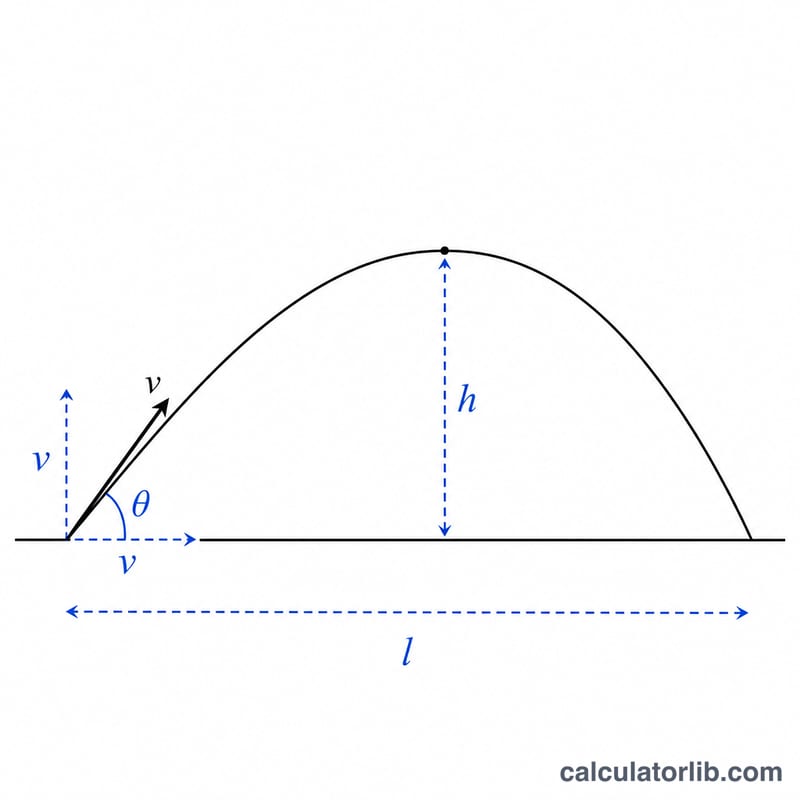
The launch velocity splits into a horizontal component \(v_x = v\cdot\cos\theta\) and a vertical component \(v_y = v\cdot\sin\theta\). The horizontal motion is uniform, \(l(t) = v_x\cdot t\), while the vertical motion is uniformly decelerated, \(h(t) = v_y\cdot t - \tfrac{1}{2}g\cdot t^{2}\). Eliminating time gives the parabola $$h(l) = l\cdot\tan\theta - \frac{g\cdot l^{2}}{2v^{2}\cos^{2}\theta}.$$ The projectile returns to launch height after \(T = 2v\cdot\sin\theta/g\), peaks at \(H = v^{2}\sin^{2}\theta/(2g)\), and lands a distance \(R = v^{2}\sin(2\theta)/g\) away.
Worked example
With \(v = 30\ \text{m/s}\), \(\theta = 60\degree\) and \(g = 9.80665\ \text{m/s}^2\): \(v_x = 15\ \text{m/s}\) and \(v_y = 25.98\ \text{m/s}\). At \(t = 0.1\ \text{s}\) the object is at \(l = 1.5\ \text{m}\) and \(h = 2.549\ \text{m}\). The time of flight is $$T = 2\times25.98/9.80665 = 5.299\ \text{s},$$ the maximum height is $$H = 25.98^{2}/(2\times9.80665) = 34.41\ \text{m},$$ and the maximum range is $$R = 900\times\sin(120\degree)/9.80665 = 79.48\ \text{m}.$$
FAQ
Does it include air resistance? No. It assumes a vacuum (drag-free) projectile, so real-world ranges are typically shorter.
What happens at \(\theta = 90\degree\)? The object goes straight up: \(v_x = 0\), so horizontal distance stays 0. In distance-sweep mode it never reaches any nonzero distance, so heights are reported as 0.
Why do some heights become negative? After the time of flight the projectile has fallen below the launch level; the table keeps listing those values as it descends.