
What is a Manometer Calculator?
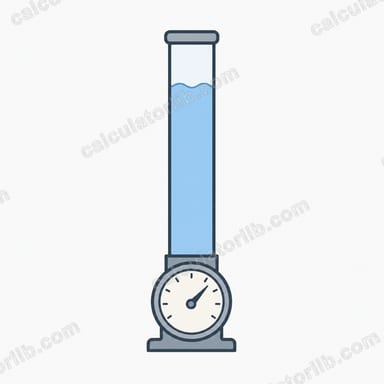
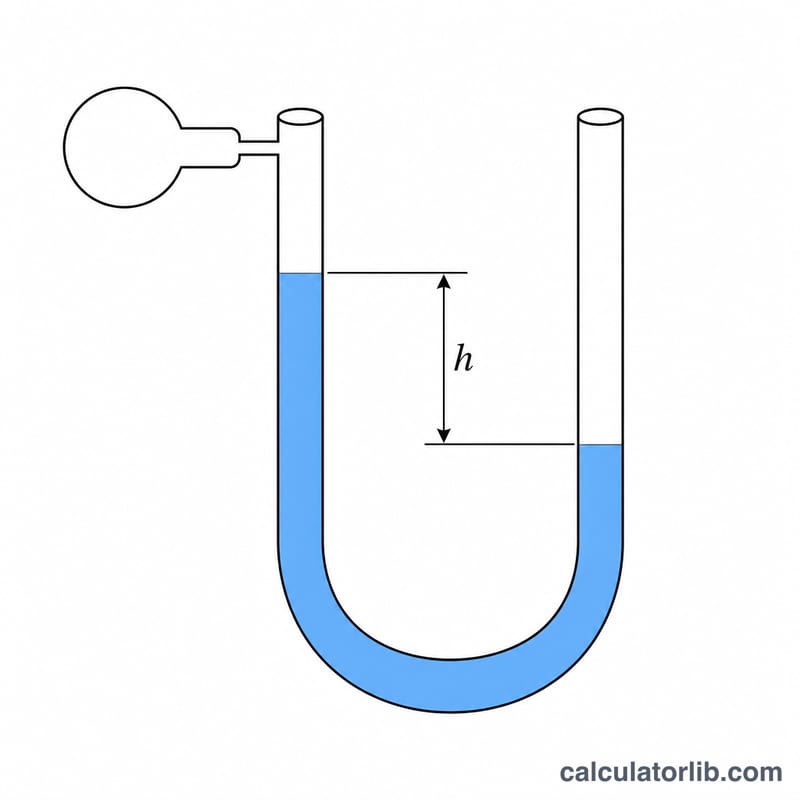
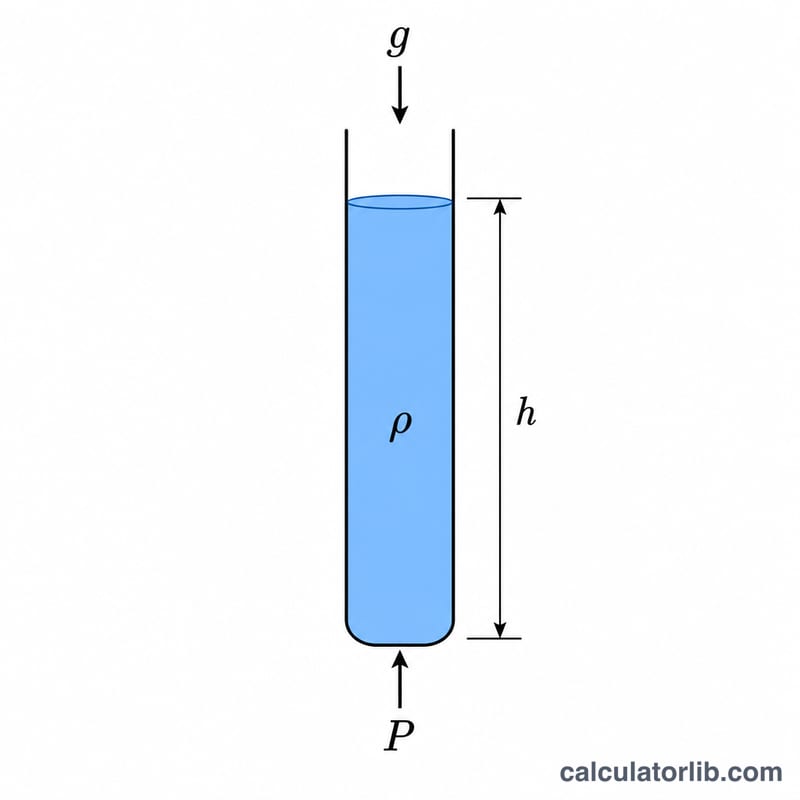
A manometer is a simple instrument that measures pressure by balancing it against the weight of a liquid column. This calculator uses the hydrostatic relationship \(P = \rho \cdot g \cdot h\) to convert the height of a fluid column into a pressure difference. It is a universal physics tool — valid anywhere, with no country-specific assumptions.
How to Use It
Enter three values: the fluid density \(\rho\) in kilograms per cubic metre (water ≈ 1000, mercury ≈ 13600), the gravitational acceleration \(g\) (Earth ≈ 9.81 m/s²), and the height \(h\) of the fluid column in metres. The calculator returns the pressure difference in pascals along with conversions to kilopascals, bar, millimetres of mercury, and pounds per square inch.
The Formula Explained
The pressure exerted by a static fluid column depends only on the vertical height of the column, not its shape or cross-section. Density (\(\rho\)) tells how heavy the fluid is per unit volume, gravity (\(g\)) sets how strongly that mass is pulled down, and height (\(h\)) is the vertical difference between the two fluid surfaces. Multiplying them gives the gauge pressure in pascals: $$P = \rho g h$$
Worked Example
A mercury manometer (\(\rho = 13600\) kg/m³) shows a height difference of 0.1 m on Earth (\(g = 9.81\) m/s²):
$$P = 13600 \times 9.81 \times 0.1 = 13341.6 \text{ Pa} \approx 13.34 \text{ kPa} \approx 100.07 \text{ mmHg}$$
FAQ
Why does shape not matter? Hydrostatic pressure depends only on vertical depth, so tube width and shape have no effect.
What density should I use for water? Pure water at room temperature is about 1000 kg/m³; mercury is about 13600 kg/m³.
Is this gauge or absolute pressure? The result is the pressure difference (gauge) created by the column; add atmospheric pressure (~101325 Pa) for absolute pressure.