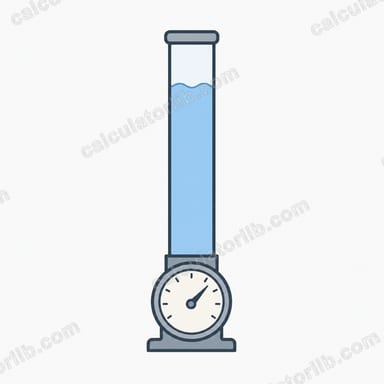

What Is the Head to Pressure Calculator?
This tool converts head — the vertical height of a column of fluid — into pressure. Engineers, pump technicians, and plumbers use head and pressure interchangeably, but switching between them requires knowing the fluid density. Enter a head value in meters or feet, choose the fluid's specific gravity, and get the equivalent pressure in psi, kPa, bar, and Pascals.
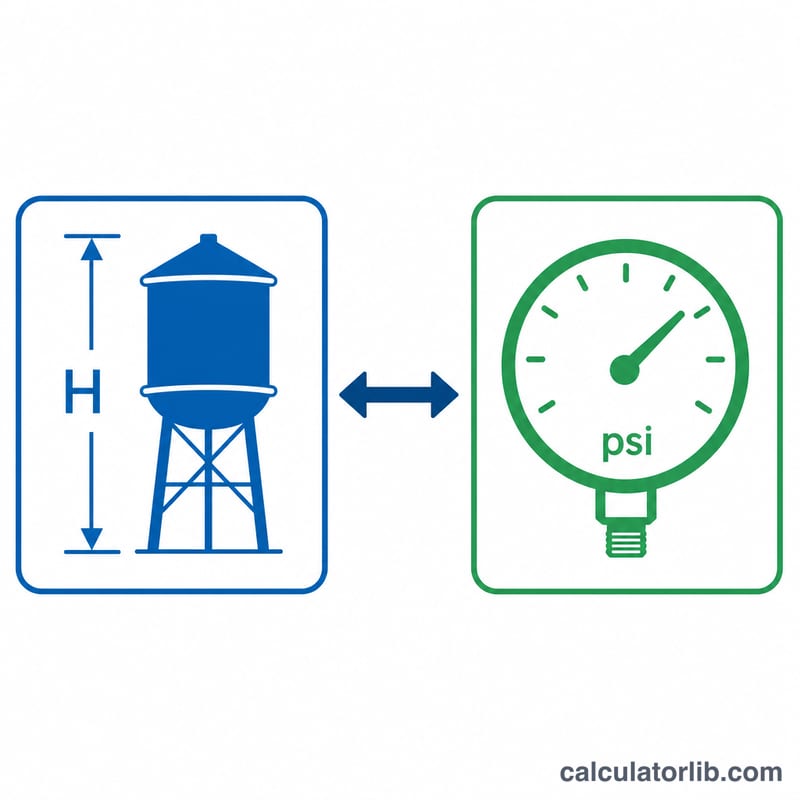
How to Use It
1. Enter the head height. 2. Pick the unit (meters or feet). 3. Set the fluid specific gravity — water is 1.0, seawater about 1.025, diesel roughly 0.85. The calculator computes pressure at the base of that fluid column. It applies to any liquid as long as you supply the correct specific gravity.
The Formula Explained
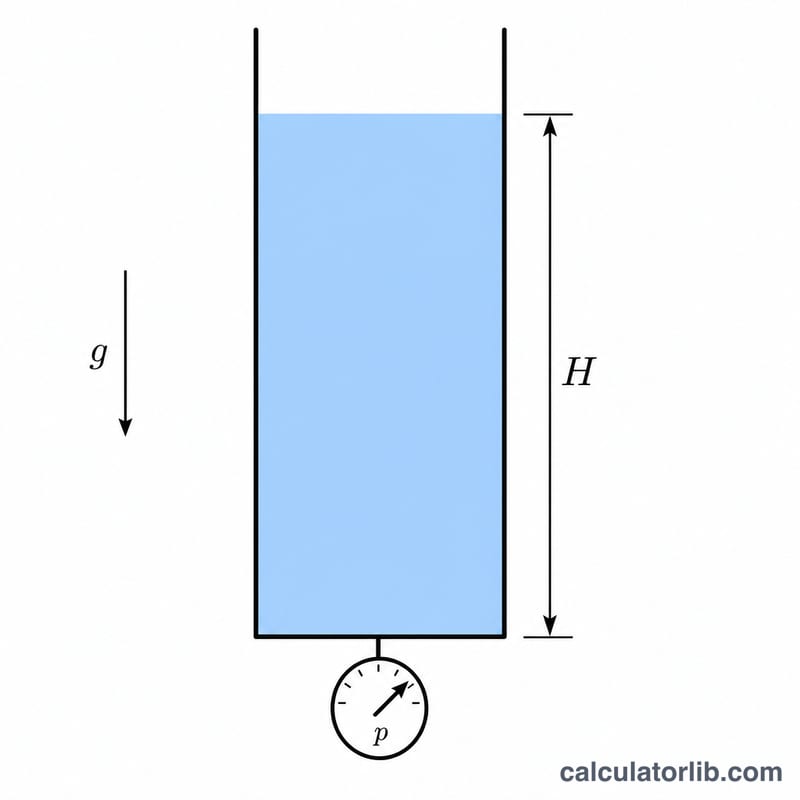
Hydrostatic pressure is \(P = \rho \cdot g \cdot H\), where ρ (rho) is the fluid density in kg/m³, g is gravitational acceleration (9.80665 m/s²), and H is head in meters. Fresh water has ρ = 1000 kg/m³; multiplying by specific gravity gives any fluid's density. The result in Pascals is then converted to other units (1 psi = 6894.757 Pa, 1 bar = 100,000 Pa).
$$\text{P}_{\text{psi}} = \frac{1000 \times \text{SG} \times 9.80665 \times \text{Head (m)}}{6894.757}$$
Worked Example
For 10 meters of water head (SG = 1.0): $$P = 1000 \times 9.80665 \times 10 = 98{,}066.5 \text{ Pa} = 98.07 \text{ kPa} = 0.981 \text{ bar} = 14.22 \text{ psi}$$ A handy rule of thumb: about 2.31 feet of water equals 1 psi.
FAQ
Does fluid type matter? Yes. Denser fluids produce more pressure for the same head, which is why specific gravity is an input.
Why use head instead of pressure? Pump curves are often given in head because head is independent of the fluid pumped, making the rating universal.
Is pipe diameter relevant? No. Static pressure from a fluid column depends only on height, density, and gravity — not on the cross-sectional area.