

What Is an ACT Superscore?
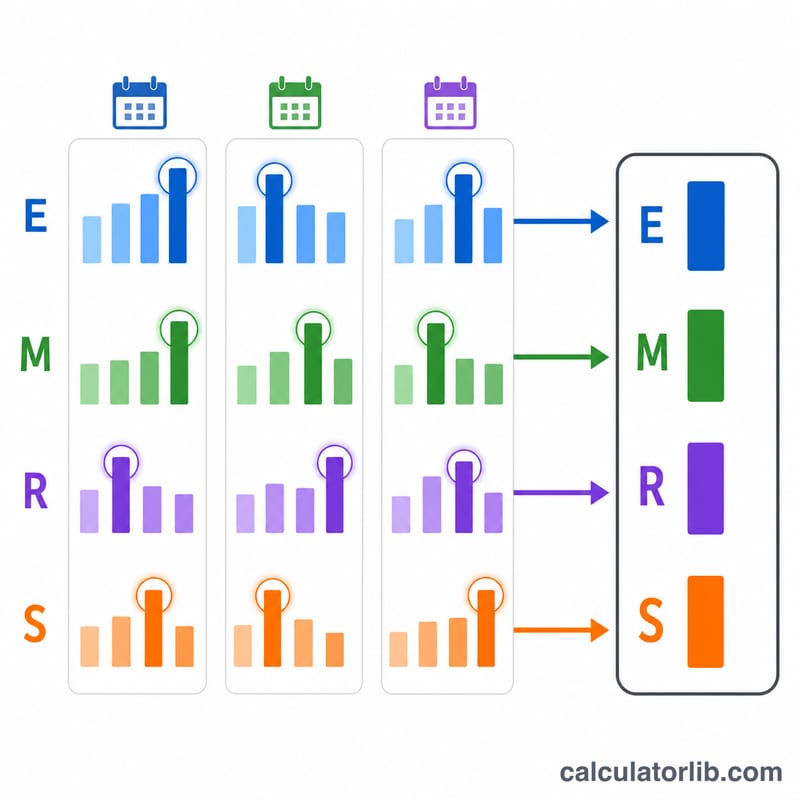
This calculator applies to the ACT (United States). A superscore is a composite ACT score built from your highest section scores (English, Math, Reading, and Science) taken from across all the times you sat the test — not just a single test date. Many US colleges now superscore the ACT, meaning they consider the best version of each section, which can raise your composite and strengthen your application. The official ACT now reports a superscore automatically once you have multiple test attempts.
How to Use This Calculator
Look across every ACT test date you have completed and pick out the single highest score you earned in each section. Enter those four best scores — English, Math, Reading, and Science — into the fields above. Each section is scored on a 1–36 scale. The calculator averages the four best scores and rounds to the nearest whole number to produce your superscore composite.
The Formula Explained
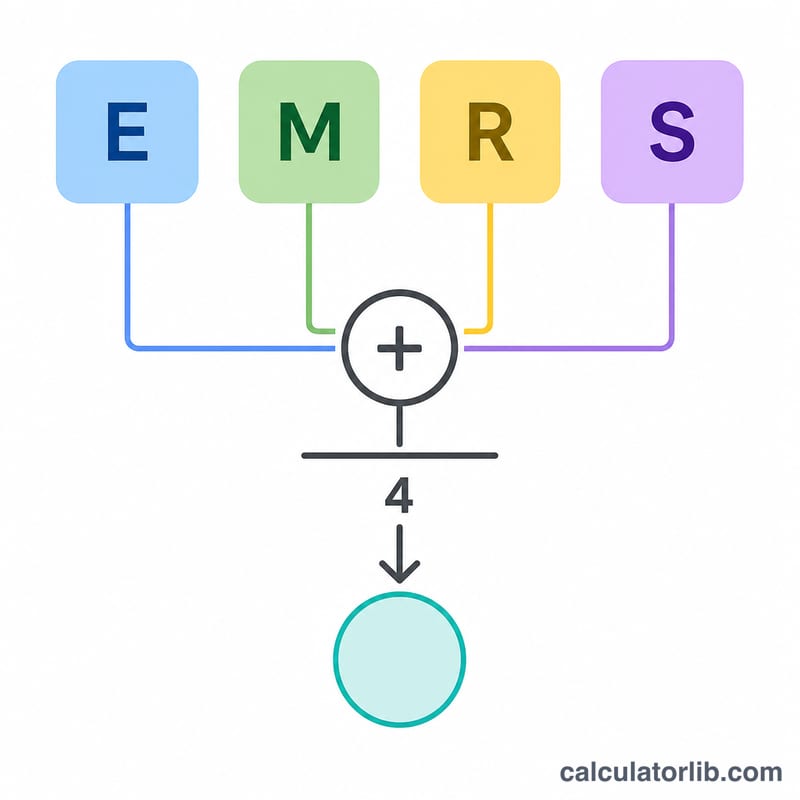
The superscore is simply the average of your four best section scores: add the maximum English, Math, Reading, and Science scores together, divide by four, then round to the nearest whole number (an average ending in .5 rounds up). Because each input is your personal best per section rather than a single sitting, the superscore is always greater than or equal to your highest single-test composite.
$$\text{Superscore} = \operatorname{round}\!\left(\frac{E_{\max}+M_{\max}+R_{\max}+S_{\max}}{4}\right)$$
Worked Example
Suppose across two test dates your best scores are English 32, Math 30, Reading 34, and Science 31. The sum is \(32 + 30 + 34 + 31 = 127\). Dividing by 4 gives \(31.75\), which rounds to 32. So your ACT superscore is 32.
Interpreting Your ACT Superscore
The ACT reports each of its four sections — English, Math, Reading, and Science — on a scale of 1 to 36. The composite (and the superscore) is simply the average of those four section scores, rounded to the nearest whole number:
$$\text{Superscore} = \text{round}\left(\frac{\text{Best English} + \text{Best Math} + \text{Best Reading} + \text{Best Science}}{4}\right)$$A superscore takes your single highest score in each section across all of your test dates and averages those four bests together. Because each section is drawn from your strongest performance, your superscore is always greater than or equal to your best single-sitting composite.
The 1–36 composite is a national standardized scale. Higher scores correspond to higher percentile ranks among recent test-takers. The approximate national percentiles below are based on widely published ACT norms and are meant as a general guide — exact percentiles shift slightly year to year:
| Composite Score | Approx. National Percentile | General Interpretation |
|---|---|---|
| 36 | 99th+ (top ~1%) | Perfect score |
| 30 | ~93rd | Highly competitive |
| 24 | ~73rd | Above national average |
| 20 | ~48th | Around the national average |
Important: Whether a college actually uses your superscore is determined by each institution's own admissions policy. Some colleges superscore the ACT automatically, some consider your single highest sitting, and others ask you to send all scores. Always check the testing policy of every school on your list before assuming a superscore will be used. To see what a single test date averages to, use a standard ACT composite of 31.
FAQ
Do all colleges accept ACT superscores? No. Policies vary — many superscore, some use your highest single sitting, and a few require all scores. Always check each school's testing policy.
How does rounding work? The four-section average is rounded to the nearest whole number; a .5 average rounds up (e.g., \(31.5\) becomes 32).
Does superscoring help my chances? It can. Since it combines your best per-section results, the composite is at least as high as your best single test date, which may improve admissions consideration where superscoring is allowed.