

What Is the ACT Composite Score?
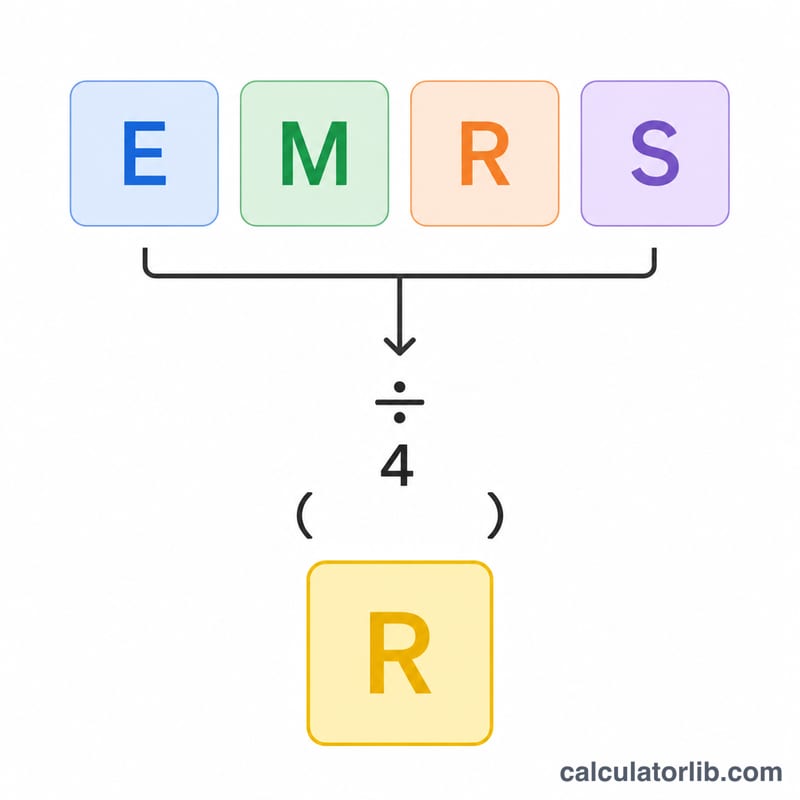
The ACT is a standardized college admissions test used in the United States. It contains four multiple-choice sections — English, Math, Reading, and Science — each scored on a scale from 1 to 36. Your composite score is the single number colleges look at most, and it is simply the average of those four section scores rounded to the nearest whole number. This calculator does that math for you instantly.
How to Use This Calculator
Enter your scaled score for each of the four sections (every score must be between 1 and 36). The calculator adds the four numbers, divides by four, and rounds the result. It also shows the raw sum and the unrounded average so you can see exactly how close you are to the next whole point.
The Formula Explained
The composite is calculated as:
$$\text{Composite} = \operatorname{round}\!\left(\frac{E + M + R + S}{4}\right)$$
The ACT rounds the average to the nearest whole number. A fractional part of 0.5 or higher rounds up, while below 0.5 rounds down. The optional Writing section is not part of the composite score, so it is not included here.
Worked Example
Suppose you score English 30, Math 28, Reading 33, and Science 29. The sum is \(30 + 28 + 33 + 29 = 120\). Dividing by 4 gives an average of \(30.0\), which rounds to a composite of 30. If instead the sum were 122, the average would be \(30.5\), which rounds up to 31.

Interpreting Your Composite Score
The ACT composite score is the average of your four section scores (English, Math, Reading, and Science), each reported on a scale of 1 to 36 and rounded to the nearest whole number. Because it is an average rather than a sum, your composite always falls within the same 1–36 range as the individual sections. For example, section scores of \(22\), \(24\), \(21\), and \(25\) average to \(\tfrac{92}{4} = 23\), giving a composite of 23.
Score bands and what they represent
The national average ACT composite has historically hovered around 19 to 21. A composite in this range places a test taker near the middle of all examinees nationwide. Scores are also tied to percentile ranks, which describe the share of test takers who scored at or below a given level — for instance, a composite near the national average corresponds roughly to the 50th percentile, while a 30 typically falls around the 93rd–95th percentile.
| Composite range | General context |
|---|---|
| 1–15 | Below the national average; well under the median composite |
| 16–18 | Approaching but below the national average |
| 19–21 | Around the national average (roughly the middle of all test takers) |
| 22–25 | Above average; competitive for many less-selective and moderately selective colleges |
| 26–29 | Strong; in the range of admitted-student middles at many selective institutions |
| 30–36 | Top scores; typical of the upper percentiles and of highly selective colleges |
Selective versus highly selective colleges
Colleges commonly publish the middle 50% range (the 25th to 75th percentile composite of admitted students) rather than a single cutoff. As a broad generalization, many selective colleges report middle-50% composites in roughly the 26–32 range, while highly selective institutions often report middle-50% ranges around 33–35. These figures vary year to year and from school to school, and many institutions are now test-optional, so published ranges reflect only the students who chose to submit scores.
ACT College Readiness context
The ACT also defines College Readiness Benchmarks for each subject — the section scores associated with a high probability of earning at least a C (and a reasonable chance of a B) in a corresponding first-year college course. The benchmarks are set at the section level (English, Math, Reading, and Science), not at the composite level, so meeting a benchmark in one subject says nothing about the others. The composite is best understood as an overall summary of performance across all four sections rather than a single readiness indicator.
This information is general and descriptive; admissions and placement decisions depend on each institution's own policies and on factors beyond test scores.
Frequently Asked Questions
Does the Writing test affect my composite? No. The optional Writing (essay) section is reported separately and does not factor into the 1-36 composite.
How does ACT round half-points? A .5 average rounds up to the next whole number (e.g., 28.5 becomes 29).
What is a good ACT composite score? The national average is roughly 19-21. Scores of 30+ are competitive for selective universities, and 36 is the maximum possible.