

What this calculator does
This tool estimates your AP® Biology exam score on the standard 1–5 scale used by the US College Board. It combines your multiple-choice (MCQ) and free-response (FRQ) performance into a single composite score and then maps that composite to a predicted grade. Note: this is an unofficial estimator for US Advanced Placement students. The College Board does not publish exact cut scores, and the real curve changes slightly each year — use these results for study planning, not as a guarantee.
How to use it
Enter the number of multiple-choice questions you answered correctly (out of 60) and the number of free-response points you earned (out of 60). The calculator adds them into a 120-point composite and reports both your composite total and the predicted 1–5 score.
The formula explained
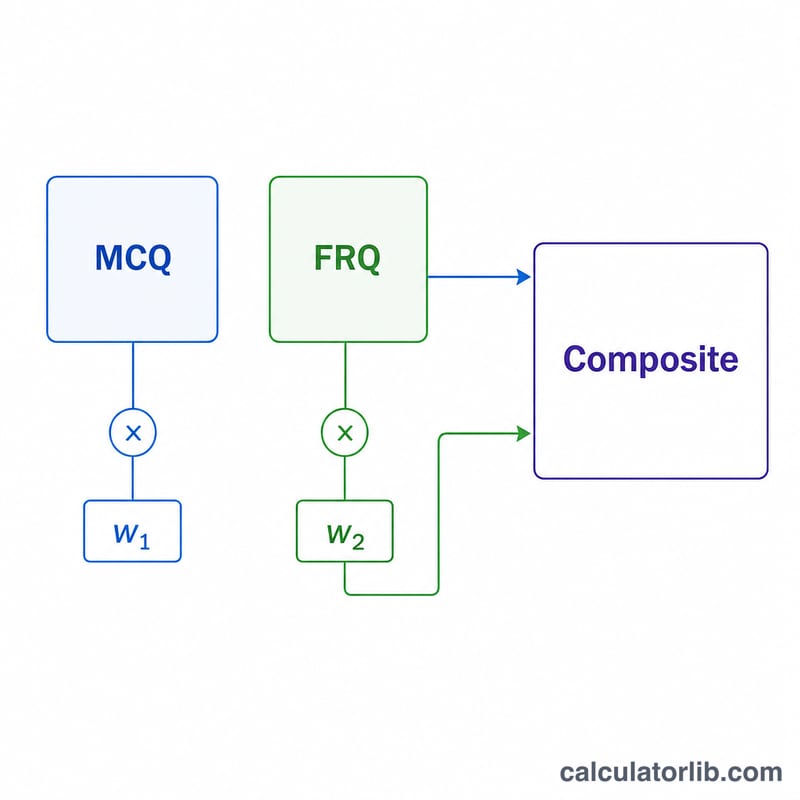
The composite is a weighted sum: $$\text{Composite} = \text{MCQ} \times 1.0 + \text{FRQ} \times 1.0$$ Because the AP Biology exam splits weight roughly evenly between the two sections, each correct MCQ and each FRQ point contributes equally here. The composite (0–120) is then compared against threshold bands: 86+ → 5, 70–85 → 4, 50–69 → 3, 31–49 → 2, below 31 → 1.
Worked example
Suppose you answer 45 multiple-choice questions correctly and earn 40 free-response points. $$\text{Composite} = 45 + 40 = 85$$ Since 85 falls in the 70–85 band, your predicted score is a 4, which is \(85 / 120 \approx 70.83\%\) of the available points.
What Your Predicted Score Means
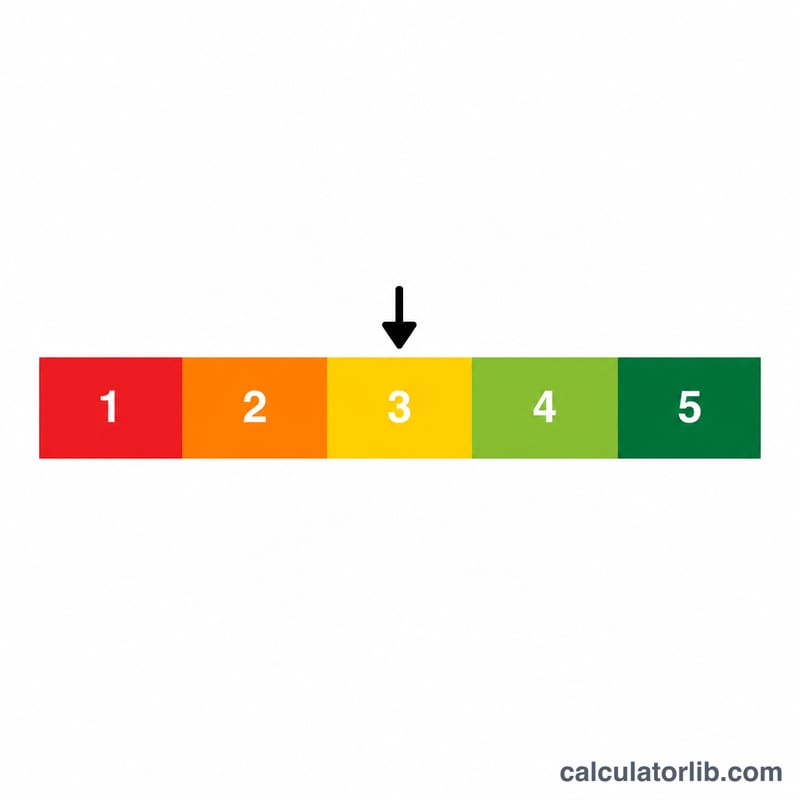
The College Board reports AP® exam results on a 1-to-5 scale, and each number corresponds to an official qualification descriptor that summarizes how well a student has demonstrated college-level achievement in the subject:
- 5 — Extremely well qualified: performance equivalent to an A in the corresponding introductory college course.
- 4 — Well qualified: performance equivalent to grades of A−, B+, or B.
- 3 — Qualified: performance equivalent to grades of B−, C+, or C; this is commonly described as a passing score.
- 2 — Possibly qualified: performance that may merit credit at some institutions.
- 1 — No recommendation: no recommendation is made for college credit or placement.
A predicted score from this tool is an estimate based on approximate composite cut points, not an official result. Because the College Board equates each year's exam, the real cut scores can shift slightly from administration to administration.
Whether a given score earns college credit, advanced placement, or neither depends entirely on each institution's own policy. Many colleges grant credit for a 3 or higher, some require a 4 or 5, and a few do not award credit for the subject at all. Check the specific credit and placement policy published by the college or university you are interested in. This information is general and educational; it is not personalized academic advice.
FAQ
Are these the official cut scores? No. The College Board keeps exact cutoffs private and re-curves every year. These bands are a widely used approximation.
What score do I need for college credit? Many US colleges grant credit for a 4 or 5, and some accept a 3 — always check your target school's AP policy.
Can I get a 5 without a perfect score? Yes. Most years a composite in the mid-80s out of 120 is enough for a 5, so you do not need to be perfect.