
What This Calculator Does
This tool estimates your score on the AP® English Language and Composition exam, administered in the United States by the College Board. It converts your raw section performance — the number of multiple-choice questions answered correctly and the points earned on each of the three free-response essays — into a composite score and a predicted scale score from 1 to 5. The cutoffs used reflect typical recent exam conversions; the College Board sets exact boundaries after each administration, so treat the result as a planning estimate.
How to Use It
Enter the number of multiple-choice questions you answered correctly (the section has 45 questions). Then enter your score for each of the three free-response questions: the Synthesis essay, the Rhetorical Analysis essay, and the Argument essay. Each essay is graded on a 0-6 rubric. Click calculate to see your weighted composite and predicted score.
The Formula Explained
The multiple-choice section contributes 45% of the composite and the free-response section 55%. To balance the two, each correct MCQ answer is multiplied by \(1.2027\), giving a maximum MCQ contribution of about 54 points. Each FRQ point is multiplied by \(3.0556\), so the three essays (max 18 raw points) contribute up to about 55 points. Together the composite tops out near 150. The composite is then compared against score bands to yield a 1-5 result.
$$\text{Composite} = 1.2027 \cdot \text{MCQ} + 3.0556 \cdot \left( \text{FRQ 1} + \text{FRQ 2} + \text{FRQ 3} \right)$$$$\text{Score} = \left\{ \begin{aligned} 5 \quad &\text{if Composite} \geq 104 \\ 4 \quad &\text{if } 92 \leq \text{Composite} < 104 \\ 3 \quad &\text{if } 76 \leq \text{Composite} < 92 \\ 2 \quad &\text{if } 56 \leq \text{Composite} < 76 \\ 1 \quad &\text{if Composite} < 56 \end{aligned} \right.$$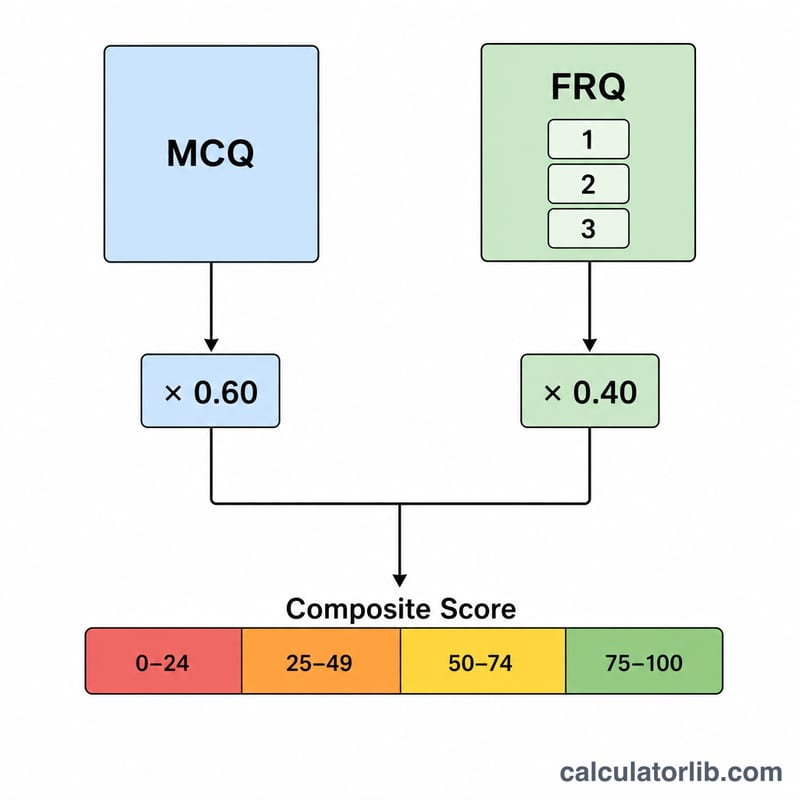
Worked Example
Suppose you answer 35 MCQs correctly and score 4, 4, and 4 on the essays. MCQ weighted = \(35 \times 1.2027 = 42.0945\). FRQ weighted = \((4+4+4) \times 3.0556 = 36.6672\). Composite = 78.76, which falls in the 76-91 band, predicting a score of 3.
AP English Language Score Bands
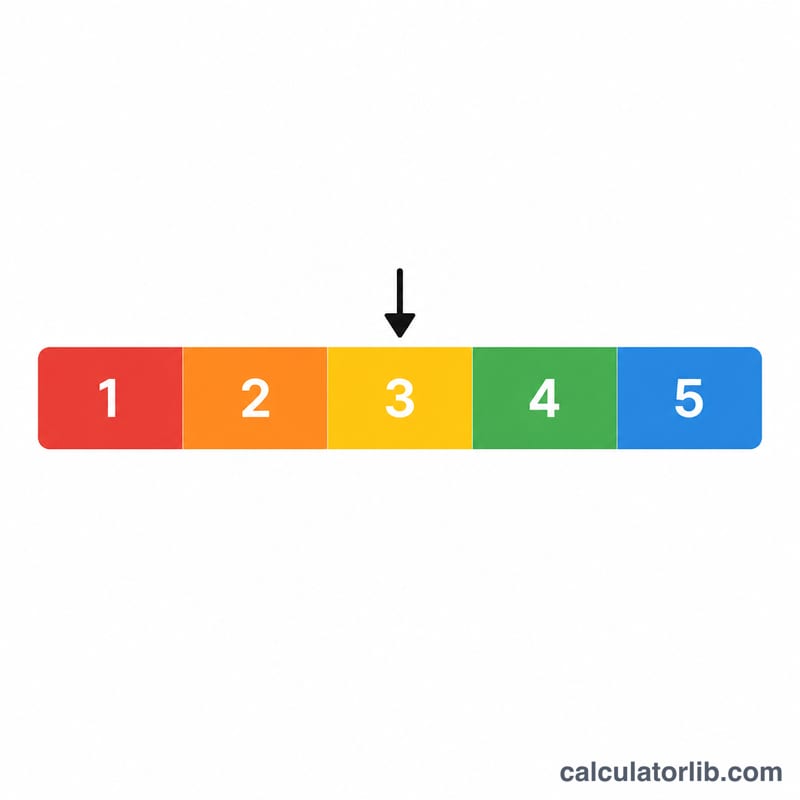
The AP® English Language & Composition exam is scored on a 1–5 scale. This calculator converts your composite score — built from 45 multiple-choice questions (weighted \(\times 1.2027\)) and three free-response essays scored 0–6 each (weighted \(\times 3.0556\)) — into a predicted AP score using the bands below. The maximum possible composite is \(1.2027 \times 45 + 3.0556 \times 18 \approx 110.1\).
| AP Score | Composite Range | College Board Qualification |
|---|---|---|
| 5 | ≥ 104 | Extremely well qualified |
| 4 | 92 – 103 | Well qualified |
| 3 | 76 – 91 | Qualified |
| 2 | 56 – 75 | Possibly qualified |
| 1 | < 56 | No recommendation |
These cutoffs are estimates modeled on released exams. The College Board re-sets the actual boundaries each year through a standard-setting process, so real cutoffs shift slightly from year to year.
What Your Score Means
The College Board assigns a qualification label to each AP score, describing how a student's performance compares with college students who took an equivalent introductory course:
- 5 — Extremely well qualified: Performance equivalent to an A in the comparable college course.
- 4 — Well qualified: Equivalent to grades of A−, B+, or B.
- 3 — Qualified: Equivalent to grades of B−, C+, or C; the score most commonly cited as “passing.”
- 2 — Possibly qualified: Some evidence of college-level ability, but generally below the threshold for credit.
- 1 — No recommendation: Insufficient evidence to recommend the student for placement or credit.
A score of 3 or higher is widely considered a “passing” result, but credit and placement policies vary by institution. Many colleges award credit for a 3, others require a 4 or 5, and some highly selective schools grant placement (skipping an intro course) rather than course credit. Always check the specific AP credit policy of the college you plan to attend.
This calculator gives an estimate only. Your actual AP score depends on the official scoring guidelines and the year-specific cutoffs set by the College Board. This is general information, not an official score report.
FAQ
Are these cutoffs official? No. The College Board recalibrates boundaries every year. This calculator uses representative cutoffs to give a realistic estimate.
What's a passing score? A 3 or higher is generally considered passing and may earn college credit, though policies vary by institution.
Does guessing hurt my MCQ score? No. There is no penalty for wrong answers on AP exams, so answer every question.