What is an IELTS Score Calculator?
An IELTS Score Calculator is a tool that computes your overall band score for the International English Language Testing System (IELTS) exam by averaging your performance across four assessment sections: Listening, Reading, Writing, and Speaking. The calculator follows the official IELTS scoring methodology, rounding the average to the nearest half-band to determine your final score on a scale from 0 to 9.
When to Use an IELTS Score Calculator
This calculator is particularly useful in the following situations:
- Before receiving your official results to estimate your overall band score
- When planning your study strategy to determine which skills need improvement to reach your target score
- For educational institutions or immigration authorities to quickly assess if an applicant meets their minimum English proficiency requirements
How to Calculate Your IELTS Score
The IELTS scoring system follows these specific steps:
Step 1: Obtain individual band scores (0-9) for each of the four skills:
- Listening score (0-9)
- Reading score (0-9)
- Writing score (0-9)
- Speaking score (0-9)
Step 2: Calculate the average of the four scores
Overall Score = (Listening + Reading + Writing + Speaking) ÷ 4
Step 3: Round to the nearest half-band (0.5)
- If the average decimal is less than 0.25, round down to the nearest whole band
- If the average decimal is between 0.25 and 0.75, round to the nearest half-band (0.5)
- If the average decimal is 0.75 or higher, round up to the nearest whole band
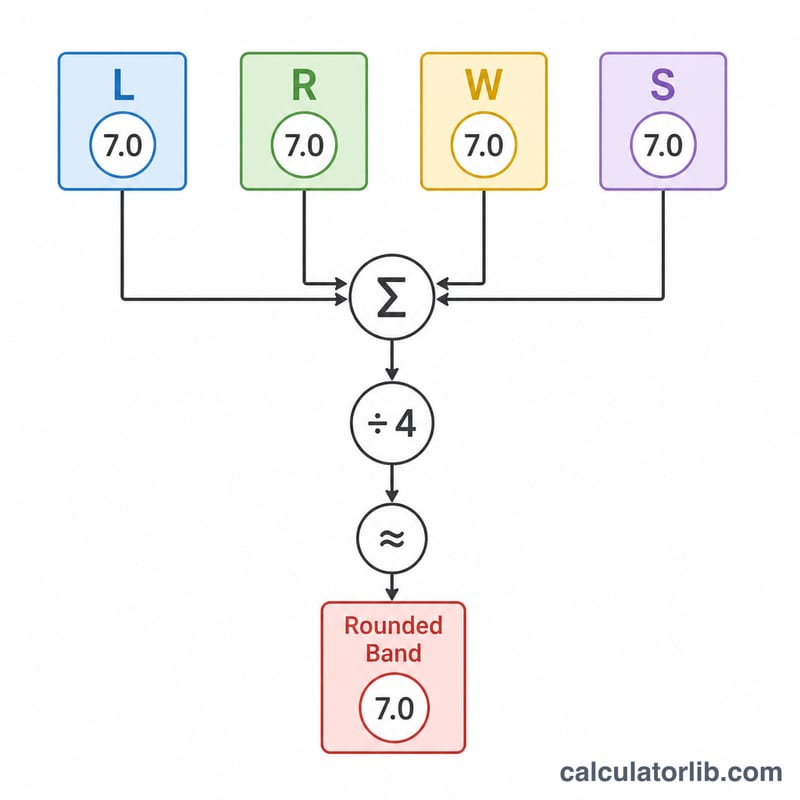
The average is already a whole or half band, so it is not rounded.
Converting Correct Answers to Band Scores
For the Listening and Reading sections, your raw score (number of correct answers) is converted to the IELTS 9-band scale.
IELTS Listening Score Conversion
| Correct Answers | Band Score |
|---|---|
| 39-40 | 9.0 |
| 37-38 | 8.5 |
| 35-36 | 8.0 |
| 32-34 | 7.5 |
| 30-31 | 7.0 |
| 26-29 | 6.5 |
| 23-25 | 6.0 |
| 18-22 | 5.5 |
| 16-17 | 5.0 |
| 13-15 | 4.5 |
| 10-12 | 4.0 |
| 6-9 | 3.5 |
| 4-5 | 3.0 |
| 3 | 2.5 |
| 2 | 2.0 |
| 1 | 1.0 |
| 0 | 0 |
IELTS Academic Reading Score Conversion
| Correct Answers | Band Score |
|---|---|
| 39-40 | 9.0 |
| 37-38 | 8.5 |
| 35-36 | 8.0 |
| 33-34 | 7.5 |
| 30-32 | 7.0 |
| 27-29 | 6.5 |
| 23-26 | 6.0 |
| 19-22 | 5.5 |
| 15-18 | 5.0 |
| 13-14 | 4.5 |
| 10-12 | 4.0 |
| 8-9 | 3.5 |
| 6-7 | 3.0 |
| 4-5 | 2.5 |
| 2-3 | 2.0 |
| 1 | 1.0 |
| 0 | 0 |
IELTS General Training Reading Score Conversion
| Correct Answers | Band Score |
|---|---|
| 40 | 9.0 |
| 39 | 8.5 |
| 37-38 | 8.0 |
| 36 | 7.5 |
| 34-35 | 7.0 |
| 32-33 | 6.5 |
| 30-31 | 6.0 |
| 27-29 | 5.5 |
| 23-26 | 5.0 |
| 19-22 | 4.5 |
| 15-18 | 4.0 |
| 0-14 | Below 4.0 |
These tables show the average number of correct answers needed for each band. IELTS states that the precise number of marks needed varies slightly from test version to test version, so use them as an estimate only.
Note: Writing and Speaking scores are assessed by trained examiners using the IELTS assessment criteria and cannot be calculated from raw scores.
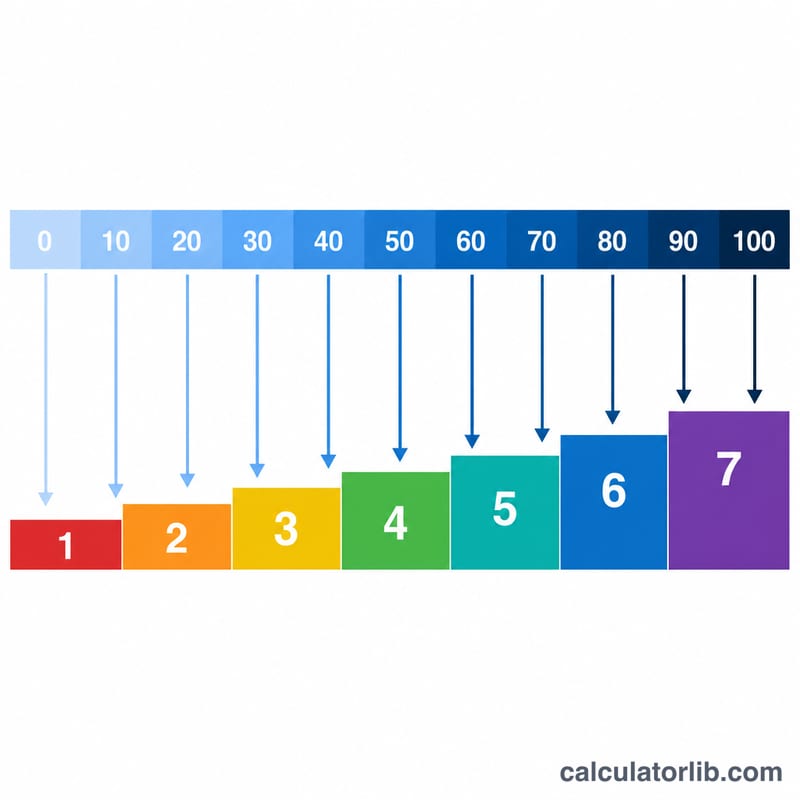
IELTS scoring in detail - ielts.org
These are the average numbers of correct answers that IELTS publishes for these bands. The exact number needed for a band varies slightly from one test version to another, so a band is shown only for these published figures.
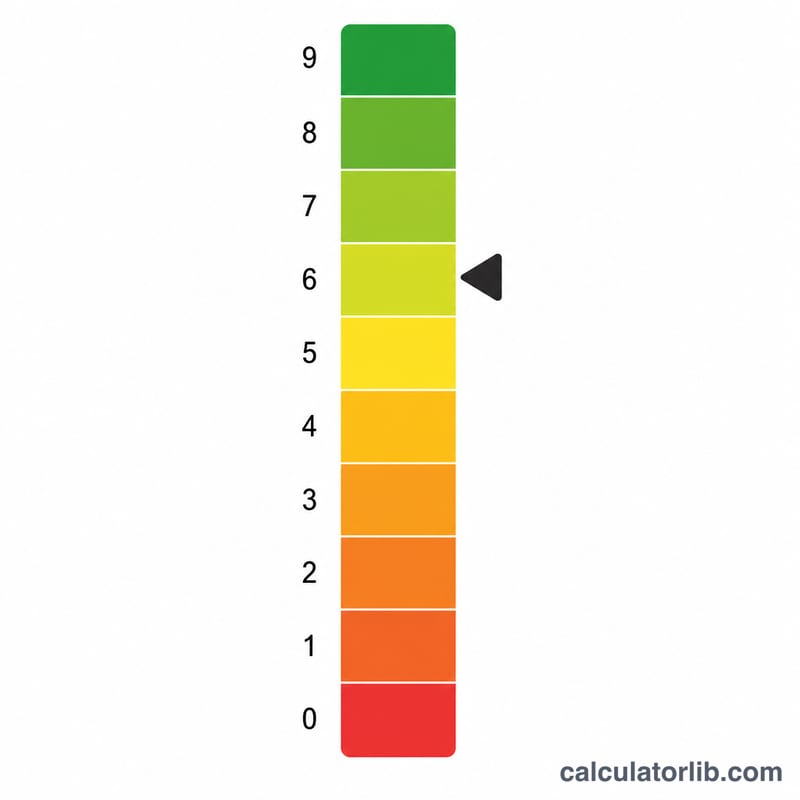
IELTS Band Score Interpretation
| Band Score | Skill Level | Description |
|---|---|---|
| 9 | Expert | Complete mastery of English |
| 8.0 - 8.5 | Very Good | Fully operational command with only occasional inaccuracies |
| 7.0 - 7.5 | Good | Operational command with occasional inaccuracies |
| 6.0 - 6.5 | Competent | Generally effective command with some inaccuracies |
| 5.0 - 5.5 | Modest | Partial command with many mistakes |
| 4.0 - 4.5 | Limited | Basic competence limited to familiar situations |
| 3.0 - 3.5 | Extremely Limited | Conveys and understands only general meaning in very familiar situations; frequent breakdowns in communication |
| 2.0 - 2.5 | Intermittent | Great difficulty understanding spoken and written English |
| 1.0 - 1.5 | Non-user | No ability to use the language except a few isolated words |
| 0 | Did not attempt the test | Did not answer the questions |
Examples of IELTS Score Calculation
Example 1: Whole Number Rounding
A test-taker receives the following scores in their IELTS test:
| Section | Band Score |
|---|---|
| Listening | 7.5 |
| Reading | 6.5 |
| Writing | 6.0 |
| Speaking | 7.0 |
Calculation:
Average = (7.5 + 6.5 + 6.0 + 7.0) ÷ 4 = 27 ÷ 4 = 6.75
Since 6.75 is greater than or equal to 6.75, we round up to the nearest whole band.
Overall Band Score: 7.0 (Good)
Example 2: Half-Band Rounding
Another test-taker achieves these scores:
| Section | Band Score |
|---|---|
| Listening | 8.0 |
| Reading | 7.5 |
| Writing | 6.0 |
| Speaking | 7.0 |
Calculation:
Average = (8.0 + 7.5 + 6.0 + 7.0) ÷ 4 = 28.5 ÷ 4 = 7.125
Since 7.125 is between 6.75 and 7.25, we round to the nearest half-band.
Overall Band Score: 7.0 (Good)
Example 3: Converting Raw Scores to Band Scores
A test-taker receives the following raw scores:
| Section | Raw Score (Correct Answers) | Converted Band Score |
|---|---|---|
| Listening (40 questions) | 32 | 7.5 |
| Academic Reading (40 questions) | 28 | 6.5 |
| Writing (assessed by examiner) | - | 6.0 |
| Speaking (assessed by examiner) | - | 7.0 |
Calculation:
Average = (7.5 + 6.5 + 6.0 + 7.0) ÷ 4 = 27 ÷ 4 = 6.75
Since 6.75 is greater than or equal to 6.75, we round up to the nearest whole band.
Overall Band Score: 7.0 (Good)
Improving Your IELTS Score
If you need to improve your IELTS score, consider using these related tools:
- SAT Score Calculator - Compare with other standardized test scores
- Final Exam Grade Calculator - Track your progress in IELTS preparation courses
- Cumulative GPA Calculator - Monitor your academic performance alongside language proficiency
Remember that consistent practice across all four skills is key to achieving your target IELTS band score.
Key IELTS Terms Explained
Understanding how your IELTS result is put together makes the overall band easier to interpret. Below are the core terms used throughout this calculator and on your official Test Report Form.
- Band score
- A score on the IELTS nine-band scale (from 0, "Did not attempt", up to 9, "Expert user") that describes your ability in a single skill. Each of the four skills receives its own band score, reported in whole or half bands (for example 6.0, 6.5, 7.0).
- Overall band score
- The single figure that summarises your performance across all four skills. It is the average of the Listening, Reading, Writing and Speaking band scores, rounded to the nearest whole or half band. For example, Listening 6.5, Reading 6.5, Writing 5.0 and Speaking 7.0 average to \((6.5 + 6.5 + 5.0 + 7.0)/4 = 6.25\), which rounds up to an overall band of 6.5.
- Raw score (correct-answer score)
- The number of questions answered correctly out of 40 in the Listening and Reading tests, before it is converted to a band. IELTS uses conversion tables to translate this raw score into the 0–9 band scale, so a raw score of, say, 30/40 corresponds to a particular band rather than a percentage.
- Half-band rounding
- The rule used when averaging the four skills to produce the overall band. An average ending in .25 is rounded up to the next half band, and an average ending in .75 is rounded up to the next whole band; other averages are rounded to the nearest half band. Formally, \(\text{Overall} = \operatorname{round}_{0.5}\!\left(\frac{L + R + W + S}{4}\right)\). For instance, an average of 6.25 becomes 6.5 and an average of 6.75 becomes 7.0, while 6.1 rounds down to 6.0.
- Academic module
- The version of IELTS designed for people applying to university, postgraduate study or professional registration in an English-speaking environment. The Listening and Speaking sections are the same as General Training, but the Reading and Writing sections use academic texts and tasks (such as describing a graph or process in Writing Task 1).
- General Training module
- The version of IELTS aimed at migration and work or training below degree level. It shares the Listening and Speaking sections with the Academic module but uses everyday and workplace texts in Reading and a letter-writing task in Writing Task 1. Because the Reading raw-to-band conversion differs, the same number of correct answers can yield a different band than in the Academic module.
- Listening
- A 30-minute test (plus transfer time on paper-based tests) with 40 questions based on four recorded monologues and conversations. It is identical for Academic and General Training candidates.
- Reading
- A 60-minute test with 40 questions. Academic candidates read three long academic passages, while General Training candidates read a mix of shorter workplace and general-interest texts.
- Writing
- A 60-minute test with two tasks. Task 1 differs by module (describing visual data for Academic, writing a letter for General Training), while Task 2 is an essay for both. Writing is scored by an examiner on criteria such as task achievement, coherence, vocabulary and grammar.
- Speaking
- An 11–14 minute face-to-face interview with an examiner in three parts: an introduction, a short individual talk on a given topic, and a two-way discussion. It is the same for both modules and assessed on fluency, vocabulary, grammar and pronunciation.