
What the AP Chemistry Score Calculator Does
This free tool estimates your score on the AP Chemistry exam, a United States college-level test administered by the College Board. The exam is graded on the familiar 1–5 scale, where 3 is typically considered passing and 4–5 may earn college credit. By entering your raw performance on the two sections of the test, you get an instant prediction of your likely final score so you can gauge where you stand before results are released.
The Two Inputs You Enter
- Multiple Choice Correct (0–60): The number of multiple-choice questions you answered correctly. The AP Chemistry exam contains 60 multiple-choice questions.
- Free Response Score (0–100): Your total score on the free-response section, scaled to a 0–100 value.
How the Formula Works
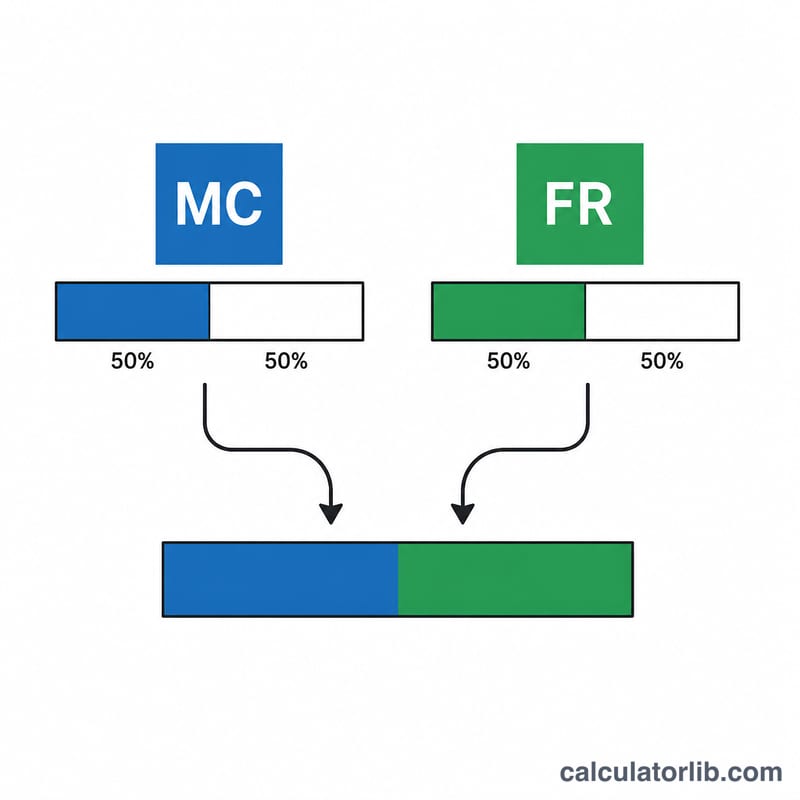
Each section is weighted equally, contributing up to 50 points to a 100-point composite, mirroring the real exam's roughly 50/50 split.
- Multiple-choice points = \(\left(\frac{\text{correct}}{60} \times 50\right)\)
- Free-response points = \(\left(\frac{\text{free-response score}}{100} \times 50\right)\)
- Total composite = MC points + FR points
The full composite formula is:
$$\text{Composite} = \left(\frac{\text{MC Correct}}{60} \times 50\right) + \left(\frac{\text{FR Score}}{100} \times 50\right)$$The composite is then mapped to an AP score:
- 82 and above → 5
- 68 to 81 → 4
- 50 to 67 → 3
- 35 to 49 → 2
- Below 35 → 1
Worked Example
Suppose you answered 45 of 60 multiple-choice questions correctly and earned a 70 on the free-response section.
- Multiple-choice points = \(\left(\frac{45}{60} \times 50\right) = 37.5\)
- Free-response points = \(\left(\frac{70}{100} \times 50\right) = 35\)
- Total composite = \(37.5 + 35 = 72.5\)
Because 72.5 falls in the 68–81 range, the calculator predicts an AP score of 4.
What Your AP Chemistry Score Means
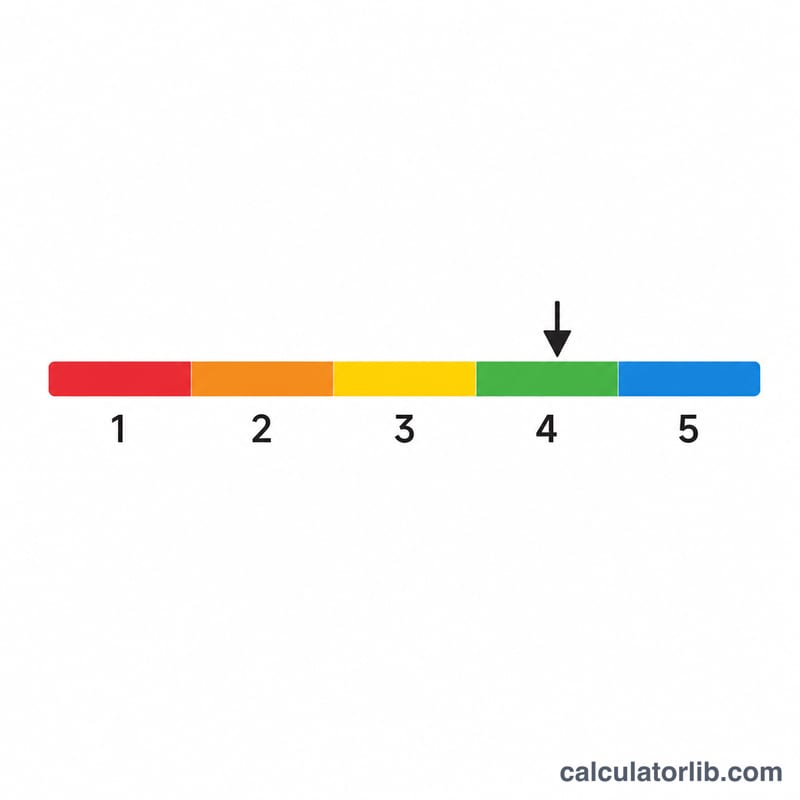
The AP Chemistry exam is scored on the College Board's standard 1–5 scale. Your raw multiple-choice and free-response performance is combined into a composite score, which is then converted to a final scaled score. Each of the five levels carries an official qualification description set by the College Board:
| AP Score | Qualification (College Board) | What It Generally Means |
|---|---|---|
| 5 | Extremely well qualified | The highest possible score; demonstrates mastery of college-level introductory chemistry. |
| 4 | Well qualified | Strong performance; widely accepted for college credit or placement. |
| 3 | Qualified | Considered passing; you have shown you are capable of doing the work of an introductory college course. |
| 2 | Possibly qualified | Below the typical passing threshold; credit is rarely granted. |
| 1 | No recommendation | The lowest score; no recommendation for credit or placement. |
A score of 3 or higher is generally regarded as “passing,” but this is only a guideline. Credit and placement policies vary by college and even by department. Many selective institutions require a 4 or 5 to grant credit for general chemistry, while others award credit for a 3, place you out of an introductory course, or grant no credit at all. Always check the specific AP credit policy of the colleges you are considering before deciding which courses to take.
The composite score produced by this calculator is an estimate. The College Board sets the exact score cutoffs each year based on exam difficulty and the performance of all test-takers, so the boundaries between a 3, 4, and 5 can shift slightly from year to year.
Frequently Asked Questions
Is this the official College Board scoring? No. The College Board adjusts its score cutoffs slightly each year based on exam difficulty. This calculator uses fixed, representative thresholds, so treat the result as an estimate, not a guarantee.
What does the free-response 0–100 input represent? It is your free-response performance scaled to a percentage of the maximum possible points. If you scored 40 out of 50 raw FR points, enter 80.
What score do I need to pass? A 3 or higher is generally considered passing. In this tool you reach a 3 with a composite of at least 50 out of 100, while a composite of 82 or more yields a top score of 5.