
What Is the LSAT Score Calculator?
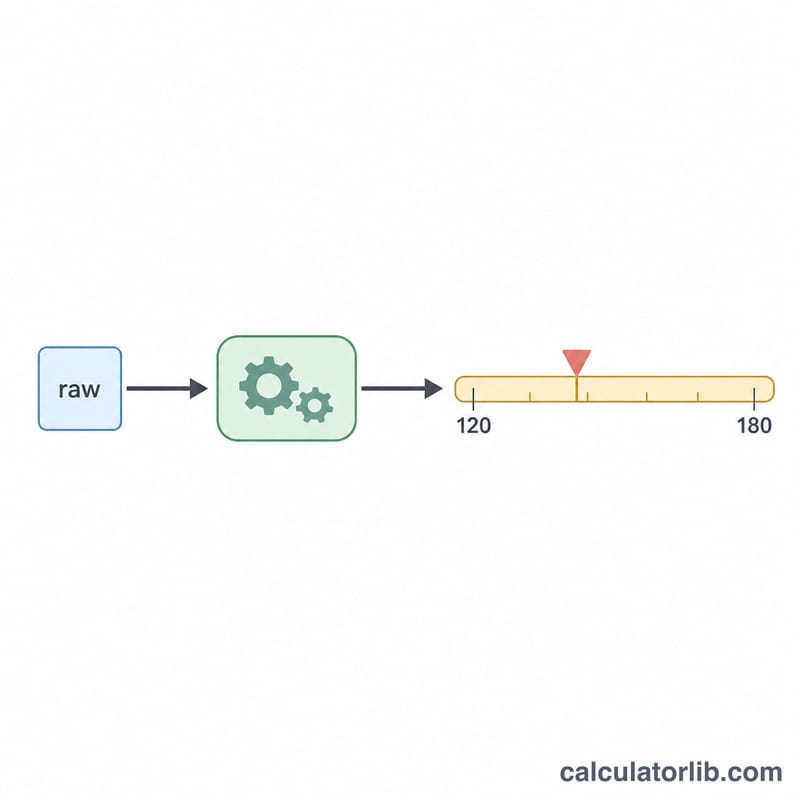
The LSAT (Law School Admission Test) is scored on a scale from 120 to 180. Your raw score — the total number of questions you answer correctly — is converted into this scaled score using a "conversion table" that varies slightly between test administrations. This calculator gives a quick, linear estimate of where your raw score would land on the 120–180 scale, which is useful when grading practice tests that don't include an official conversion chart.
How to Use It
Enter the number of questions you answered correctly (your raw score) and the total number of scored questions on the test (modern LSATs have roughly 75–76 scored questions, while older paper tests had around 100–101). The tool returns an estimated scaled score plus your percent correct and an approximate percentile rank.
The Formula Explained
The estimate spreads your performance evenly across the 60-point band of the scale:
$$\text{Score} = 120 + \operatorname{round}\!\left(60 \times \frac{\text{Raw Score}}{\text{Total Questions}}\right)$$
A perfect raw score (raw = total) yields \(120 + 60 = 180\), and zero correct yields \(120\). Because real LSAT curves are not perfectly linear, treat the output as a ballpark figure rather than an official score.
Worked Example
Suppose you answer 67 of 100 questions correctly. Then \(60 \times 67 \div 100 = 40.2\), which rounds to \(40\). Your estimated scaled score is \(120 + 40 = \mathbf{160}\), putting you near the 80th percentile of test takers.
FAQ
Is this the official LSAT conversion? No. Each LSAT uses its own equated conversion table. This is a linear approximation for practice and planning.
How many questions are on the LSAT? Current digital LSATs have about 75–76 scored questions across the Logical Reasoning and Reading Comprehension sections.
Why is the percentile only approximate? Percentiles come from the rolling distribution of recent test takers; we map score bands to typical published values, so they are estimates.