
What is a Deviation IQ?
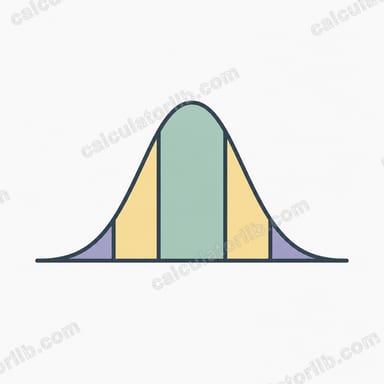
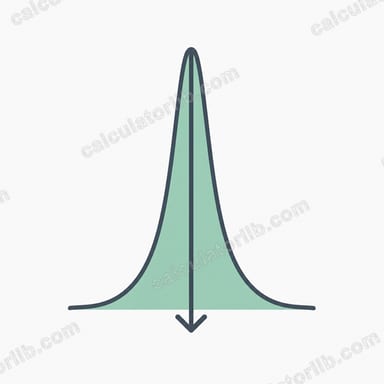
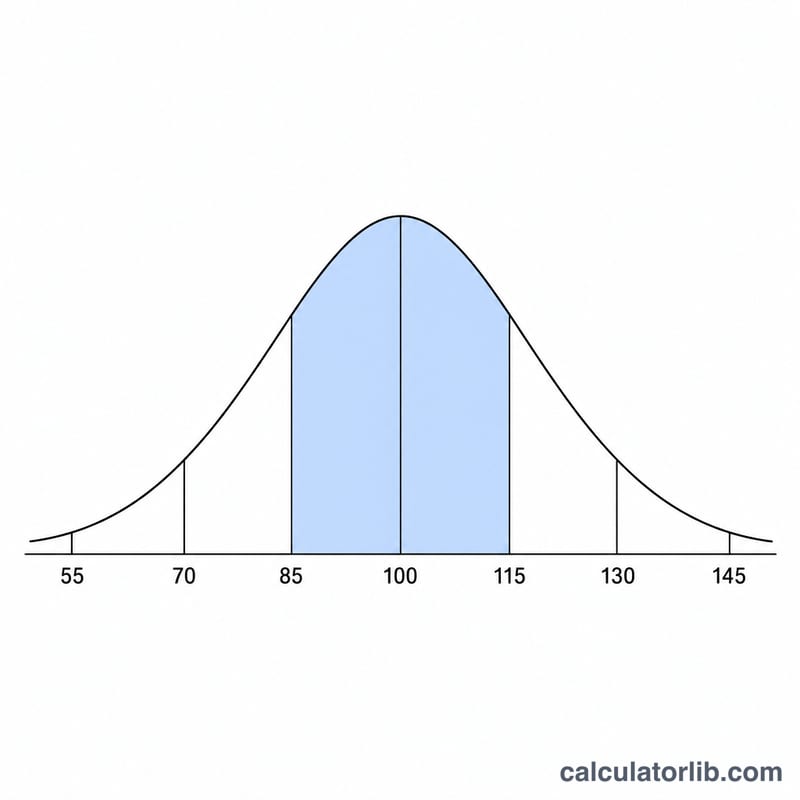
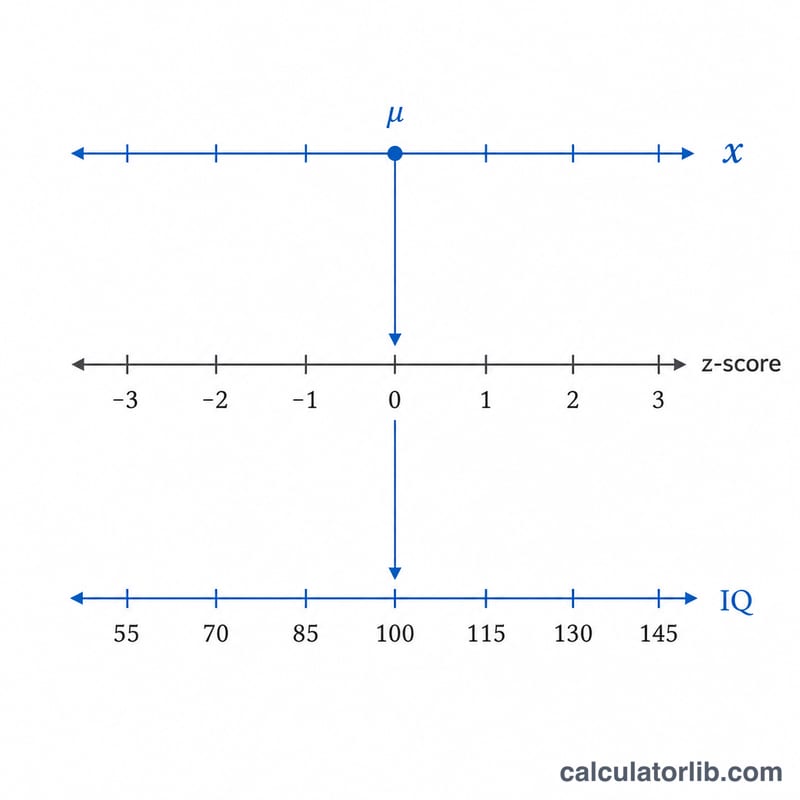
Modern intelligence tests no longer use the old "mental age ÷ chronological age" ratio. Instead, they report a deviation IQ: a score that describes how far your raw test performance lies from the average of a reference group, expressed on a standardized scale. By convention the scale has a mean of 100 and a standard deviation of 15, so the same number means the same thing across different tests and age groups.
How to use this calculator
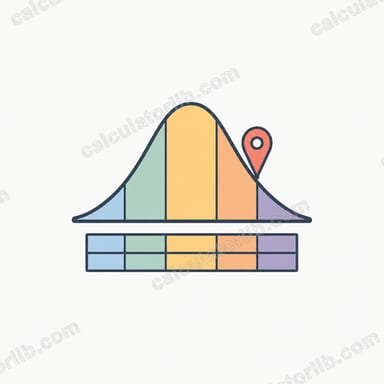
Enter three numbers: your raw score (\(x\)), the mean of the norming sample (\(\mu\)), and the standard deviation of that sample (\(\sigma\)). The calculator returns your deviation IQ, the underlying z-score, an approximate percentile, and a descriptive classification band.
The formula explained
The conversion is a two-step linear transform. First compute the z-score, $$z = \frac{x - \mu}{\sigma}$$ which standardizes the score to a mean of 0 and SD of 1. Then rescale to the IQ metric: $$\text{IQ} = 100 + 15 \cdot z$$ The "100" recenters the average to 100 and the "15" stretches one standard deviation to 15 IQ points.
Worked example
Suppose you scored 130 on a test where the norm group averaged 100 with a standard deviation of 15. Then $$z = \frac{130 - 100}{15} = 2.0$$ and $$\text{IQ} = 100 + 15 \times 2.0 = 130$$ A \(z\) of 2.0 corresponds to roughly the 97.7th percentile — better than about 98% of the population.
FAQ
Why 15 and not 16 or 24? Most major tests (e.g., Wechsler scales) use SD 15, but some historically used 16 or 24. Always rescale using the SD your test reports.
Is the percentile exact? It assumes a normal distribution and uses a standard analytic approximation of the normal CDF, which is accurate to within a fraction of a percent for typical scores.
Can IQ exceed 200 or be negative? Mathematically yes, but extreme values are statistically unreliable because real test norms break down far from the mean.