
What is the base-100 multiplication trick?
This is a pure-math mental-arithmetic technique, often taught as part of "Vedic" or Indian-style fast multiplication. It lets you multiply two numbers that sit near 100 with very little effort, by measuring how far each number deviates from a chosen base value of 100. The math is universal and works for any integers, though it is fastest when both factors are roughly between 80 and 120.
How to use this calculator
Enter the first number and the second number, then read the answer plus the working. The tool shows each deviation, the cross sum, the deviation product, and the final result so you can follow the technique and learn to do it in your head.
The formula explained
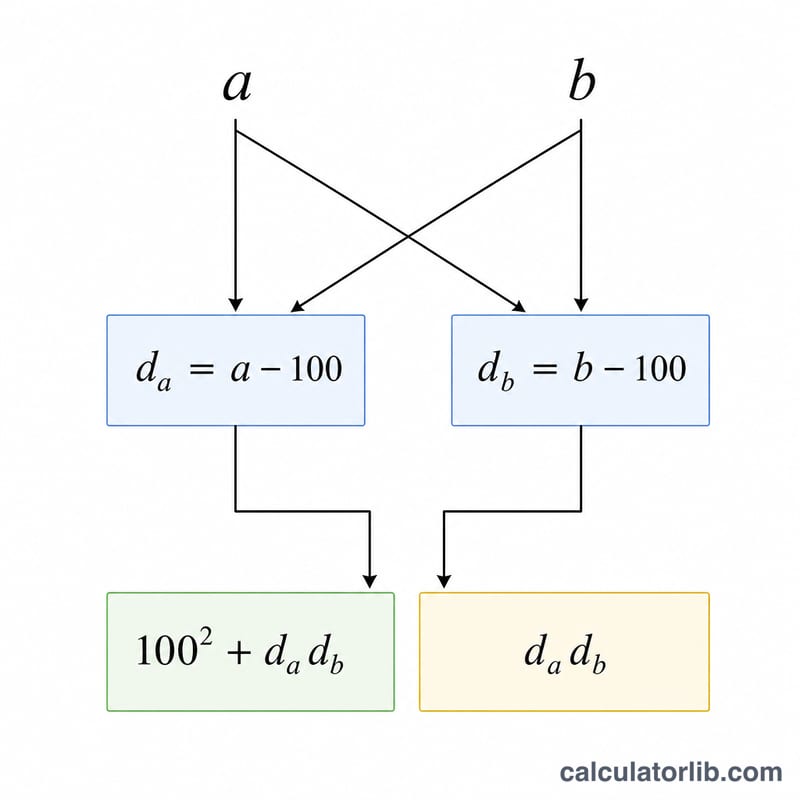
Pick the base \(B = 100\). Compute the deviations \(d_a = a - 100\) and \(d_b = b - 100\). The cross sum is \(a + d_b\), which always equals \(b + d_a\) (both equal \(a + b - 100\)). The product is then $$\text{crossSum} \times 100 + (d_a \times d_b).$$ This is exact for any numbers because \((a + d_b)\cdot 100 + d_a d_b\) expands algebraically to \(a \times b\). When one factor is above 100 and the other below, the deviation product is negative and the formula handles it automatically.
Worked example
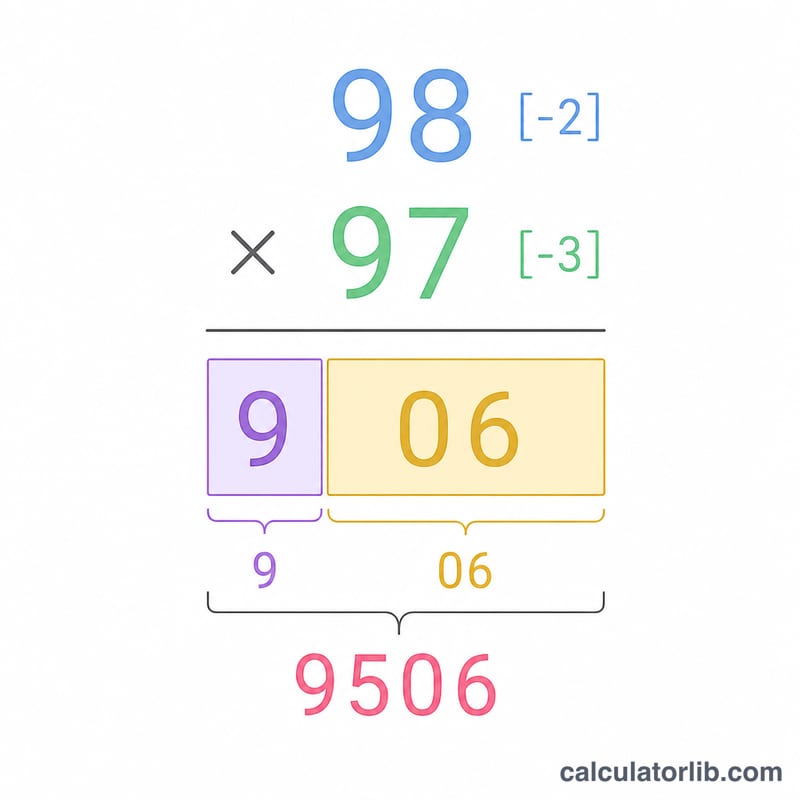
Multiply \(89 \times 92\). Deviations: \(d_a = 89 - 100 = -11\) and \(d_b = 92 - 100 = -8\). Cross sum \(= 89 + (-8) = 81\) (check: \(92 + (-11) = 81\)). Product: $$81 \times 100 + ((-11)\times(-8)) = 8100 + 88 = 8188.$$ Direct multiplication confirms \(89 \times 92 = 8188\).
FAQ
Does the trick only work near 100? No — it is exact for any numbers, but the deviation product grows large when factors are far from 100, which makes it harder to do mentally.
What if one number is above 100 and the other below? The deviation product becomes negative, and the formula subtracts it automatically, still giving the correct answer.
Can I use decimals? Yes, the identity holds for non-integers too; the calculator simply displays the exact product.