
What is the Indian-style base multiplication method?
This calculator multiplies two numbers and frames the result around the Indian (Vedic) base method, a mental-math shortcut for multiplying numbers that sit near a convenient round base such as 200, 300, ... up to 900. Instead of long multiplication, you measure how far each factor strays from the base and combine those deviations. The tool returns the exact product while showing every intermediate step so you can practise the technique.
How to use it
Enter the first factor in the "Problem" box and the second factor after the multiplication sign. The calculator picks a base B automatically as the nearest multiple of 100 to the average of your two numbers, clamped to the 200-900 range. It then displays the base, each deviation, the cross sum and the vertical product, and the final answer. The chosen base never changes the product - it only shapes how the shortcut is presented.
The formula explained
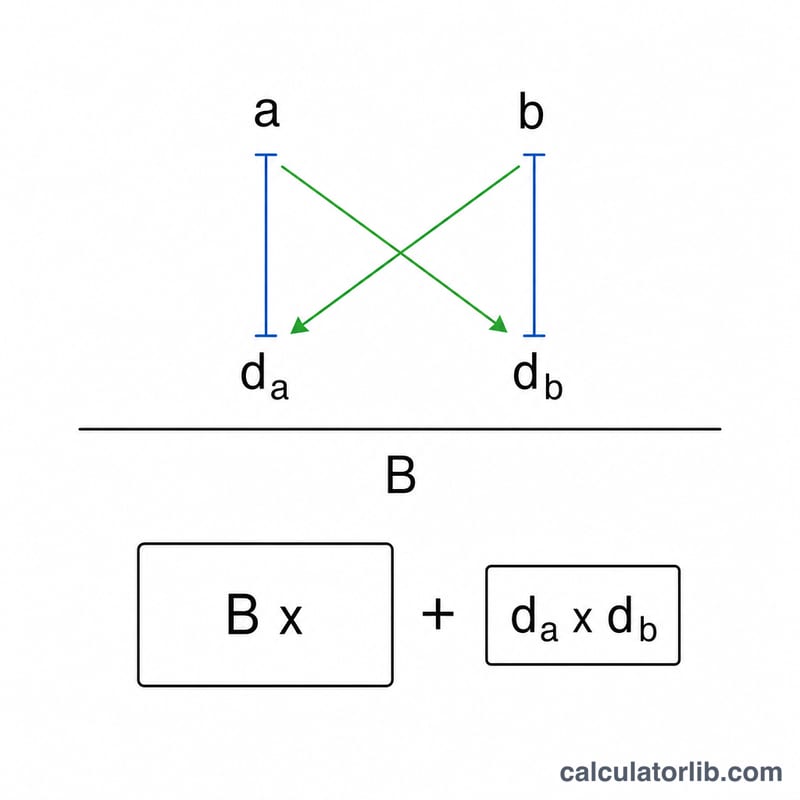
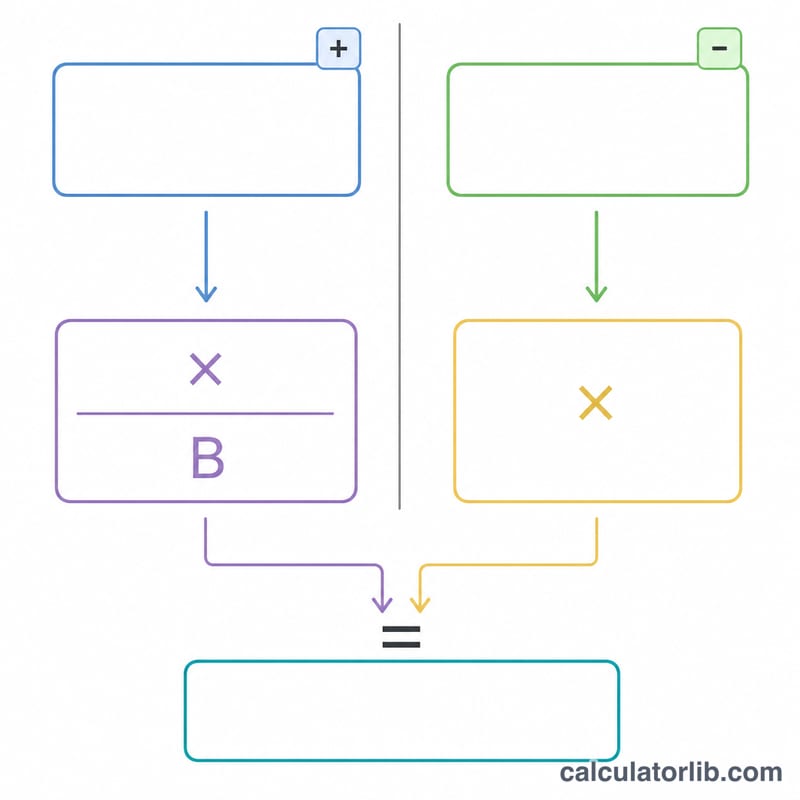
For factors \(a\) and \(b\) and base \(B\), define the deviations \(d_a = a - B\) and \(d_b = b - B\). The identity is $$a \times b = B \times (a + d_b) + (d_a \times d_b).$$ The first term, the "cross sum times base", is \(B(a + d_b)\) which also equals \(B(b + d_a)\). The second term, the "vertical product", is simply \(d_a \times d_b\). Adding them returns \(a \times b\) exactly. A deviation is negative when a factor is below the base, and the algebra still holds.
Worked example
Take \(216 \times 205\). The mean is 210.5, so \(B\) rounds to 200. Then \(d_a = 216 - 200 = 16\) and \(d_b = 205 - 200 = 5\). The cross sum times base is $$200 \times (216 + 5) = 200 \times 221 = 44200,$$ and the vertical product is \(16 \times 5 = 80\). Adding gives $$44200 + 80 = 44280,$$ which matches \(216 \times 205 = 44280\).
FAQ
Does the base affect the answer? No. The product is always \(a \times b\) regardless of which base you use; the base only organises the mental steps.
Can I use numbers outside 200-900? Yes - the math is valid for any numbers. The 200-900 range is just where this presentation is most instructive.
What if a factor is below the base? Its deviation becomes negative and the vertical product may be negative, but the identity still produces the correct product.