What is the Multiplication Calculator?
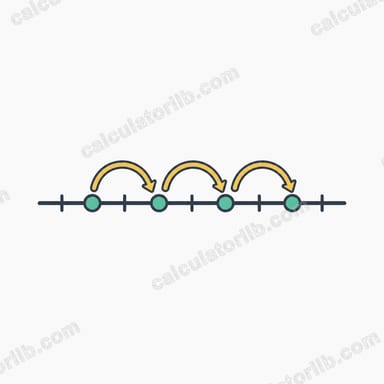
The Multiplication Calculator finds the product of two numbers — that is, the result of multiplying one value by another. Multiplication is one of the four basic arithmetic operations and answers the question "how much is a groups of b?" or "a copies of b added together?" This tool handles whole numbers, decimals, and negative values, returning an exact product instantly.
How to use it
Enter your first number in the a field and your second number in the b field, then submit. The calculator multiplies them and displays the product along with a summary of the values you entered. You can use positive numbers, negative numbers, or decimals such as 3.5.
The formula explained
The formula is simply:
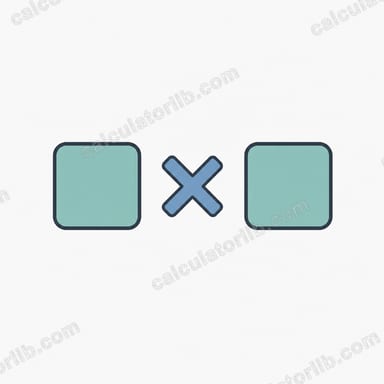
$$\text{product} = a \times b$$Multiplication is commutative, which means the order does not matter: \(a \times b\) always equals \(b \times a\). Multiplying by 0 always gives 0, and multiplying by 1 leaves the number unchanged. Multiplying two negative numbers produces a positive result, while multiplying a positive and a negative number gives a negative result.

Worked example
Suppose you want to multiply 12 by 8. Using the formula: $$\text{product} = 12 \times 8 = 96.$$ If you sold 12 boxes that each contain 8 items, you would have 96 items in total.

How to Multiply by Hand: Step-by-Step
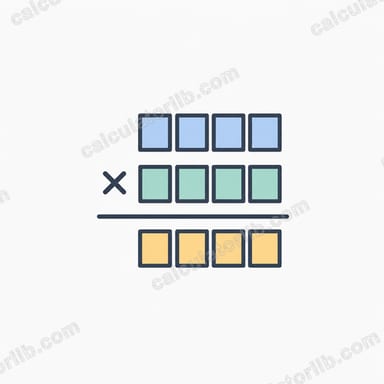
Long multiplication breaks a big product into smaller partial products that are easy to compute, then adds them. Here is the method for \(23 \times 47\).
- Set up the problem. Write 47 under 23 (or the other way round), lining up the digits by place value.
- Multiply by the ones digit. Multiply 23 by 7: \(23 \times 7 = 161\). This is the first partial product.
- Multiply by the tens digit, using a placeholder zero. The 4 in 47 stands for 40. Write a 0 in the ones column as a placeholder, then multiply 23 by 4: \(23 \times 4 = 92\). With the placeholder this becomes 920, which equals \(23 \times 40\).
- Add the partial products. \(161 + 920 = \)1081.
Check: \(23 \times 47 = 23 \times (40 + 7) = 920 + 161 = 1081\). This is the distributive property at work.
Multiplying decimals
- Ignore the decimal points and multiply the numbers as whole numbers. For \(3.5 \times 2.4\), compute \(35 \times 24\): \(35 \times 4 = 140\) and \(35 \times 20 = 700\), so \(140 + 700 = 840\).
- Count the decimal places in both factors combined. 3.5 has 1 and 2.4 has 1, so the total is 2.
- Place the decimal point so the result has that many decimal places. Moving the point two places left in 840 gives 8.40, which is 8.4 once the trailing zero is dropped.
Sense check: 3.5 is a little more than 3 and 2.4 a little less than 2.5, so a product near 8 is reasonable.
Sign rules
- Positive × positive = positive: \(6 \times 4 = 24\).
- Negative × positive (or positive × negative) = negative: \((-6) \times 4 = -24\).
- Negative × negative = positive: \((-6) \times (-4) = 24\).
In short, if the two signs are the same the product is positive, and if they differ it is negative. Multiply the absolute values first, then apply the sign. Multiplying by zero always gives zero.
FAQ
Can I multiply decimals? Yes — enter values like 2.5 and 4.2 to get 10.5.
What happens if I multiply by zero? Any number multiplied by zero equals zero.
Does the order of the numbers matter? No. Because multiplication is commutative, \(a \times b\) gives the same answer as \(b \times a\).