What is the Halving Calculator?
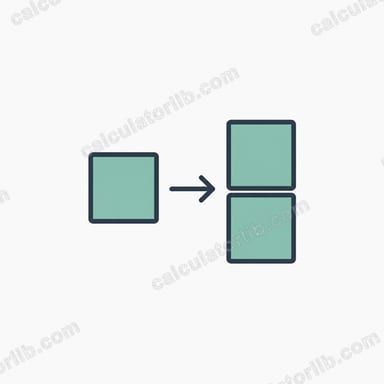
The Halving Calculator finds exactly half of any number you enter. Halving means splitting a value into two equal parts, which is the same as dividing by 2 (or multiplying by 0.5). It works with whole numbers, decimals, and very large values, making it handy for quick mental-math checks, recipe scaling, splitting bills, and classroom practice.
How to use it
Type any number into the input box and the calculator returns half of that value immediately. For example, entering 250 returns 125. You can use decimals too — entering 7.5 returns 3.75. Negative numbers are supported as well: half of -40 is -20.
The formula explained
The calculation is simply:
$$\text{half} = \frac{n}{2}$$
Here \(n\) is the number you enter. Dividing by 2 always produces a value that is exactly midway between zero and the original number. Dividing by 2 is mathematically identical to multiplying by 0.5, so both methods give the same answer.
Worked example
Suppose you want half of 360. Apply the formula: $$360 \div 2 = 180.$$ So half of 360 is 180. If you halved a recipe that calls for 1.5 cups of flour, you would use \(1.5 \div 2 = 0.75\) cups.
Quick Reference: Halves of Common Numbers
Halving means dividing by 2. For a number \(n\), the half is
$$\text{Half} = \frac{n}{2}$$Even numbers always halve to another whole number; odd numbers halve to a value ending in .5, because an odd number is one more than an even one and that leftover 1 splits into two halves of 0.5.
| Number \(n\) | Half \(n/2\) |
|---|---|
| 1 | 0.5 |
| 2 | 1 |
| 3 | 1.5 |
| 4 | 2 |
| 5 | 2.5 |
| 6 | 3 |
| 7 | 3.5 |
| 8 | 4 |
| 9 | 4.5 |
| 10 | 5 |
| 11 | 5.5 |
| 12 | 6 |
| 13 | 6.5 |
| 14 | 7 |
| 15 | 7.5 |
| 16 | 8 |
| 17 | 8.5 |
| 18 | 9 |
| 19 | 9.5 |
| 20 | 10 |
| 25 | 12.5 |
| 30 | 15 |
| 40 | 20 |
| 50 | 25 |
| 60 | 30 |
| 75 | 37.5 |
| 100 | 50 |
| 150 | 75 |
| 200 | 100 |
| 500 | 250 |
| 1000 | 500 |
Halving is the exact inverse of doubling, so every row can be read in either direction. Left to right it is a halving fact (\(60 \div 2 = 30\)); right to left it is the matching doubling fact (\(30 \times 2 = 60\)). That symmetry is why the two operations undo each other: \(\frac{n}{2} \times 2 = n\) for any number \(n\).
How to Halve a Number by Hand
The fastest mental method is to break the number apart by place value, halve each piece separately, then put the pieces back together. Halving distributes over addition, so nothing is lost:
$$\frac{a+b+c}{2} = \frac{a}{2} + \frac{b}{2} + \frac{c}{2}$$Worked example: half of 486
- Split by place value. \(486 = 400 + 80 + 6\).
- Halve each part. \(400 \div 2 = 200\), \(80 \div 2 = 40\), \(6 \div 2 = 3\).
- Add the parts back. \(200 + 40 + 3 = 243\), so half of 486 is 243.
When a place value is odd
If a digit's place value is odd, it cannot be split evenly on its own. Carry the leftover 1 down to the next place, where it is worth 10, and halve it there as 5.
- 74: split as \(70 + 4\). The tens part is odd (7 tens), so halve it as \(70 \div 2 = 35\), and \(4 \div 2 = 2\). Add: \(35 + 2 = 37\).
- 35: split as \(30 + 5\). Then \(30 \div 2 = 15\) and \(5 \div 2 = 2.5\). Add: \(15 + 2.5 = 17.5\). The odd units digit is what produces the trailing .5.
Decimals work the same way
Ignore the decimal point while you split, then keep it where it was. For 9.4: \(9.4 = 9 + 0.4\), so \(9 \div 2 = 4.5\) and \(0.4 \div 2 = 0.2\), giving \(4.5 + 0.2 = 4.7\). Equivalently, \(\frac{9.4}{2} = \frac{94}{20} = 4.7\).
Always check by doubling
Because doubling undoes halving, multiply your answer by 2 and confirm you get the original number back:
$$243 \times 2 = 486 \quad\text{and}\quad 4.7 \times 2 = 9.4$$If the doubled value is short by exactly 1, you most likely dropped a carried remainder at an odd place value; if it is off by a factor of 10, re-check where you placed the decimal point.
FAQ
Is halving the same as dividing by 2? Yes. Halving a number and dividing it by 2 produce identical results.
Can I halve decimals or negative numbers? Yes. The calculator handles decimals and negatives. Half of -9 is -4.5.
What is half of an odd number? Halving an odd whole number gives a decimal ending in .5 — for example, half of 7 is 3.5.