

What Is the ACB Investment Future Value Calculator?
This calculator estimates how much an investment could grow over time when you start with an initial lump sum and add a fixed amount every month. It combines the compound growth of your starting balance with the future value of a stream of regular contributions, giving you a single projected balance at the end of your chosen period. It is a universal financial tool and applies to any currency.
How to Use It
Enter four values: your initial investment (the lump sum you start with), your monthly contribution, the expected annual interest rate as a percentage, and the number of years you plan to invest. The calculator converts the annual rate into a monthly rate, compounds monthly, and returns the total future value along with how much you contributed and how much was earned in interest.
The Formula Explained
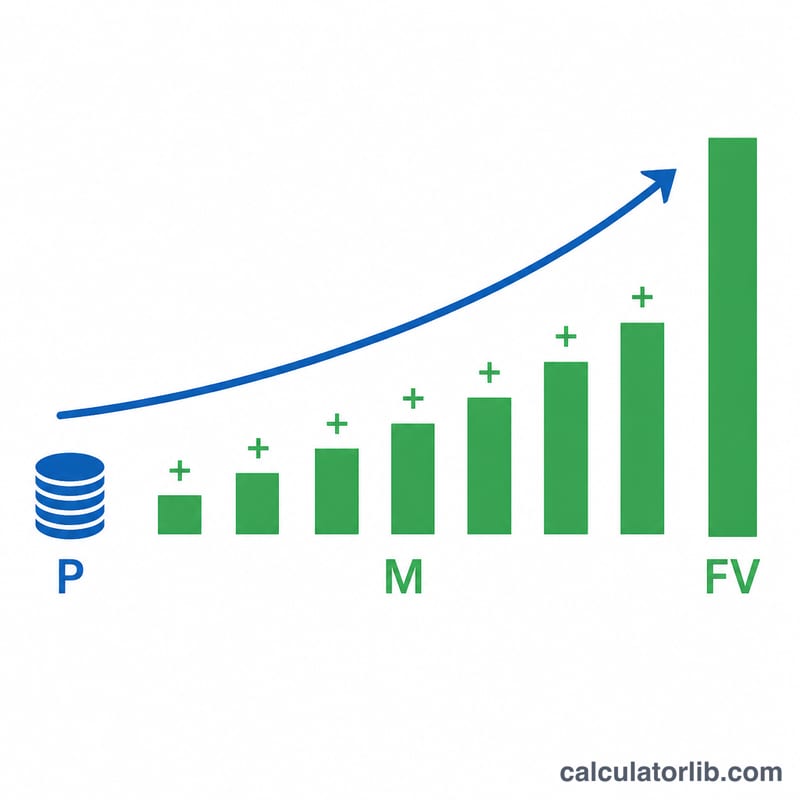
The core equation is $$FV = P(1+i)^n + M\left(\dfrac{(1+i)^n - 1}{i}\right)$$. The first term grows your initial principal \(P\) at the monthly rate \(i\) over \(n\) months. The second term is the future value of an ordinary annuity — each monthly contribution \(M\) earns compound interest for the remaining months. Here \(i = \dfrac{r/100}{12}\) and \(n = 12y\).
Worked Example
Suppose you invest $10,000 up front, add $500 every month, expect 6% annual interest, and invest for 10 years. The monthly rate \(i = 0.005\) and \(n = 120\) months. The growth factor \((1.005)^{120} \approx 1.81940\). The principal grows to about $18,194, and the contributions grow to about $81,940, for a total future value of roughly $100,134.
Interpreting Your Result
The future value this calculator returns is a nominal projection: it assumes a single, constant annual rate applied every month for the entire term, with every monthly contribution made on schedule and all interest reinvested. Real-world investments rarely behave this smoothly — returns fluctuate year to year, and the calculator does not model volatility, fees, taxes, or missed contributions.
Because the figure is nominal, its real purchasing power will be lower than it appears. If prices rise at roughly 2–3% per year, a balance reached decades from now buys noticeably less than the same number of dollars today. To gauge what your projection is worth in today's terms, you can deflate it using an inflation measure or estimate a real target with an inflation-adjusted goal tool. For example, a $100,000 goal today would need to be larger in future dollars to preserve the same buying power.
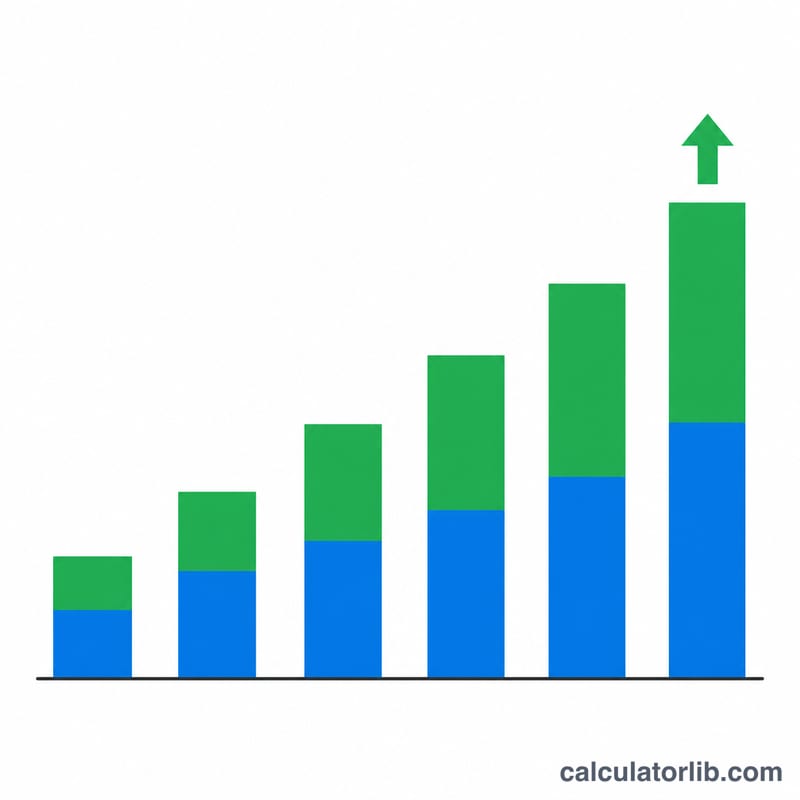
The split between total contributed and interest earned is the most informative part of the output. Early on, most of the balance is simply money you put in. As the term lengthens, the interest portion grows faster than your contributions because each period's interest itself earns interest — the hallmark of compounding. A result where interest exceeds contributions signals that time and reinvestment, not just deposits, are doing the heavy lifting.
Treat the number as an illustrative planning estimate for comparing scenarios, not a guaranteed outcome. This is general educational information, not personalized financial advice; consult a qualified professional for decisions about your own situation.
Definitions & Glossary
- Principal (P)
- The initial lump sum invested at the start, before any monthly contributions. In the formula it grows on its own as \(P(1+i)^n\).
- Monthly contribution (M)
- The fixed amount added at each monthly period throughout the term. The contributions accumulate as an annuity: \(M\frac{(1+i)^n-1}{i}\).
- Annual interest rate (r)
- The yearly rate of return entered as a percentage (e.g. 6 for 6%). It is the nominal annual rate before conversion to a monthly figure.
- Monthly rate (i)
- The annual rate converted to a per-month basis: \(i = r/1200\) — that is, the percentage divided by 100 and then by 12 months.
- Number of periods (n)
- The total count of compounding/contribution periods, equal to \(12 \times \text{years}\) for monthly compounding.
- Compound interest
- Interest calculated on both the original principal and previously accumulated interest, so growth accelerates over time rather than staying linear.
- Ordinary annuity
- A series of equal payments made at the end of each period. This calculator's contribution formula assumes ordinary-annuity timing; deposits made at the start of each period (an annuity due) would grow slightly more.
- Future value (FV)
- The projected total worth of the investment at the end of the term — the principal's growth plus the accumulated value of all contributions and their compounded interest.
FAQ
Does this assume monthly compounding? Yes. The annual rate is divided by 12 and interest compounds each month, matching the monthly contribution schedule.
When are contributions added? The formula uses an ordinary annuity, meaning each contribution is added at the end of the month.
What if the interest rate is 0%? With a 0% rate the future value is simply your initial amount plus all contributions, with no interest earned.