What is this calculator?
This tool multiplies any number by a percentage, giving you the portion of that number represented by the percent. It answers questions like "What is 15% of 200?" or "What is 7.5% of 1,250?" in one step. It works for any value — money, quantities, scores, measurements — and supports decimals.
How to use it
Enter the Number you want to take a percentage of, then enter the Percentage as a plain number (for example, type 15 for 15%). The calculator multiplies the number by the percent divided by 100 and shows the result instantly.
The formula explained
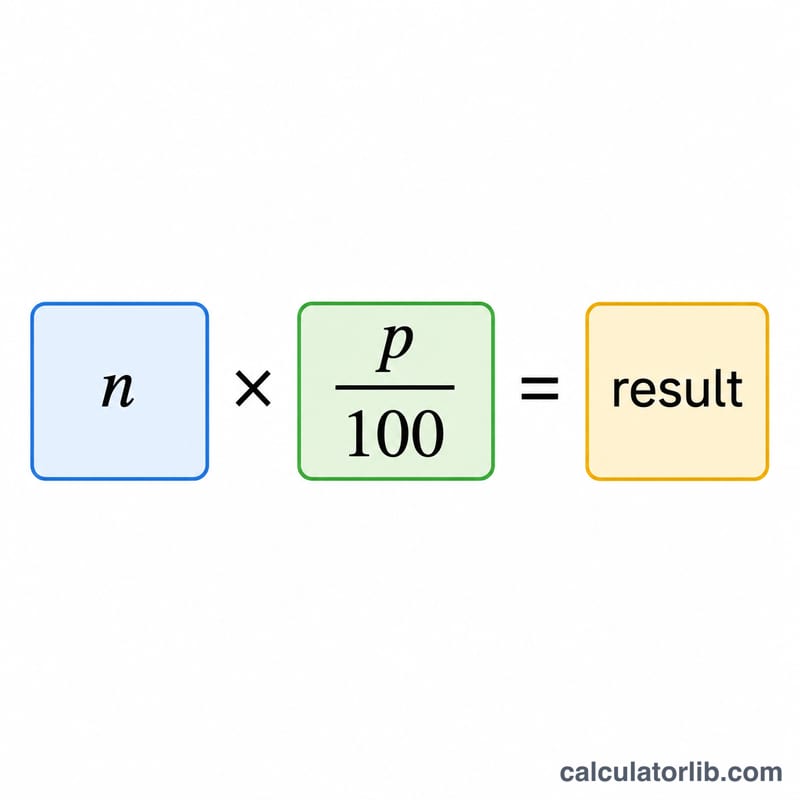
The calculation is simply:
$$\text{result} = \text{number} \times \frac{\text{percentage}}{100}$$
Because "percent" means "per hundred," a percentage like 25% is the same as the fraction \(\frac{25}{100} = 0.25\). Multiplying your number by this fraction scales it down (or up, for percentages over 100) to the requested portion.
Worked example
Suppose you want 15% of 200. First convert the percentage to a decimal: \(15 \div 100 = 0.15\). Then multiply: \(200 \times 0.15 = \mathbf{30}\). So 15% of 200 is 30. For a percentage above 100, such as 150% of 80, you get \(80 \times 1.5 = 120\).
Percent, Decimal and Fraction Equivalents
A percentage is just a number divided by 100, so every percent has an exact decimal multiplier and (for the common values) a tidy fraction. To multiply a number by a percentage, you multiply by that decimal: \(n \times p\% = n \times \frac{p}{100}\). The last column shows what each percentage of 200 works out to.
| Percentage | Decimal multiplier | Fraction | Example (of 200) |
|---|---|---|---|
| 1% | 0.01 | 1/100 | 2 |
| 5% | 0.05 | 1/20 | 10 |
| 10% | 0.1 | 1/10 | 20 |
| 12.5% | 0.125 | 1/8 | 25 |
| 15% | 0.15 | 3/20 | 30 |
| 20% | 0.2 | 1/5 | 40 |
| 25% | 0.25 | 1/4 | 50 |
| 33.33% | 0.3333 | 1/3 | 66.67 |
| 50% | 0.5 | 1/2 | 100 |
| 75% | 0.75 | 3/4 | 150 |
| 100% | 1.0 | 1/1 | 200 |
| 150% | 1.5 | 3/2 | 300 |
| 200% | 2.0 | 2/1 | 400 |
Two notes on reading the table. The 33.33% row is rounded: the exact third of 200 is \(66.\overline{6}\), so 0.3333 × 200 = 66.66 rather than 66.67 — use the fraction 1/3 when you need exactness. And percentages above 100% are perfectly legal; they simply return more than the original number (200% of 200 = 400).
The most common conversion error: a percentage below 1%. Half a percent is 0.5%, and \(0.5 \div 100 = 0.005\) — not 0.05, which is ten times too large and is really 5%. The same trap catches 0.1% (0.001, not 0.01) and 0.25% (0.0025). If the percent sign comes with a decimal point in front of it, count the zeros carefully: 0.5% of 200 is 1, while 5% of 200 is 10.
FAQ
Can I use decimals? Yes. Both the number and the percentage can include decimals, such as 7.5% of 1,250.5.
What if the percentage is over 100? The result will be larger than the original number, which is correct — 200% of 50 is 100.
Is "X% of Y" the same as "Y% of X"? Yes. Because multiplication is commutative, 15% of 200 equals 200% of 15 — both are 30.