What is a Ratio to Percentage Calculator?
A ratio compares two quantities, written as A:B. A percentage expresses a value out of 100. This calculator converts any ratio into an equivalent percentage so you can interpret proportions, splits, and shares more easily. It supports two common interpretations of a ratio, letting you pick the one that matches your problem.
How to use it
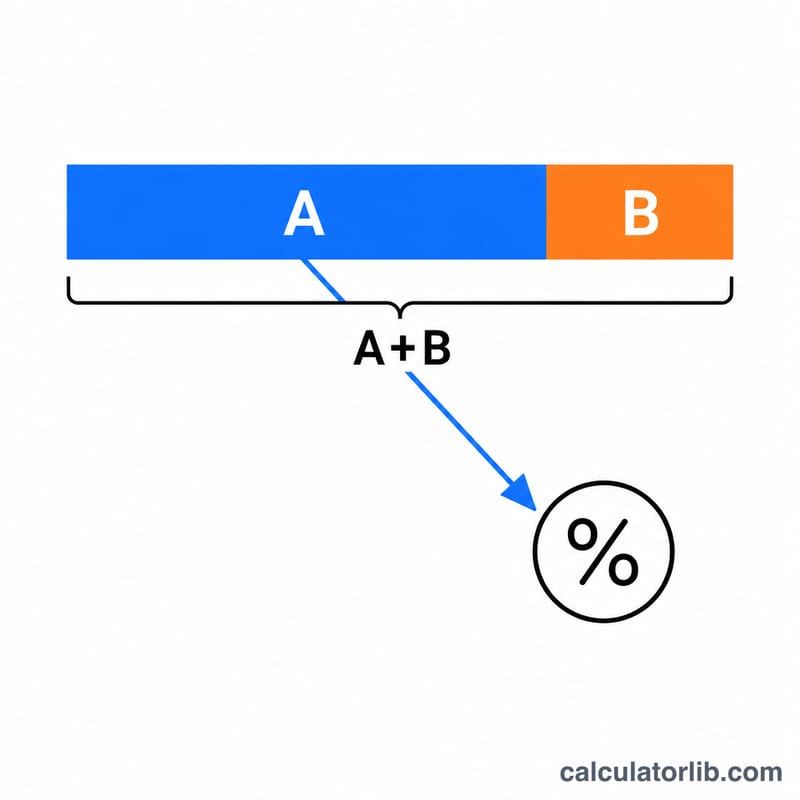
Enter the first term (A) and the second term (B) of your ratio. Then choose how you want the percentage measured: A as part of the whole treats A + B as 100%, while A relative to B treats B as the 100% baseline. Click calculate to see the percentage, the decimal fraction, and the denominator that was used.
The formula explained
When A is a part of a whole, the percentage is the part divided by the total, times 100: $$\text{Percentage} = \frac{\text{A}}{\text{A} + \text{B}} \times 100\%$$ For example, a 3:1 ratio means 3 parts out of 4 total, so A is 75%. When you want A measured against B, use $$\text{Percentage} = \frac{\text{A}}{\text{B}} \times 100\%$$ The same 3:1 ratio then gives 300%, because 3 is three times B.
Worked example
Suppose a class has a boys-to-girls ratio of 3:2. Using A as part of the whole: $$\frac{3}{3 + 2} \times 100 = \frac{3}{5} \times 100 = 60\%$$ So boys make up 60% of the class. Using A relative to B: $$\frac{3}{2} \times 100 = 150\%$$ meaning there are 50% more boys than girls.
Common Ratios and Their Percentages
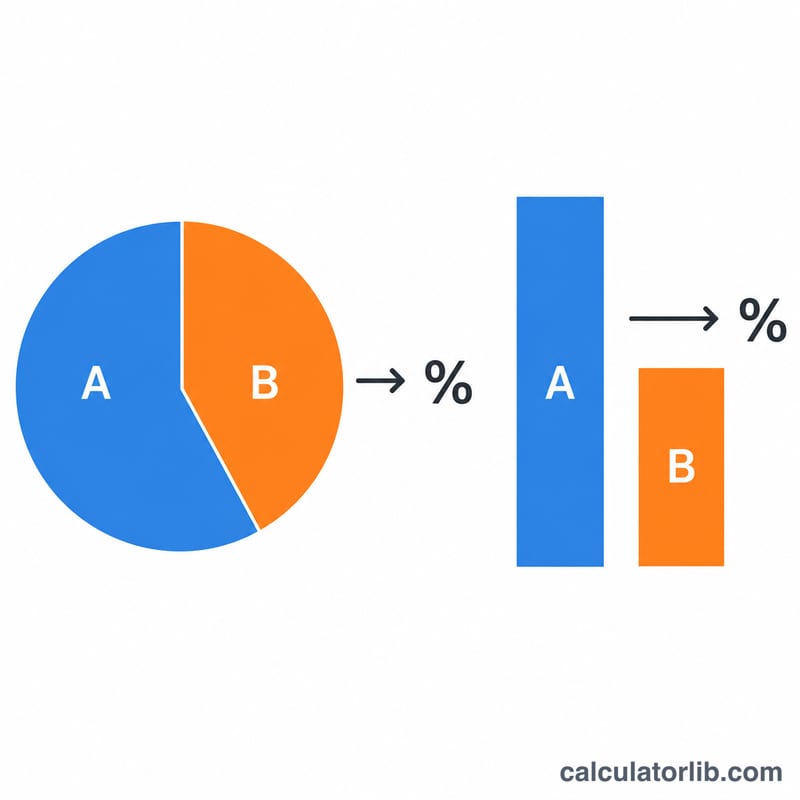
A ratio A:B can be turned into a percentage in two ways. Part of whole uses \(\frac{A}{A+B}\times 100\%\). A relative to B uses \(\frac{A}{B}\times 100\%\). The table shows both for common ratios. Values are rounded to two decimals where needed.
| Ratio A:B | A as part of whole (%) | B as part of whole (%) | A relative to B (%) |
|---|---|---|---|
| 1:1 | 50% | 50% | 100% |
| 1:2 | 33.33% | 66.67% | 50% |
| 1:3 | 25% | 75% | 33.33% |
| 1:4 | 20% | 80% | 25% |
| 2:3 | 40% | 60% | 66.67% |
| 3:2 | 60% | 40% | 150% |
| 3:1 | 75% | 25% | 300% |
| 4:1 | 80% | 20% | 400% |
| 9:1 | 90% | 10% | 900% |
| 99:1 | 99% | 1% | 9,900% |
Example: for 1:3, \(\frac{1}{1+3}\times 100\% = 25\%\), \(\frac{3}{1+3}\times 100\% = 75\%\), and \(\frac{1}{3}\times 100\% \approx 33.33\%\). The two part-of-whole percentages always add up to 100%. The relative-to-B percentage can exceed 100% whenever A is larger than B.
Part-of-Whole vs. Relative-to-B: Side-by-Side
The same ratio gives different percentages depending on the mode you choose. Pick the mode that matches the question you are asking.
| Ratio A:B | Part of whole: A/(A+B) | Relative to B: A/B | Typical use |
|---|---|---|---|
| 1:1 | \(\frac{1}{2}\times 100\% = 50\%\) | \(\frac{1}{1}\times 100\% = 100\%\) | Equal profit share between two partners |
| 2:3 | \(\frac{2}{5}\times 100\% = 40\%\) | \(\frac{2}{3}\times 100\% \approx 66.67\%\) | Class composition: 2 boys to 3 girls means 40% of the class are boys |
| 5:5 | \(\frac{5}{10}\times 100\% = 50\%\) | \(\frac{5}{5}\times 100\% = 100\%\) | Recipe split: equal parts of two ingredients |
| 4:1 | \(\frac{4}{5}\times 100\% = 80\%\) | \(\frac{4}{1}\times 100\% = 400\%\) | Mix of 4 parts concentrate to 1 part water is 80% concentrate, and the amount of A is 4 times B |
| 1:4 | \(\frac{1}{5}\times 100\% = 20\%\) | \(\frac{1}{4}\times 100\% = 25\%\) | Growth comparison: A is a quarter the size of B |
Rule of thumb: use part of whole when A and B together make up a total (a recipe, a class, a profit pool). Use relative to B when B is a baseline you are comparing against (a size, a growth figure, a benchmark).
Key Terms
- Ratio: a comparison of two quantities, written A:B, that shows how much of one there is for a given amount of the other.
- Term (A and B): each number in a ratio. A is the first term and B is the second term.
- Part: one portion of a group or total. In a part-of-whole conversion, A is the part you want to express as a percentage.
- Whole: the total of all parts. For a two-term ratio the whole is A + B.
- Baseline: the reference quantity you compare against. In the relative-to-B mode, B is the baseline, so 100% means A equals B.
- Percentage: a number expressed as parts per hundred, found by dividing one quantity by another and multiplying by 100.
- Part-to-part ratio: compares one part with another part, such as 2 boys to 3 girls (2:3). Here the whole is not shown directly.
- Part-to-whole ratio: compares one part with the total, such as 2 boys out of 5 students (2:5). This ratio converts directly to a percentage: \(\frac{2}{5}\times 100\% = 40\%\).
To convert a part-to-part ratio A:B into a part-to-whole percentage, first add the terms to get the whole (A + B), then divide A by that total.
FAQ
Which mode should I use? Use "part of whole" for shares or splits (e.g., what fraction of the total). Use "relative to B" to compare one quantity against another baseline.
Can the percentage exceed 100%? Yes — in "relative to B" mode, if A is larger than B the result is over 100%, which is correct.
What if B is zero? Division by zero is undefined, so the calculator returns 0 to avoid an error. Make sure your denominator is non-zero for a meaningful result.