
What Is the Sum of First N Natural Numbers?
The natural numbers are the counting numbers 1, 2, 3, 4, and so on. Adding them up in order — 1 + 2 + 3 + ... + n — gives a value that grows quickly as n increases. Instead of adding each term one by one, you can use a single closed-form formula to get the answer instantly, no matter how large n is.
The Formula
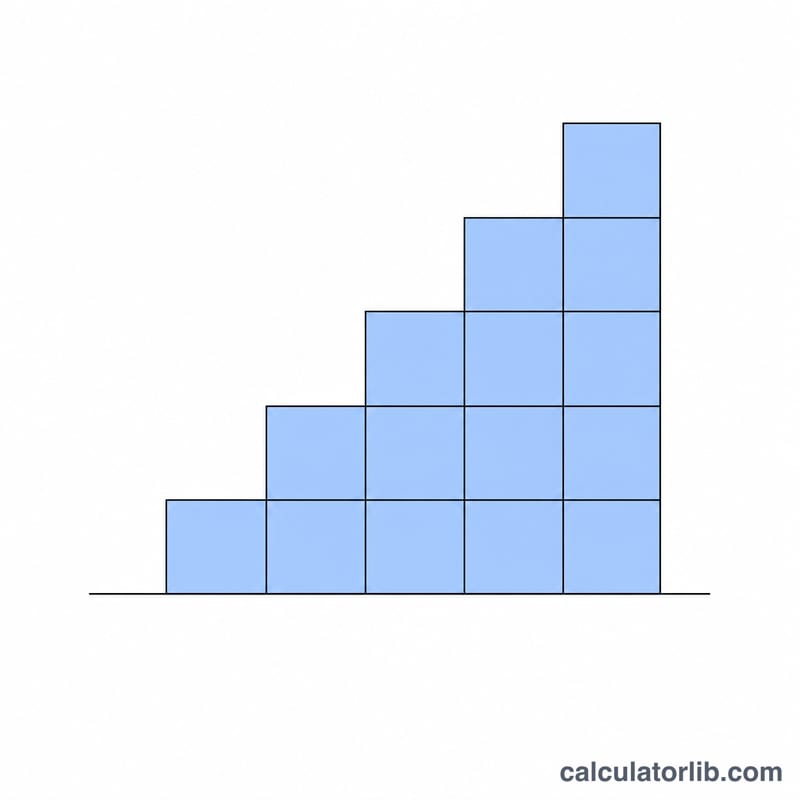
The sum of the first n natural numbers is given by:
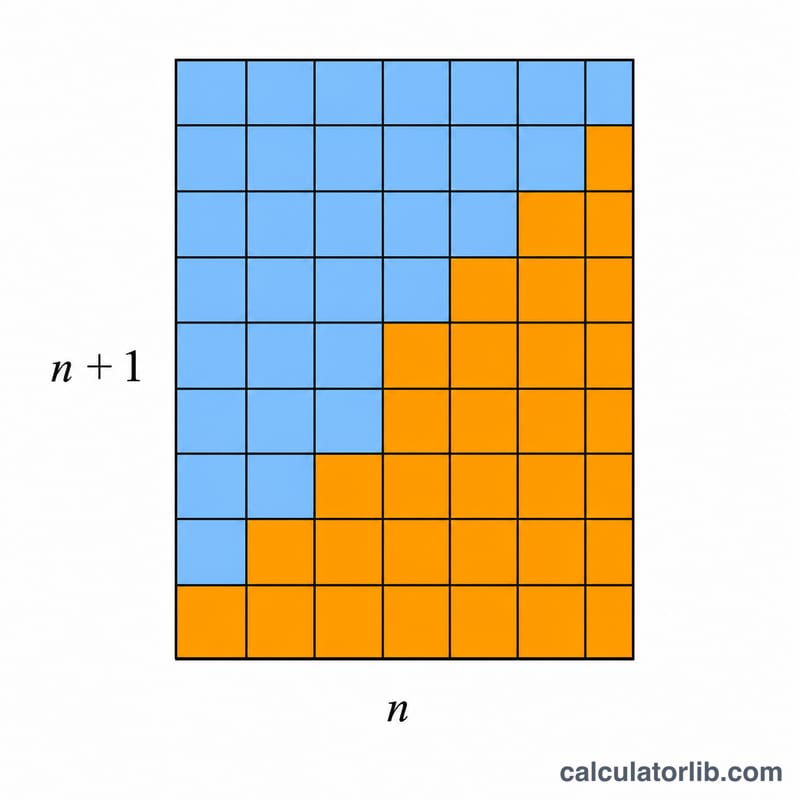
$$S_n = \frac{n(n + 1)}{2}$$
This is a special case of the arithmetic series sum, where the first term is 1, the common difference is 1, and there are \(n\) terms. The story goes that a young Carl Friedrich Gauss discovered this trick by pairing the first and last terms \((1 + n)\), the second and second-to-last \((2 + n-1)\), and so on — each pair sums to \((n + 1)\), and there are \(n/2\) such pairs.
How to Use This Calculator
Enter the number of terms (n) — the count of natural numbers starting from 1 that you want to add. Click calculate and the tool returns the total sum, the number of terms, and the average of those terms. Use whole positive numbers only.
Worked Example
Suppose \(n = 100\). Plugging into the formula: $$S_{100} = \frac{100 \times (100 + 1)}{2} = \frac{100 \times 101}{2} = \frac{10{,}100}{2} = 5{,}050.$$ So the sum of all whole numbers from 1 to 100 is 5,050. The average term is \(\frac{100 + 1}{2} = 50.5\).
FAQ
Does this include zero? No. Natural numbers here start at 1, so the series is 1 + 2 + ... + n.
Why divide by 2? Pairing the terms from both ends gives \(n/2\) pairs that each total \((n + 1)\), so the sum is \(\frac{n(n + 1)}{2}\).
Can I use it for large n? Yes. Because it uses a closed-form formula rather than looping, results are instant even for very large values of n.