

What This Calculator Does
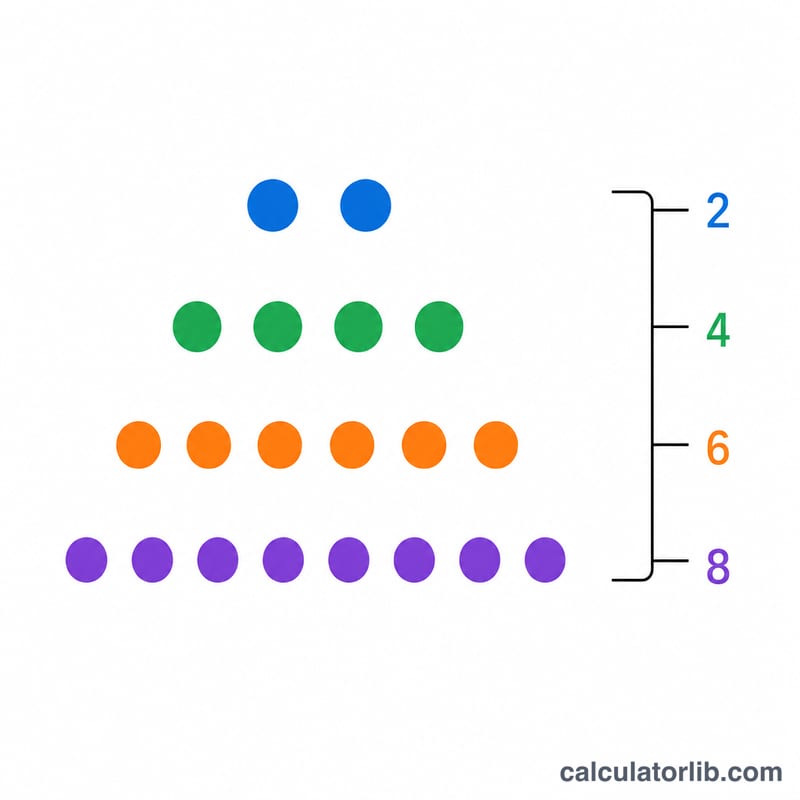
This tool adds up the first n positive even numbers — that is, \(2 + 4 + 6 + 8 + \ldots + 2n\) — and returns the total instantly. Instead of adding each term one by one, it uses the elegant closed-form identity \(n(n + 1)\), which gives the exact answer in a single step no matter how large n is.
How to Use It
Enter how many even numbers you want to add (the value of n) and submit. For example, set n = 5 to add the first five even numbers: \(2 + 4 + 6 + 8 + 10\). The calculator shows the total, the count of terms, and the largest even number in the series (2n).
The Formula Explained
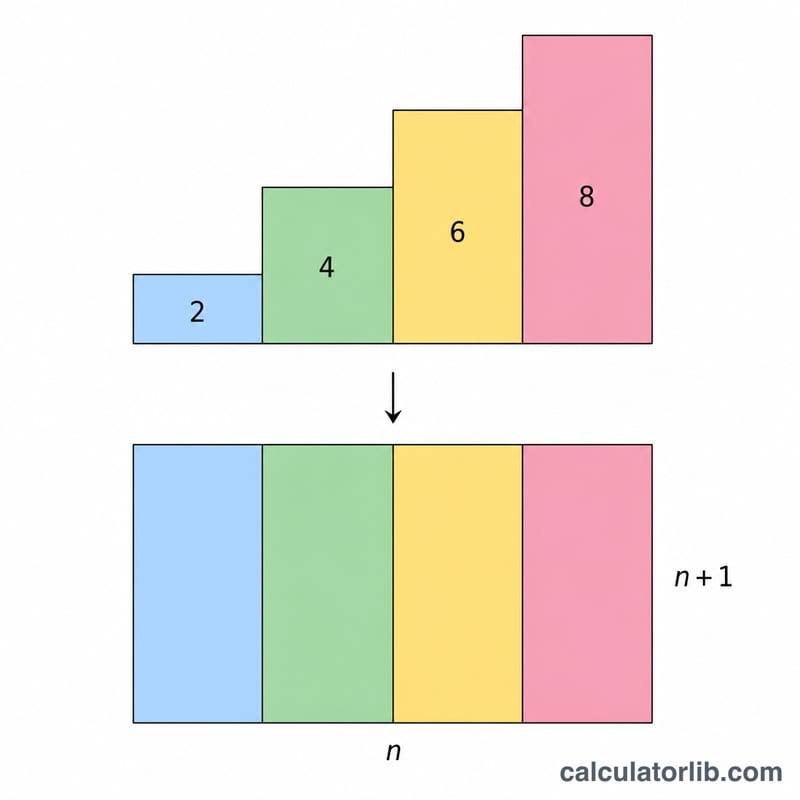
The even numbers form an arithmetic series with first term a = 2 and common difference d = 2. The sum of an arithmetic series is (number of terms) × (first term + last term) / 2. Here that is \(n \times (2 + 2n) / 2 = n(1 + n)\). So the sum simplifies neatly to $$S = n(n + 1)$$ A handy way to remember it: the sum of the first n even numbers always equals n more than the square of n, because \(n(n+1) = n^2 + n\).
Worked Example
Suppose n = 10. The first ten even numbers are 2, 4, 6, 8, 10, 12, 14, 16, 18, 20. Using the formula: $$S = 10 \times (10 + 1) = 10 \times 11 = 110$$ Adding them by hand confirms \(2 + 4 + \ldots + 20 = 110\).
FAQ
Is this the same as the sum of odd numbers? No. The sum of the first n odd numbers equals \(n^2\), while the sum of the first n even numbers equals \(n(n + 1) = n^2 + n\) — exactly n larger.
Does it count zero as even? No. This counts positive even numbers starting at 2, so the first even number is 2 and the n-th is 2n.
What if I enter n = 0? An empty series has a sum of 0, which the formula correctly returns since \(0 \times 1 = 0\).