
What Is Expanded Form?
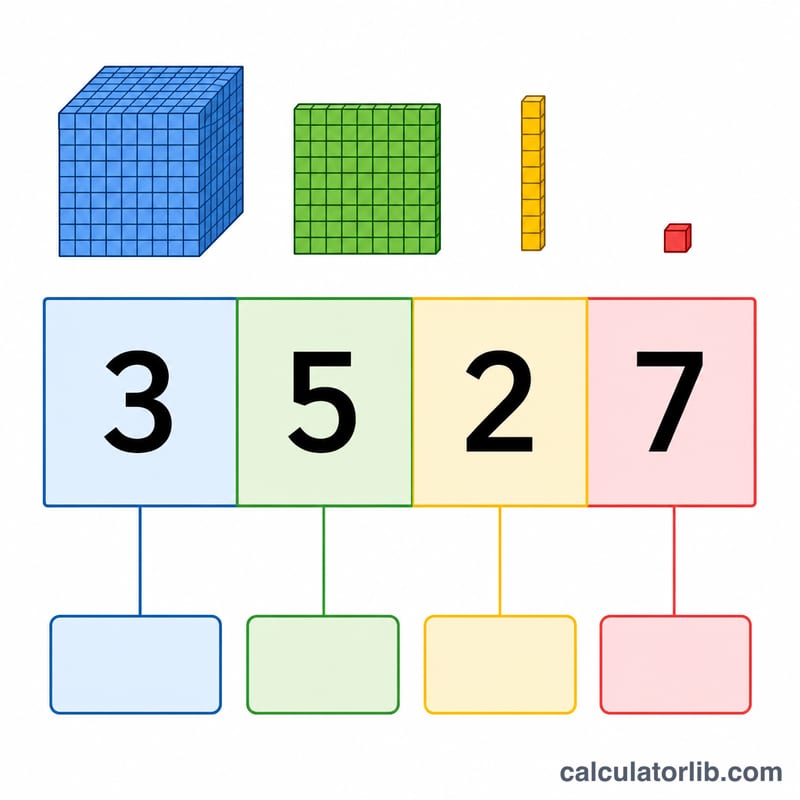
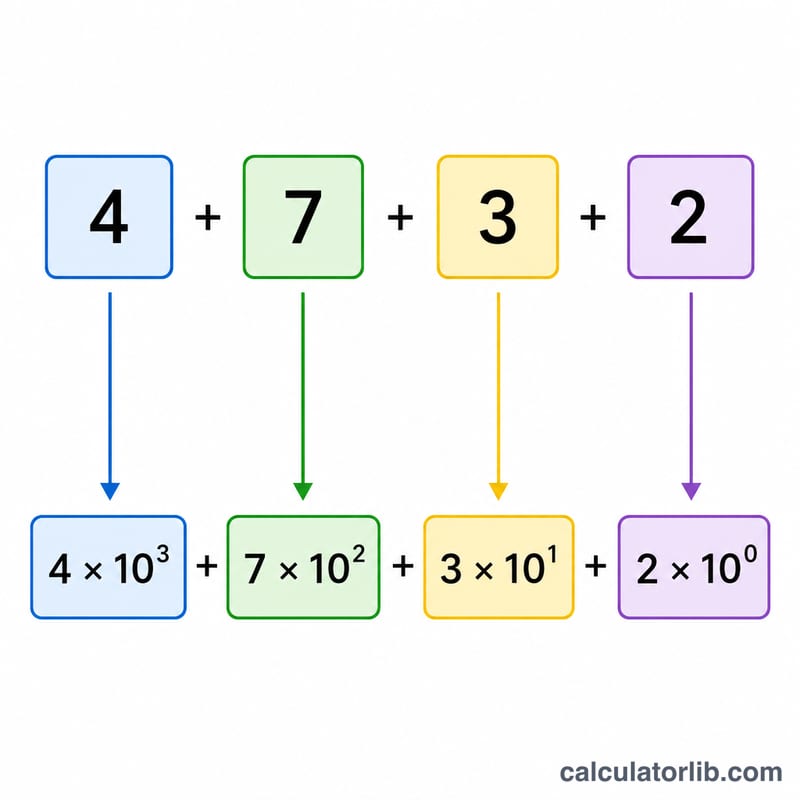
Expanded form (also called expanded notation) breaks a number apart to show how much each digit is really worth based on its position, or place value. Instead of writing 4,572 as a single block, expanded form reveals it as \(4 \times 1000 + 5 \times 100 + 7 \times 10 + 2\) — making the structure of our base-10 number system clear. This calculator turns any whole number you enter into its expanded form using powers of ten.
How to Use the Calculator
Type a whole number into the box and the tool instantly rewrites it as a sum of place values. Leading zeros are ignored and digits equal to zero are omitted from the sum because they contribute nothing. The result shows the expanded expression, the original value, the digit count, and how many non-zero terms appear.
The Formula Explained
For a number with digits d at positions p (counting from the right starting at 0), the value is the sum of each digit multiplied by ten raised to its place: $$\text{Number} = \sum_{i=0}^{n-1} d_i \times 10^{\,n-1-i}$$. The rightmost digit sits in the ones place (\(10^0 = 1\)), the next in the tens place (\(10^1 = 10\)), then hundreds (\(10^2 = 100\)), and so on.
Worked Example
Take the number 3,406. Counting places from the right: 6 is in the ones place, 0 in the tens, 4 in the hundreds, 3 in the thousands. The expanded form is $$3 \times 10^3 + 4 \times 10^2 + 6 = 3000 + 400 + 6 = 3406$$. The zero in the tens place is dropped because \(0 \times 10 = 0\).
FAQ
Why are zeros left out? A digit of zero multiplied by any power of ten equals zero, so it adds nothing to the sum and is omitted from the expanded form.
What about decimals? This version handles whole numbers. Decimal place values use negative exponents (tenths = \(10^{-1}\)), which would extend the same formula.
Is expanded form the same as scientific notation? No. Scientific notation writes a number as one factor times a single power of ten, while expanded form lists every place value separately.