
What Is the Difference of Cubes?
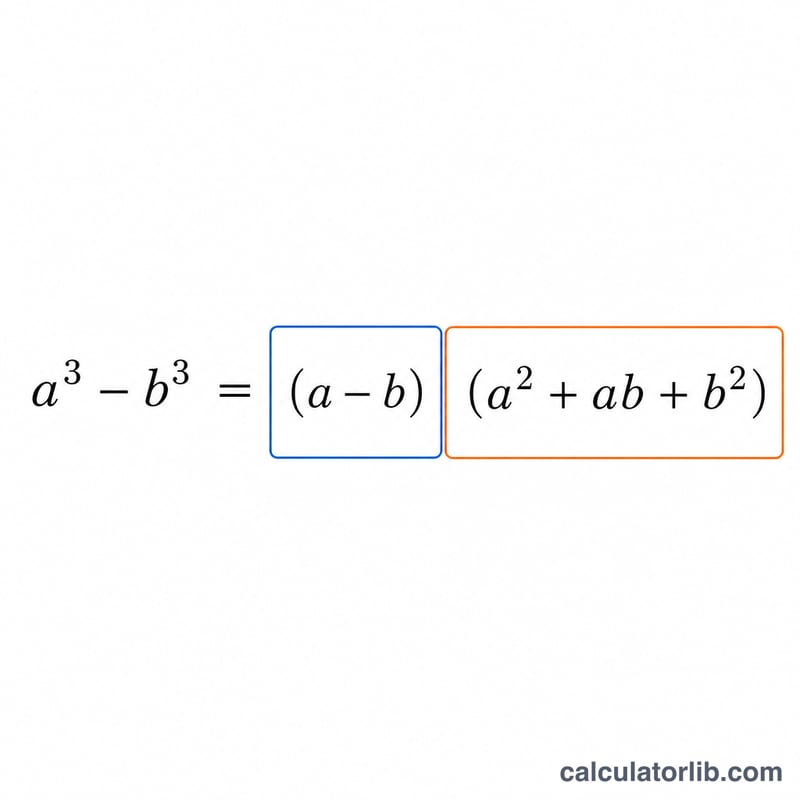
A difference of cubes is any expression of the form \(a^3 - b^3\). It has a fixed factoring pattern that turns it into the product of a binomial and a trinomial: $$a^3 - b^3 = (a - b)(a^2 + ab + b^2)$$ This calculator takes the values a and b (the cube roots of the two terms) and instantly returns the fully factored form, each individual term, and the numeric result.
How to Use This Calculator
Enter a, the cube root of the first term, and b, the cube root of the second term. For example, to factor \(8x^3 - 27\) you would treat it as \((2x)^3 - 3^3\), so \(a = 2\) and \(b = 3\) (with the variable carried along separately). For purely numeric problems just type the two base numbers. The tool computes \((a - b)\), \(a^2\), \(ab\), and \(b^2\), then assembles the factored answer and the value of \(a^3 - b^3\).
The Formula Explained
The trinomial factor \(a^2 + ab + b^2\) never factors further over the real numbers (its discriminant is negative), which is why this pattern is so useful. Note the sign rule: the binomial uses the same sign as the original (minus), while the trinomial is always all positive. This differs from the sum of cubes, which uses \((a + b)(a^2 - ab + b^2)\).
Worked Example
Factor \(27 - 8\). Here \(a^3 = 27\) so \(a = 3\), and \(b^3 = 8\) so \(b = 2\). Then \(a - b = 1\), \(a^2 = 9\), \(ab = 6\), \(b^2 = 4\). The factored form is $$(3 - 2)(9 + 6 + 4) = (1)(19) = 19,$$ which matches \(27 - 8 = 19\).
FAQ
What if a equals b? Then \(a - b = 0\) and the whole expression is 0, which the factored form correctly shows.
Can a and b be decimals or negatives? Yes. The pattern works for any real numbers; the calculator handles fractions and negatives.
How is this different from a sum of cubes? A sum of cubes \(a^3 + b^3\) factors to \((a + b)(a^2 - ab + b^2)\) — the binomial and middle trinomial sign flip.