
What this calculator does
This tool answers a common algebra question: "What value do I still need to reach a target average?" It works for grades, test scores, performance metrics, or any set of numbers where you know some values, know how many values there are in total, and have a goal average in mind. Enter your known values, the total number of items, and your target average, and it solves for the missing amount.
How to use it
Type your known values separated by commas (for example, three quiz scores). Enter the total number of items the average will be based on — including the items you have not yet completed. Finally enter your target average. The calculator returns the total contribution still required from the remaining items and, if more than one item remains, the value each remaining item must equal (assuming they are equal).
The formula explained
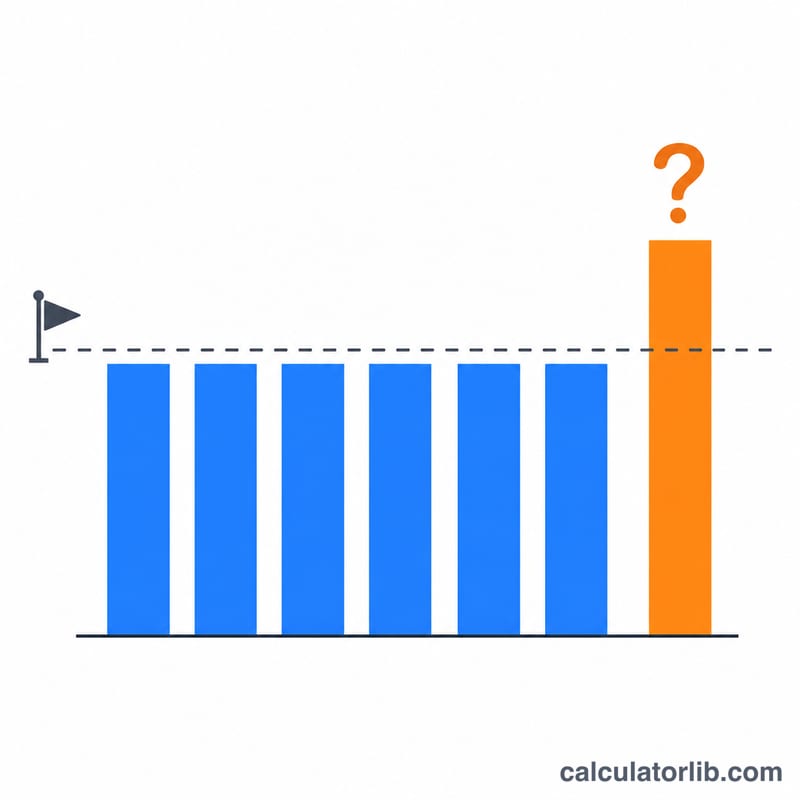
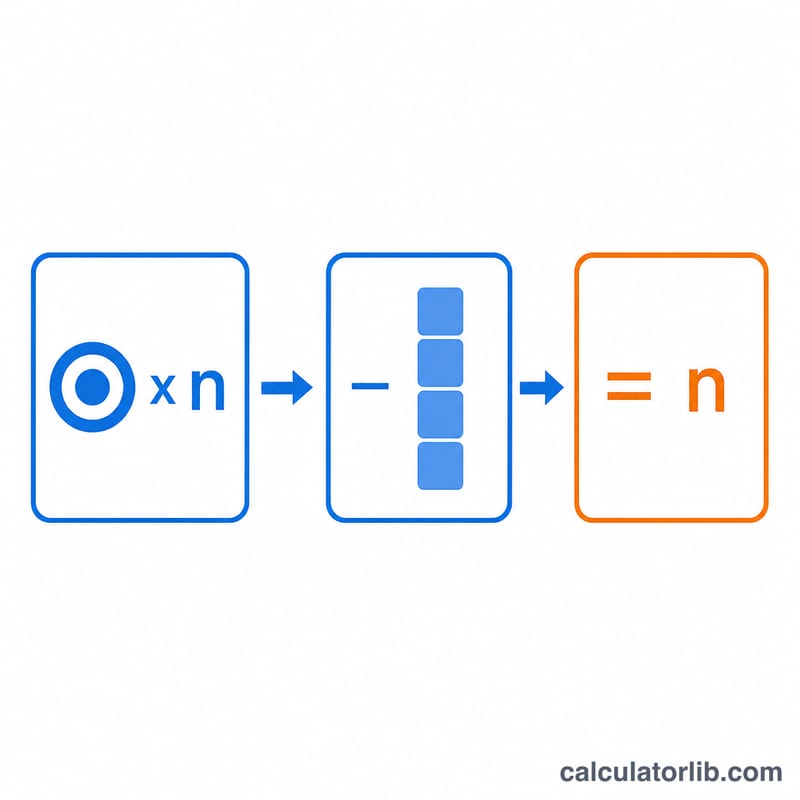
An average of \(n\) items equals the sum of all items divided by \(n\). To reach a target average, the total sum must equal \(\text{target} \times n\). The amount still needed is therefore the required grand total minus the sum of the values you already know:
$$\text{needed} = \text{target} \times n - \sum \text{known}$$Dividing by the number of remaining items gives the value each one must reach.
Worked example
Suppose you have three test scores: 85, 90, and 78, and there will be four tests total. You want a final average of 85. The required grand total is
$$85 \times 4 = 340$$Your known sum is
$$85 + 90 + 78 = 253$$So you need
$$340 - 253 = 87$$on the fourth test. With one item remaining, the per-item value is also 87.
FAQ
What if the result is higher than possible? If the needed value exceeds the maximum achievable (such as over 100 on a graded test), the target average is not reachable with the remaining items.
Can I have more than one remaining item? Yes. If total is larger than the count of known values by more than one, the per-item figure assumes every remaining item earns the same value.
Does it work for weighted averages? This calculator assumes equal weighting for each item. For weighted means, convert each item to its weight-adjusted equivalent first.