
What Is a Duct Size Calculator?
A duct size calculator determines the duct dimensions needed to carry a given volume of air at a target velocity. Properly sized ductwork keeps an HVAC system efficient and quiet: ducts that are too small create excess static pressure, noise, and strain on the blower, while oversized ducts waste material and reduce air speed. This tool works with the velocity method, the most common rule-of-thumb sizing approach for residential and light-commercial systems.
How to Use It
Enter the required airflow in CFM (cubic feet per minute) for the room or branch. Enter the target air velocity in FPM (feet per minute) — typical values are 600–900 FPM for main supply trunks and 400–600 FPM for branch runs to minimize noise. Choose round or rectangular. For rectangular ducts, also enter one known side (for example a fixed height that fits between joists) and the calculator returns the other side.
The Formula Explained
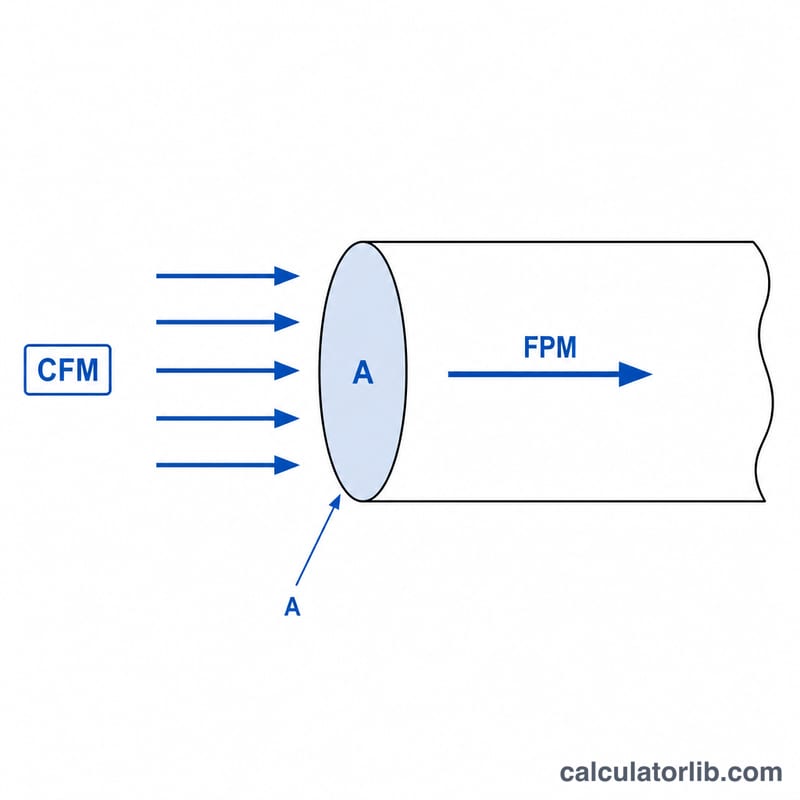
The required cross-sectional area is airflow divided by velocity: \(A = \dfrac{\text{CFM}}{V}\), giving square feet. Multiply by 144 to convert to square inches. For a round duct, the diameter is \(d = \sqrt{\dfrac{4A}{\pi}}\). For a rectangular duct, the second side equals the area divided by the known side.
$$D = \sqrt{\dfrac{4 \times A}{\pi}}$$ $$A = 144 \times \dfrac{\text{Airflow (CFM)}}{\text{Velocity (FPM)}}$$ $$\text{Other Side} = \dfrac{A}{\text{Known Side (in)}}$$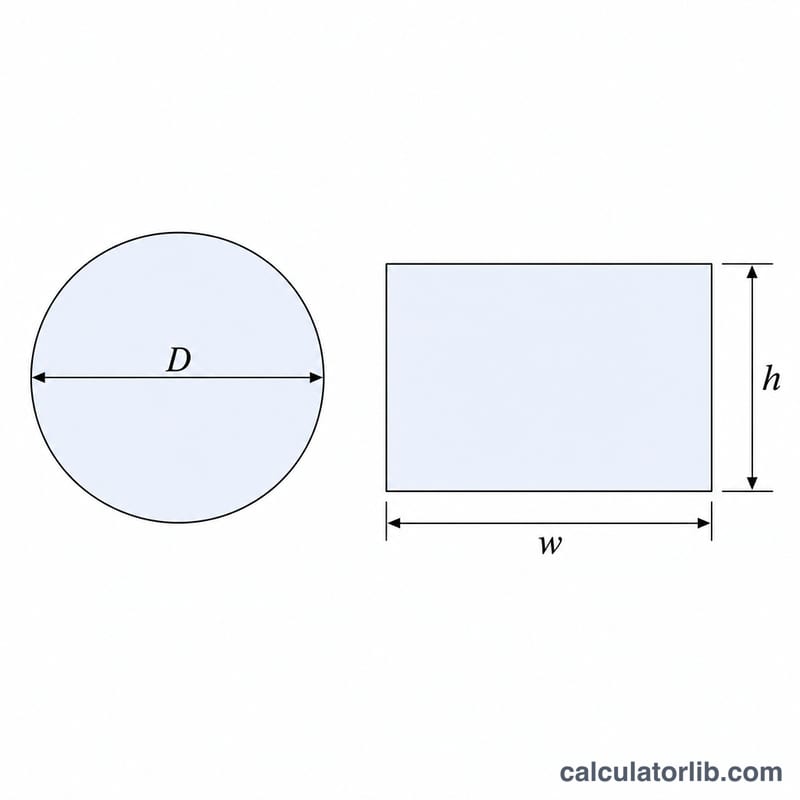
Worked Example
Suppose you need 400 CFM at 700 FPM. Area = \(\dfrac{400}{700} = 0.5714\) sq ft = 82.29 sq in.
$$A = \dfrac{400}{700} = 0.5714 \text{ sq ft} = 82.29 \text{ sq in}$$The round diameter = √(4 × 82.29 / π) = √(104.78) ≈ 10.24 inches, so you would select a 10-inch round duct.
$$D = \sqrt{\dfrac{4 \times 82.29}{\pi}} = \sqrt{104.78} \approx 10.24 \text{ inches}$$For a rectangular duct 8 inches tall, the width = 82.29 / 8 ≈ 10.29 inches, so roughly an 8×10 duct.
$$\text{width} = \dfrac{82.29}{8} \approx 10.29 \text{ inches}$$FAQ
What velocity should I use? Lower velocities are quieter. Use 600–900 FPM for trunk lines and 400–600 FPM for branches near living spaces.
Why convert to square inches? Airflow over velocity yields square feet, but duct sizes are stated in inches, so we multiply by 144.
Is rectangular or round better? Round duct moves air with less friction and uses less material per cross-section, but rectangular duct fits flat spaces like joist cavities. The calculator shows the equivalent round diameter for reference.