
What Is the Winch Size Calculator?
Choosing the right winch is the most important decision in off-road recovery gear. A winch that is too small can burn out its motor, overheat, or simply fail to pull your vehicle free. This calculator tells you the minimum rated line pull your winch should provide based on your vehicle's weight and a chosen safety factor.
How to Use It
Enter your vehicle's loaded weight in pounds (use the gross vehicle weight rating, or GVWR, including cargo and passengers, for the safest result). Then pick a safety factor: 1.5x is the standard minimum, 2x is recommended for regular off-road use, and 3x suits heavy mud, deep recovery, or winching uphill.
The Formula Explained
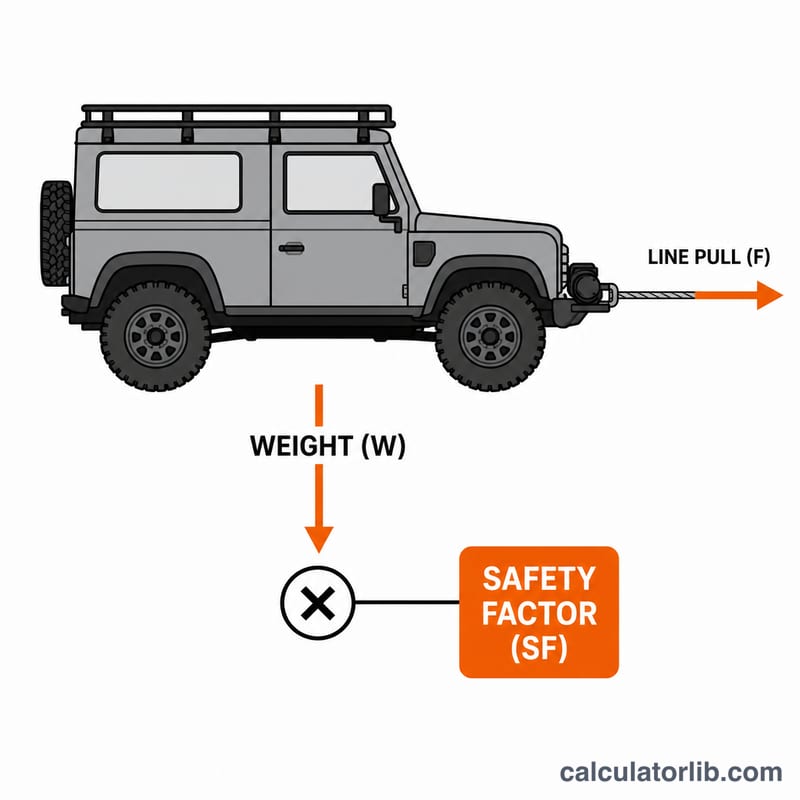
The calculation is simple: $$\text{Min Winch Capacity} = \text{Vehicle Weight (lbs)} \times \text{Safety Factor}$$ The safety factor accounts for the extra resistance from mud, inclines, suction, and the inefficiency of a winch pulling at the limit of its rating. Winches lose pulling power as more line spools onto the drum, so oversizing protects against real-world losses.
Worked Example
Suppose your fully loaded SUV weighs 5,000 lbs and you choose the standard 1.5x factor. The calculation is $$5{,}000 \times 1.5 = 7{,}500 \text{ lbs}$$ You would round up to the next available winch size, so a 8,000 lb or 9,000 lb winch would be appropriate. If you frequently wheel in mud, the 2x factor (10,000 lbs) is the smarter buy.
FAQ
Should I use curb weight or GVWR? Use GVWR or your loaded weight for safety — recovery often happens when you are fully loaded.
Why not just buy the biggest winch? Larger winches are heavier and add weight to the front axle, but a moderate oversize is always wise. A 1.5x minimum is the accepted industry rule of thumb.
Does line and rigging affect capacity? Yes — using a snatch block (pulley) roughly doubles your effective pulling power, which can let a smaller winch handle a tough recovery.