What is the Quilt Binding Calculator?
Binding is the fabric strip that wraps and finishes the raw edges of a quilt. This calculator tells you how many binding strips to cut across the width of your fabric and how much fabric you need to buy. It works for any quilt size and the standard double-fold (French) binding most quilters use.
How to use it
Enter the finished quilt's length and width in inches, the strip width you plan to cut (2.5" is the most common for double-fold binding), and your usable fabric width (about 42" for quilting cotton after trimming the selvages). The calculator returns the number of strips, total binding length, and the fabric yardage required.
The formula explained
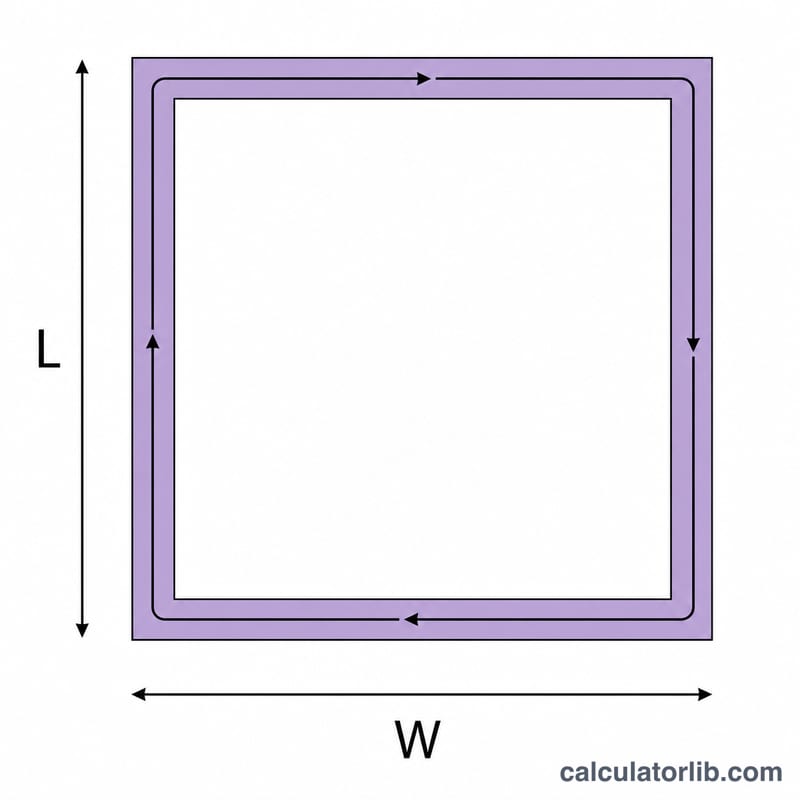
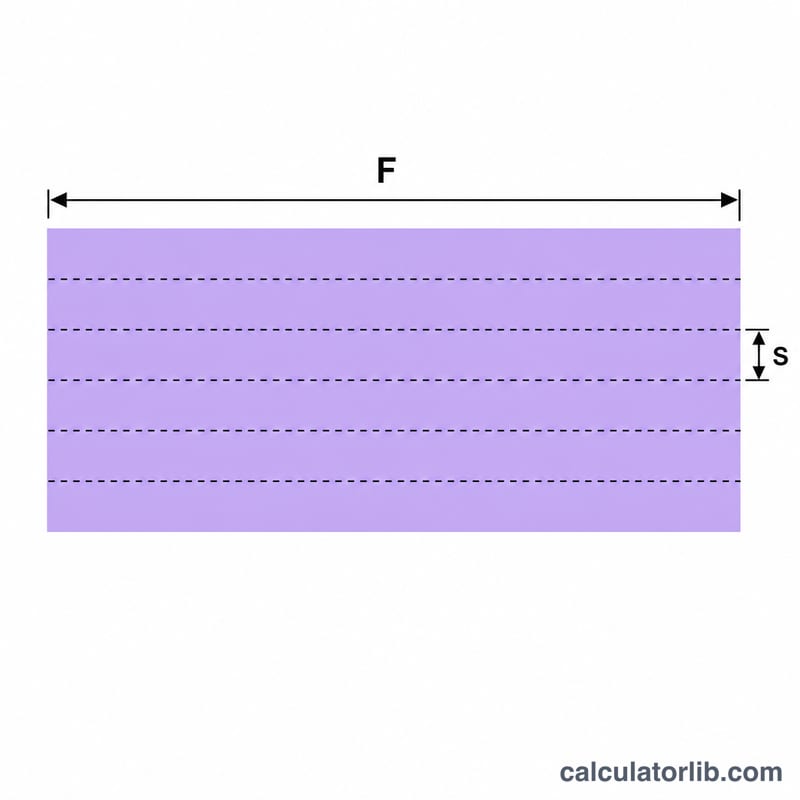
The perimeter of a rectangle is \(2 \times (\text{length} + \text{width})\). We add 10 inches of extra binding to fold around the four corners and join the strip ends with diagonal seams. Dividing by the usable fabric width gives how many full-width strips are needed, rounded up because you can't cut a partial strip. Multiplying that strip count by the cut width gives the length of fabric you must buy down the bolt.
$$\begin{gathered} \text{Yardage} = \frac{\left\lceil \dfrac{P}{\text{Fabric Width}} \right\rceil \times \text{Strip Width}}{36} \\[1.5em] \text{where}\quad P = 2\left(\text{Length} + \text{Width}\right) + 10 \end{gathered}$$Worked example
For a 60" × 48" quilt with 2.5" strips on 42" fabric: perimeter = \(2 \times (60 + 48) = 216\), plus 10 = 226 inches. \(226 \div 42 = 5.38\), rounded up to 6 strips. Fabric needed = \(6 \times 2.5 = 15\) inches (about 0.42 yard). Buying half a yard gives a safe margin.
Binding Yardage by Common Quilt Size
The table uses the calculator's formula with 2.5" strips cut across 42" of usable fabric width (inches and yards, as used in US-style quilting). The binding length needed is \(P = 2(L + W) + 10\), which adds 10" for corners and joining the ends. The number of strips is \(\lceil P / 42 \rceil\), and the exact yardage is \(\text{strips} \times 2.5 / 36\). The last column rounds up to a purchasable cut. Sizes are typical examples, and your quilt may differ.
| Quilt size | Dimensions (in) | P = 2(L+W)+10 (in) | Strips (2.5" × 42") | Exact yardage | Buy |
|---|---|---|---|---|---|
| Baby | 36 × 52 | 186 | 5 | 0.35 yd | 3/8 yd |
| Throw | 50 × 65 | 240 | 6 | 0.42 yd | 1/2 yd |
| Twin | 70 × 90 | 330 | 8 | 0.56 yd | 5/8 yd |
| Full | 85 × 108 | 396 | 10 | 0.69 yd | 3/4 yd |
| Queen | 90 × 108 | 406 | 10 | 0.69 yd | 3/4 yd |
| King | 108 × 108 | 442 | 11 | 0.76 yd | 7/8 yd |
Worked example (twin): \(P = 2(70 + 90) + 10 = 330\) in. Then \(330 / 42 = 7.86\), which rounds up to 8 strips. Yardage is \((8 \times 2.5)/36 = 20/36 = 0.556\) yd, so buy 5/8 yd.
Typical Binding Strip Widths and Fabric Widths
Cut width of the binding strip
- 2": a thin binding, or single-fold binding. It works for small projects and thin batting.
- 2.25"–2.5": the standard range for double-fold binding. 2.5" is the most common choice.
- 2.75"–3": suits thick batting or a wider, more visible binding.
Usable fabric width
- About 40–42" is usable from standard 44/45" quilting cotton once the selvages are trimmed. Use 40" if you want a safer estimate.
- 54–60" is typical of some home-decor fabrics. Enter the real usable width in the calculator, since fewer strips are needed.
Bias binding needs extra fabric. The calculator assumes straight-grain strips cut across the width. Bias strips cut at 45° waste fabric at the edges, so plan for noticeably more yardage than the calculator shows.
Practical Tips for Buying Binding Fabric
- Round up. Buy the next 1/8 or 1/4 yard above the calculated amount. For example, 0.56 yd becomes 5/8 yd.
- Allow a little extra. Fabric can shrink when washed, and you lose some width squaring up the cut edge. A small allowance also covers cutting errors.
- The extra 10" is a minimum. It covers four corners and the join at the end. Large quilts, thick batting, or a wide binding can use more, so add a few inches if in doubt.
- Bias or directional prints use more fabric. Bias cuts and stripes or prints you want to match need extra yardage compared with straight-grain cuts.
- Join strips with diagonal seams. Sew the strips end to end at a 45° angle, trim the seam allowance, and press the seams open. This reduces bulk in the folded binding.
These are general crafting guidelines. Results vary with batting thickness, seam allowance and personal technique.
FAQ
Why the extra 10 inches? Corners (mitered folds) and diagonal seams joining the strips consume length; 10 inches is a reliable buffer.
What strip width should I use? 2.25"–2.5" for double-fold binding is standard. Wider strips give a thicker binding.
Does this include the binding for a hanging sleeve or extra trim? No — it covers the perimeter binding only. Add more strips if you want a label sleeve or scrappy joins.