
What Is the Curtain Panel Calculator?
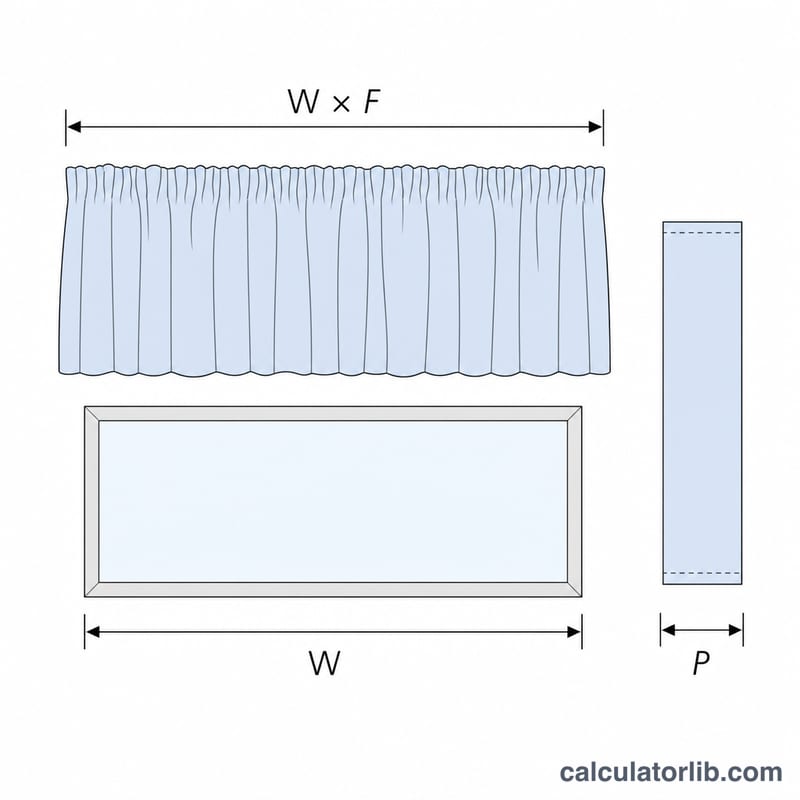
This tool tells you how many curtain panels to buy so your window looks properly dressed instead of skimpy. Curtains aren't hung flat — they're gathered for body and drape. The amount of extra fabric is set by a "fullness ratio," and this calculator combines that with your window and panel measurements to give a whole-panel count, rounded up.
How to Use It
Measure the window width (the width of the area you want covered, in inches — measure the rod or the window opening). Enter the panel width of a single curtain panel you plan to buy. Pick a fullness ratio: 1.5 for a light, casual gather, 2.0 for a standard full look, 2.5–3.0 for very full drapes or sheer fabrics. The calculator returns the number of panels needed.
The Formula Explained
The math is: $$\text{Panels} = \left\lceil \frac{\text{Window Width} \times \text{Fullness}}{\text{Panel Width}} \right\rceil$$ First, window width \(\times\) fullness ratio gives the total fabric width you need so the curtains gather nicely. Dividing by a single panel's width tells you how many panels that takes, and rounding up (ceiling) ensures you never end up short.
Worked Example
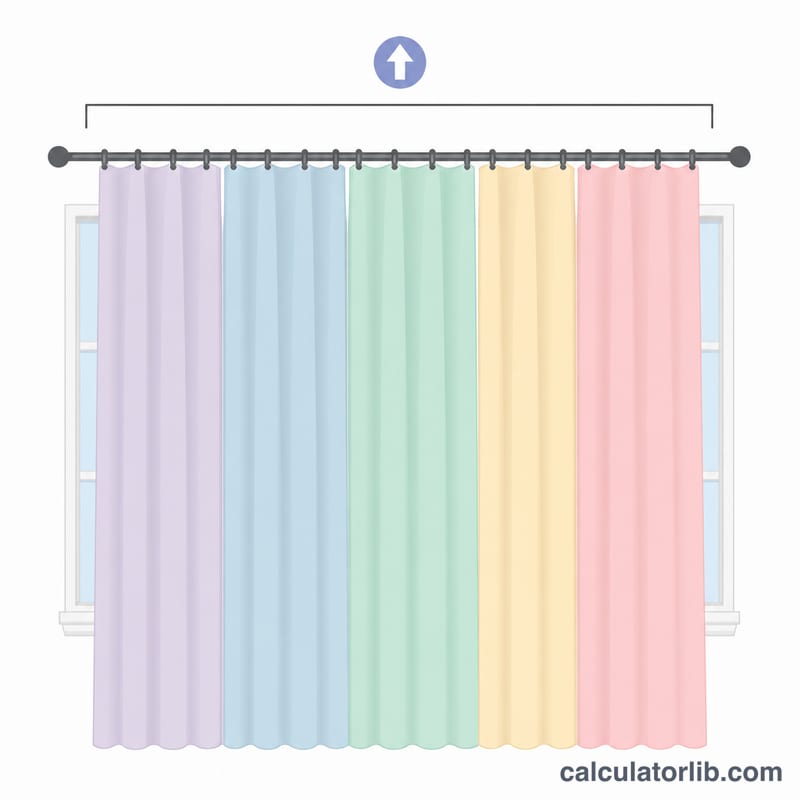
Say your window is 72 inches wide, each panel is 50 inches wide, and you want a standard fullness of 2.0. Required width $$= 72 \times 2 = 144 \text{ inches}.$$ Divide by 50 $$= 2.88 \text{ panels}.$$ Rounding up gives 3 panels. Three 50-inch panels supply 150 inches of fabric width — comfortably more than the 144 inches required.
FAQ
What fullness ratio should I use? 1.5 looks tailored but light, 2.0 is the most popular all-round choice, and 2.5–3.0 gives a rich, luxurious gather often used for sheers and formal drapes.
Should I round up or down? Always round up. Too few panels leave gaps and a flat look; an extra panel adds fullness.
Does this account for hems and seams? No — it calculates panel count by width only. For exact yardage, add allowances for side hems, returns and pattern repeats.