
What is the Bag Fabric Calculator?
This tool estimates how much fabric you need to sew a simple box-bottom bag or tote. By entering the finished bag's width, height and depth — plus a seam allowance — it calculates the combined surface area of all panels so you can buy the right amount of material before cutting.
How to use it
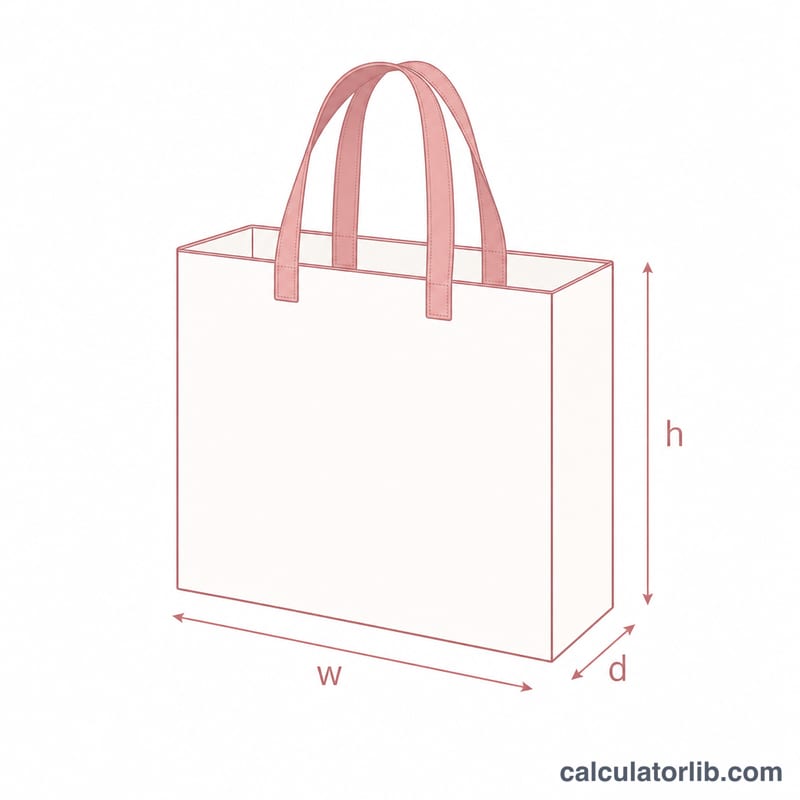
Measure your desired finished bag and enter the width (front face), height and depth (gusset thickness) in centimetres. Add a seam allowance value in square centimetres to cover seams, hems and the bag opening. The calculator returns the total fabric area in cm² and converts it to m² for ordering.
The formula explained
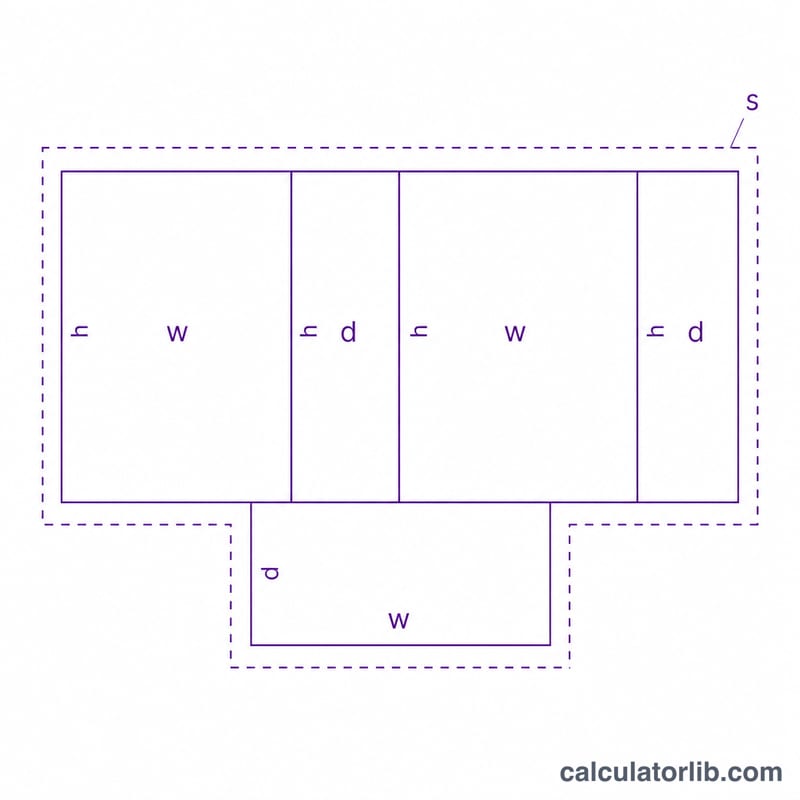
A box-bottom bag is built from a front and back panel (each width × height), two side panels (each depth × height) and a bottom panel (width × depth):
$$A = 2\left(\text{Width} \times \text{Height}\right) + 2\left(\text{Depth} \times \text{Height}\right) + \text{Width} \times \text{Depth} + \text{Seam}$$
Front and back share the same size, so they are doubled; likewise the two sides. The seam allowance is a flat extra you choose based on your pattern and finishing.
Worked example
For a bag 30 cm wide, 40 cm tall, 10 cm deep with a 100 cm² seam allowance: front+back = \(2\times(30\times40)=2400\), sides = \(2\times(10\times40)=800\), bottom = \(30\times10=300\), plus 100 seam. Total = $$2400 + 800 + 300 + 100 = 3600\ \text{cm}^2$$ or 0.36 m².
Practical Sewing & Buying Tips
- Add 10–15% for cutting waste and pattern matching. Cutting rectangular panels from a bolt always leaves offcuts, and aligning stripes, plaids or large prints uses more. For the medium tote's 0.498 m² shell, a 15% buffer means buying for roughly \(0.498 \times 1.15 \approx 0.57\ \text{m}^2\).
- Double the area for a lining. A fully lined bag needs the outer fabric plus the same area again in lining fabric. If you also add interfacing for structure, budget that area too.
- Round fabric length up to the next 0.1 m. Fabric is sold by length off a fixed-width bolt, so always round up — buying 0.6 m instead of an exact 0.57 m gives a small safety margin for mistakes.
- Account for directional and one-way prints. If the pattern only looks right one way (e.g. text, animals, nap on velvet/corduroy), all panels must be cut in the same orientation, which can increase fabric use by 20% or more.
- Check the usable width before ordering. Quilting cotton is often about 110 cm wide, home-décor and canvas around 140–150 cm. Make sure your largest single panel fits within the usable width (after trimming selvages) before converting area into running length.
This is general sewing guidance, not a guaranteed material quote. Always test your layout on the actual fabric width before cutting.
Fabric Area & Length Conversions
To convert the calculator's area into a length to buy, first change cm² to m², then divide by the bolt's usable width in metres:
$$\text{Area in m}^2 = \frac{\text{Area in cm}^2}{10000} \qquad \text{Length (m)} = \frac{\text{Area in m}^2}{\text{Usable width (m)}}$$For example, the large grocery bag's 7330 cm² is \(7330 \div 10000 = 0.733\ \text{m}^2\). On a 140 cm bolt that is \(0.733 \div 1.40 \approx 0.53\) m, rounded up to 0.6 m.
| Area (m²) | Length on 110 cm bolt | Length on 140 cm bolt | Length on 150 cm bolt |
|---|---|---|---|
| 0.25 | 0.23 m | 0.18 m | 0.17 m |
| 0.50 | 0.45 m | 0.36 m | 0.33 m |
| 0.75 | 0.68 m | 0.54 m | 0.50 m |
| 1.00 | 0.91 m | 0.71 m | 0.67 m |
These lengths assume every panel fits within the usable width; long single panels may force a longer cut. Yard/metre reference for ordering:
| Length | Equivalent |
|---|---|
| 1 metre | ≈ 1.094 yards |
| 1 yard | 0.9144 metre (91.44 cm) |
| 0.5 metre | 50 cm ≈ 0.547 yard |
| 0.5 yard | ≈ 45.72 cm |
If your shop sells by area or you are comparing offcuts, you can also convert between square metres and square feet or square yards using the related converters — for instance 0.733 m² is about 7.89 ft².
FAQ
Does this include lining? No. Double the result if you want a fully lined bag.
How big should the seam allowance be? A practical starting point is roughly 1–1.5 cm per seam edge; many sewists add 80–150 cm² total for a medium bag.
How do I convert to fabric length? Divide the area (m²) by your fabric's usable width to estimate running length needed.