
What is the Bag Footprint Calculator?
This tool estimates the lifetime carbon footprint of the shopping bags you use, so you can compare plastic, paper, and cotton on a like-for-like basis. The headline figure many people miss is that a bag's environmental impact depends far more on how many times it is reused than on the material it is made from. A cotton tote made once has a huge footprint, but reused hundreds of times its per-use impact becomes tiny.
How to use it
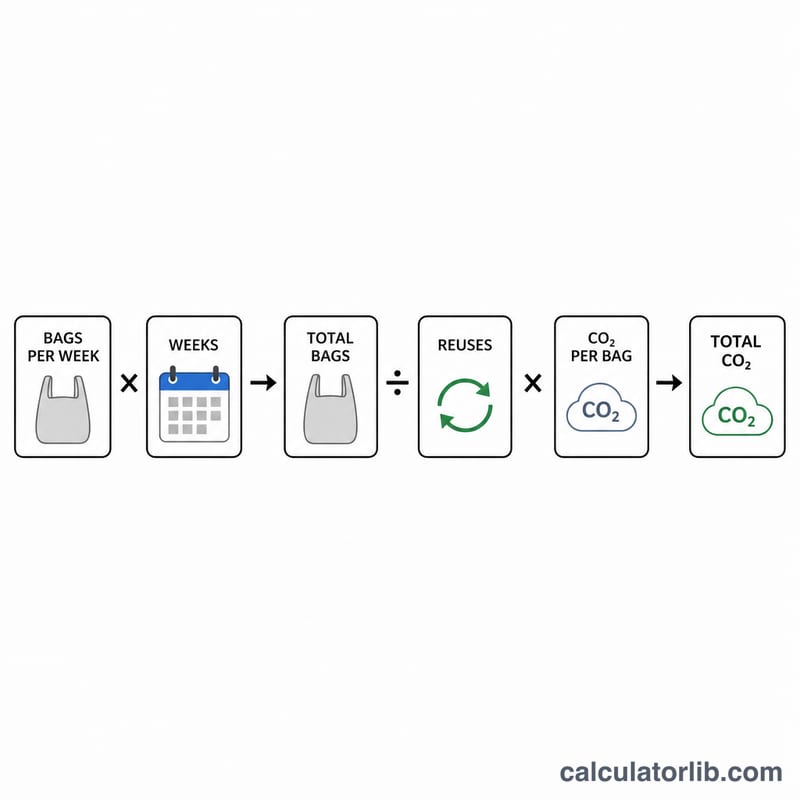
Pick a bag type, enter how many bags you use per week, how many weeks the period covers, and how many times you reuse each individual bag before discarding it. The calculator works out how many new bags you actually need, multiplies that by the manufacturing footprint, and reports total CO₂e plus the footprint per single use.
The formula explained
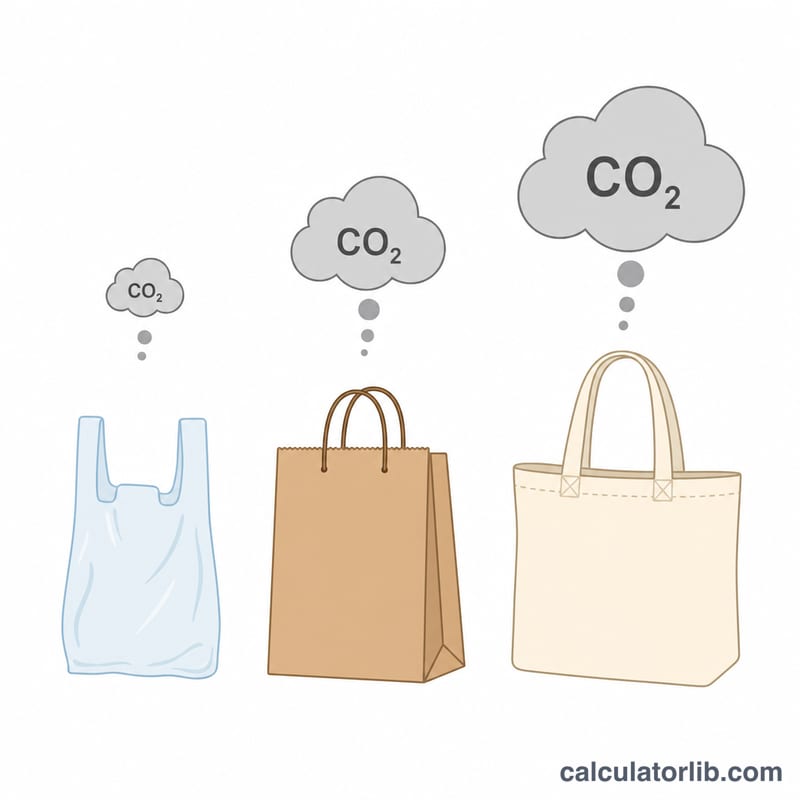
Total uses = bags per week × weeks. Because one durable bag covers several uses, the new bags needed = total uses ÷ reuses. Multiply that by the CO₂e of manufacturing one bag to get the total footprint. We use representative manufacturing estimates of about 33 g CO₂e for a lightweight plastic (LDPE) bag, 80 g for a paper bag, and 1,700 g for an organic cotton tote.
$$\begin{gathered} \text{CO}_2\,(\text{kg}) = \frac{\text{Bags/week} \times \text{Weeks}}{\text{Reuses}} \times \frac{33}{1000} \\[1.2em] \text{where}\quad 33 = \text{g CO}_2\text{e per Plastic (LDPE) bag} \end{gathered}$$
$$\begin{gathered} \text{CO}_2\,(\text{kg}) = \frac{\text{Bags/week} \times \text{Weeks}}{\text{Reuses}} \times \frac{80}{1000} \\[1.2em] \text{where}\quad 80 = \text{g CO}_2\text{e per Paper bag} \end{gathered}$$
$$\begin{gathered} \text{CO}_2\,(\text{kg}) = \frac{\text{Bags/week} \times \text{Weeks}}{\text{Reuses}} \times \frac{1700}{1000} \\[1.2em] \text{where}\quad 1700 = \text{g CO}_2\text{e per Cotton (organic) bag} \end{gathered}$$
Worked example
Suppose you use 10 plastic bags a week for 52 weeks and reuse each once (no reuse beyond the trip). Total uses = 520, bags needed = 520, footprint = \(520 \times 33 = 17{,}160 \text{ g} = 17.16 \text{ kg CO}_2\text{e}\). A cotton bag reused 520 times for the same 520 uses needs just 1 bag: \(1 \times 1{,}700 = 1.7 \text{ kg}\) — over ten times lower.
CO₂e Footprint by Bag Material
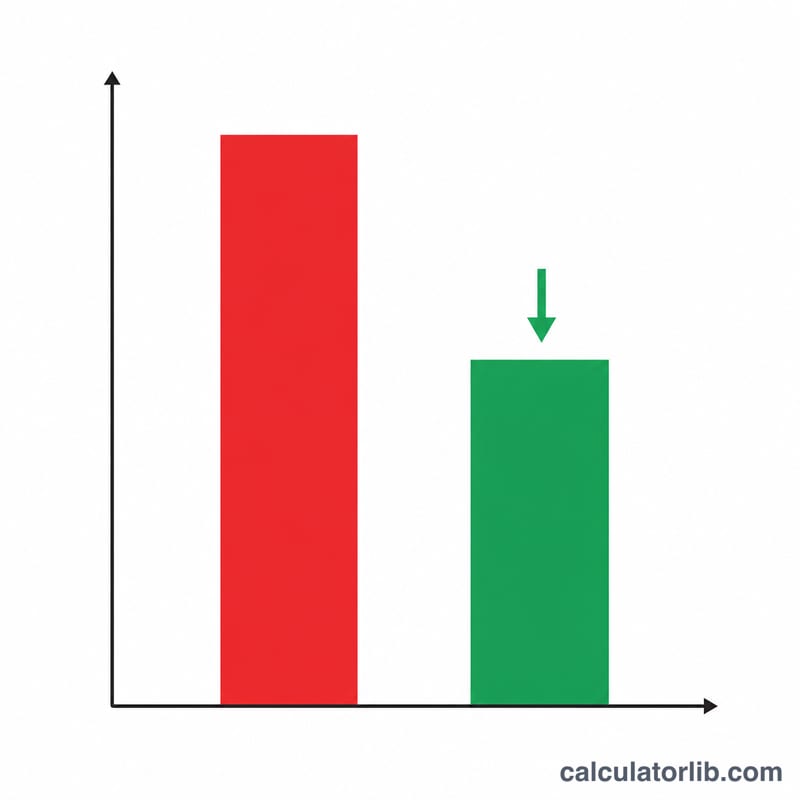
The carbon footprint of a shopping bag is dominated by its manufacturing emissions. Heavier, more durable bags carry a much larger up-front CO₂e cost, which is only justified if the bag is reused many times. The table below lists typical manufacturing emissions per bag and the approximate number of uses needed to break even with a single-use lightweight plastic (LDPE) bag — that is, how many trips a bag must make before its per-use footprint falls below 33 g.
| Bag material | CO₂e per bag (manufacturing) | Reuses to break even vs. single-use LDPE |
|---|---|---|
| Lightweight plastic (LDPE) | ~33 g | 1 (reference) |
| Paper | ~80 g | ~3 |
| Non-woven polypropylene (PP) | ~50 g | ~2 |
| Conventional cotton | ~1,000–1,700 g | ~50–80 |
| Organic cotton | ~1,700 g | ~150 |
Break-even is estimated as the bag's CO₂e divided by 33 g. For example, an organic cotton tote at 1,700 g must be reused about 52 times before each trip costs less than a single-use plastic bag — and far more to offset its full life-cycle (water, land, end-of-life) impacts. Figures are approximate and vary by source, region and study methodology.
Interpreting Your Result
The single most important driver of a bag's footprint is how many times you reuse it. Because manufacturing emissions are fixed per bag, the per-trip footprint falls in proportion to the number of reuses: a tote used 100 times carries one-hundredth of its manufacturing CO₂e on each trip. This is why a heavy cotton bag can be either the worst or the best option depending entirely on user behaviour.
Published life-cycle assessments back this up. The UK Environment Agency's 2011 study found that a conventional cotton bag must be reused on the order of 131 times to have a lower global-warming impact than a single-use HDPE plastic bag used once, while paper bags needed about 3–4 uses and bags-for-life around 4 uses. A 2018 Danish EPA study, which counted a broader set of environmental impacts (water, ozone, ecotoxicity), found organic cotton bags needed thousands of reuses to be the environmentally preferable choice on every indicator.
Two important caveats when reading your result:
- Manufacturing CO₂e is not the whole story. This calculator estimates greenhouse-gas emissions from production only. It does not capture litter, marine plastic pollution, land use, water consumption, or end-of-life disposal — areas where thin plastic bags perform poorly despite their low carbon footprint.
- Reuse must be realistic. The greenest bag is the one you actually carry and reuse. The most reliable way to cut your footprint is to choose a durable bag and use it as many times as possible, then recycle or repurpose it at end of life.
Figures here are general estimates for comparison and education, not a precise life-cycle assessment of any specific product.
FAQ
Why does cotton look so bad at first? Cotton growing and processing is energy- and water-intensive, so a single tote has a large up-front footprint that only pays off after many reuses.
Are these numbers exact? No — they are representative averages from lifecycle studies. Real values vary by region, recycling rates, and bag thickness, so treat results as a comparison guide.
What's the greenest choice? Whatever bag you already own and reuse the most. Maximising reuse beats switching materials.