
What is the Reduce Your Plastic Calculator?
This tool estimates how much single-use plastic you can keep out of landfills and oceans by changing a few everyday habits. By avoiding plastic items each week — such as straws, bottles, bags, or coffee cup lids — small changes add up to meaningful amounts over a full year. The calculator converts your weekly habit into an annual figure expressed in kilograms of plastic avoided.
How to use it
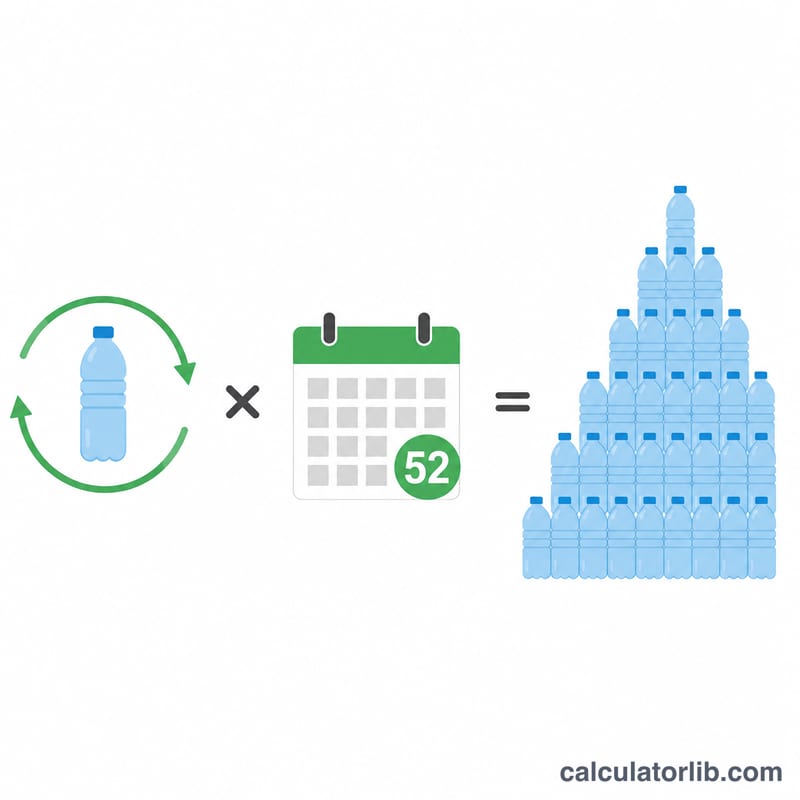
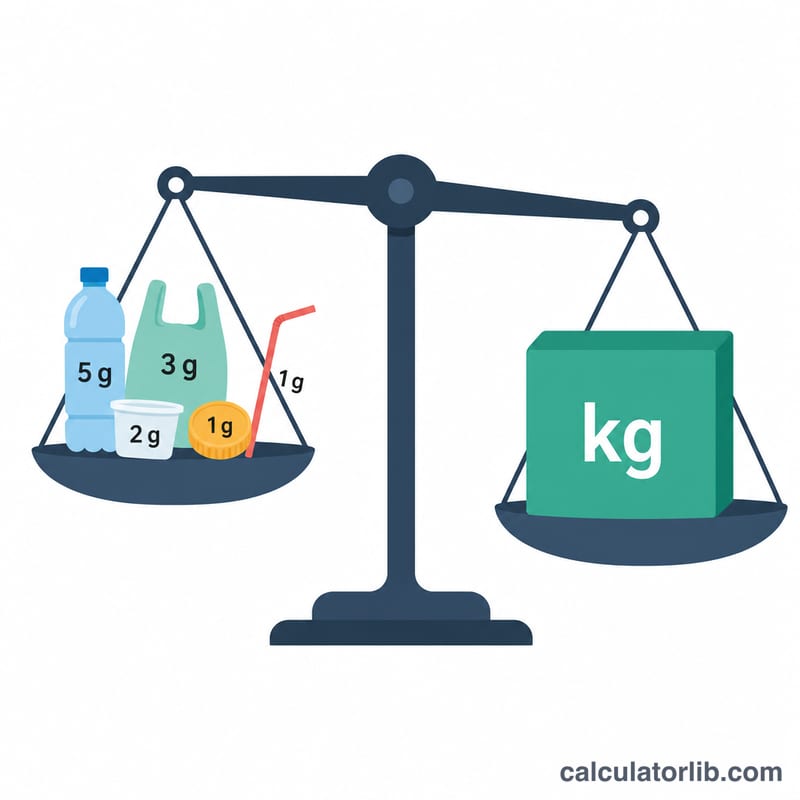
Enter the number of single-use plastic items you avoid in a typical week. Then enter the average weight of one of those items in grams. The calculator multiplies your weekly count by 52 weeks and by the per-item weight to estimate your yearly plastic savings. For reference, a plastic straw weighs roughly 0.4 g, a plastic bag about 5 g, and a 500 ml water bottle around 10 g.
The formula explained
The math is simple: $$\text{Plastic Saved (kg/year)} = \frac{\text{Items per week} \times 52 \times \text{Weight per item (g)}}{1000}$$ Multiplying by 52 converts a weekly habit into an annual total, and dividing the gram weight by 1000 converts the result into kilograms, the standard unit for measuring waste reduction.
Worked example
Suppose you stop using 10 plastic items per week, each weighing 5 grams. That is \(10 \times 52 = 520\) items per year. At 5 g each, that is 2,600 g, or 2.6 kg of plastic avoided in a single year. Avoiding just a few extra items each week can easily double or triple this figure.
FAQ
How accurate is this estimate? It is an estimate based on the weights you provide. Real item weights vary, so use it as a motivating guide rather than an exact measurement.
Does this include packaging? Only the items you count. To include food packaging or wrappers, add them to your weekly item count and estimate their weight.
Why measure in kilograms? Kilograms make it easy to compare your impact over time and relate it to recycling and waste statistics, which are usually reported in kg or tonnes.