What Is Keystrokes per Hour (KPH)?
Keystrokes per hour (KPH) is a standard measure of data-entry speed used by employers, recruiters, and typing-test sites to evaluate how quickly you can input characters. Unlike words per minute (WPM), KPH counts every individual key press — letters, numbers, symbols, and the spacebar — making it the preferred metric for numeric and alphanumeric data-entry roles. A typical office data-entry benchmark is around 8,000–10,000 KPH, while fast professional operators exceed 12,000 KPH.
How to Use This Calculator
Enter the total number of keystrokes you recorded during a typing or data-entry session, then enter the time you spent typing in minutes. The calculator converts your minutes into hours and divides to give your keystrokes per hour, along with your keystrokes per minute for comparison.
The Formula Explained
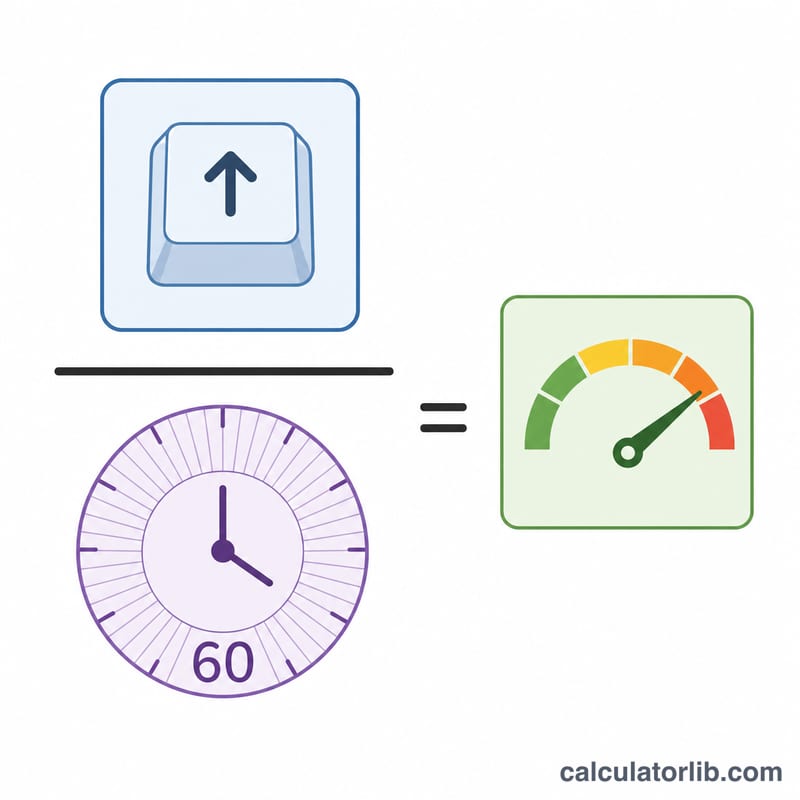
The math is a simple rate calculation. First convert minutes to hours by dividing by 60. Then divide your total keystrokes by that number of hours:
$$\text{KPH} = \frac{\text{Total Keystrokes}}{\dfrac{\text{Minutes}}{60}}$$
This is equivalent to multiplying keystrokes per minute by 60.
Worked Example
Suppose you typed 9,000 keystrokes in 45 minutes. Convert the time to hours: \(45 \div 60 = 0.75\) hours. Then divide: $$9{,}000 \div 0.75 = 12{,}000 \text{ KPH}$$ Your KPM would be \(9{,}000 \div 45 = 200\) keystrokes per minute.
Typical KPH Benchmarks by Role and Skill Level
The bands below are commonly cited industry rules of thumb for data entry work. They are not a single official standard, and employer or contract requirements vary widely by country, industry, and the type of material being keyed (numeric, alphanumeric, or free text). WPM is approximated as KPH ÷ 300, using the convention of 5 keystrokes per word.
| Skill level / role | KPH | KPM (KPH ÷ 60) | Approx. WPM (KPH ÷ 300) |
|---|---|---|---|
| Beginner | Under 6,000 | Under 100 | Under 20 |
| Entry-level | 6,000–8,000 | 100–133 | 20–27 |
| Standard office | 8,000–10,000 | 133–167 | 27–33 |
| Fast | 10,000–12,000 | 167–200 | 33–40 |
| Expert / specialist | 12,000+ | 200+ | 40+ |
KPH measures sustained keystroke throughput over a work period, including pauses, so it is usually lower than a short burst typing-test speed.
KPH, KPM and WPM Conversion Table
Use \(\text{KPM} = \text{KPH} \div 60\) and \(\text{WPM} \approx \text{KPH} \div 300\). The WPM figure relies on the common convention that one "word" equals 5 characters (keystrokes), including spaces.
| KPH | KPM | Approx. WPM |
|---|---|---|
| 6,000 | 100 | 20 |
| 8,000 | 133 | 27 |
| 10,000 | 167 | 33 |
| 12,000 | 200 | 40 |
| 15,000 | 250 | 50 |
Values are rounded to the nearest whole number.
Scenario Comparison: Same Keystrokes, Different Times
The calculator uses \(\text{KPH} = \dfrac{\text{keystrokes}}{\text{minutes} \div 60}\). The same keystroke count gives very different KPH depending on the time taken.
| Total keystrokes | Minutes | Hours (minutes ÷ 60) | KPM | KPH |
|---|---|---|---|---|
| 5,000 | 30 | 0.5 | 166.7 | 10,000 |
| 9,000 | 45 | 0.75 | 200.0 | 12,000 |
| 12,000 | 60 | 1 | 200.0 | 12,000 |
| 20,000 | 120 | 2 | 166.7 | 10,000 |
Example: \(\dfrac{9{,}000}{45 \div 60} = \dfrac{9{,}000}{0.75} = 12{,}000\) KPH. Note that 5,000 keystrokes in 30 minutes and 20,000 in 120 minutes both equal 10,000 KPH, so the pace matters, not the total.
FAQ
Is KPH the same as WPM? No. WPM counts standardized "words" (typically 5 keystrokes each), while KPH counts every individual key press. Roughly, \(\text{KPH} \approx \text{WPM} \times 5 \times 60\).
What is a good KPH score? 8,000 KPH is solid for general data entry; 10,000–12,000+ KPH is considered fast and competitive for specialist roles.
Do backspaces count? Most tests count gross keystrokes including corrections, but some report net (error-adjusted) figures. Check your test's definition for an exact match.