
What Is the Meeting Cost Calculator?
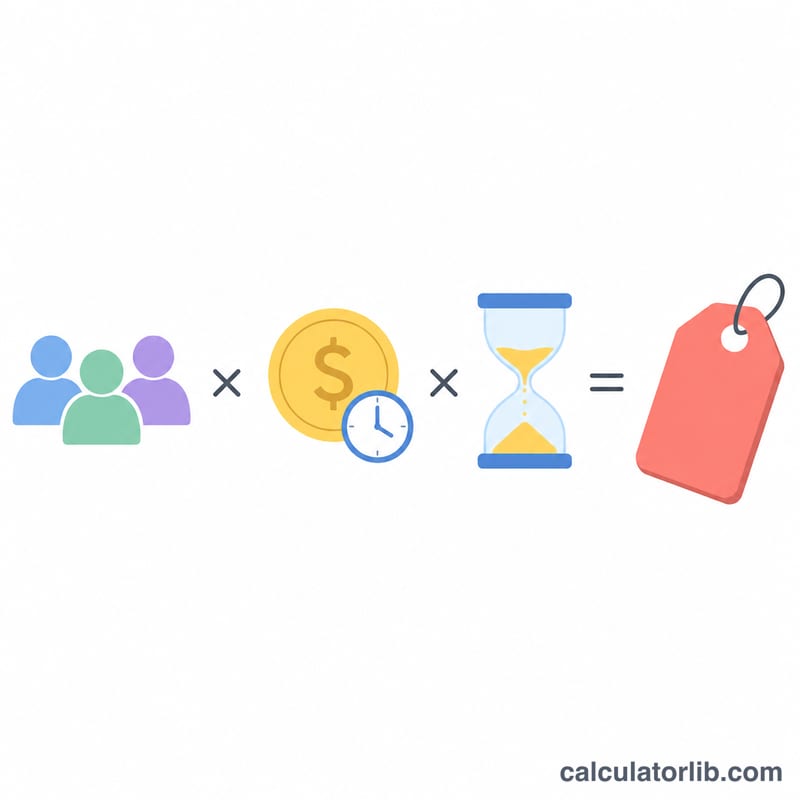
Meetings consume one of your organization's most expensive resources: people's time. This calculator translates that time into a concrete dollar figure so you can decide whether a meeting is worth holding. By multiplying the number of attendees by their average hourly wage and the meeting length, you instantly see what an hour of "just a quick sync" actually costs the business.
How to Use It
Enter the number of people attending, their average hourly wage, and the meeting duration in hours and minutes. The tool returns the total cost in attendee salary time, the duration in decimal hours, and a handy cost-per-minute figure so you can feel every minute that runs over.
The Formula Explained
The core equation is $$\text{Cost} = \text{Attendees} \times \text{Wage (\$/hr)} \times \left( \text{Hours} + \frac{\text{Minutes}}{60} \right)$$ Because meetings rarely land on whole hours, the duration is computed as \(t = \text{hours} + \text{minutes} / 60\). If 8 people earning $60/hour meet for 45 minutes, that is 0.75 hours, so the cost is \(8 \times 60 \times 0.75 = \$360\).
Worked Example
Suppose 5 attendees each earn an average of $50 per hour and the meeting lasts 1 hour. $$\text{Cost} = 5 \times 50 \times 1 = \$250$$ Cost per minute = \(\$250 \div 60 \approx \$4.17\). Trim the meeting to 40 minutes and you save roughly $83.

FAQ
Should I use salary or fully-loaded cost? For a more accurate figure, use a fully-loaded hourly rate that includes benefits and overhead — often 1.25–1.4× base wage.
How do I find an average hourly wage? Divide each person's annual salary by about 2,080 working hours, then average across attendees.
Does this include preparation time? No — it covers the meeting itself. Add prep and follow-up time as extra duration if you want the complete picture.