

What Is Marginal Cost?
Marginal cost (MC) is the additional cost incurred to produce one more unit of a good or service. It is one of the most important concepts in economics and managerial decision-making, because comparing marginal cost to marginal revenue tells a business whether producing extra output is profitable. This calculator works for any currency or unit — it is a universal arithmetic tool.
How to Use the Calculator
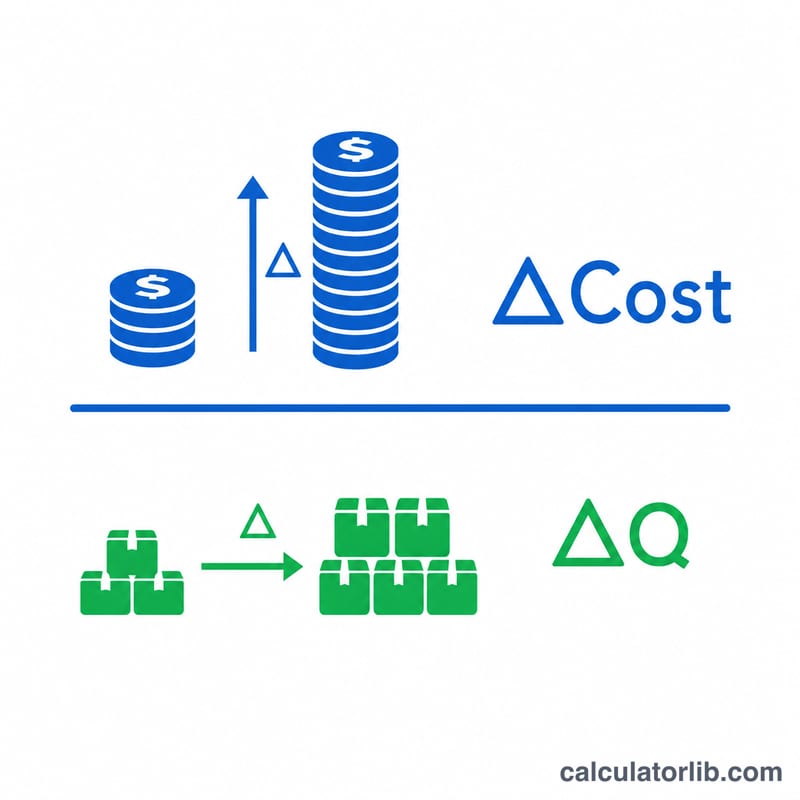
Enter four values: the initial total cost and quantity (before the change) and the new total cost and quantity (after the change). The calculator finds the change in total cost (\(\Delta TC\)) and the change in quantity (\(\Delta Q\)), then divides \(\Delta TC\) by \(\Delta Q\) to give the marginal cost per additional unit.
The Formula Explained
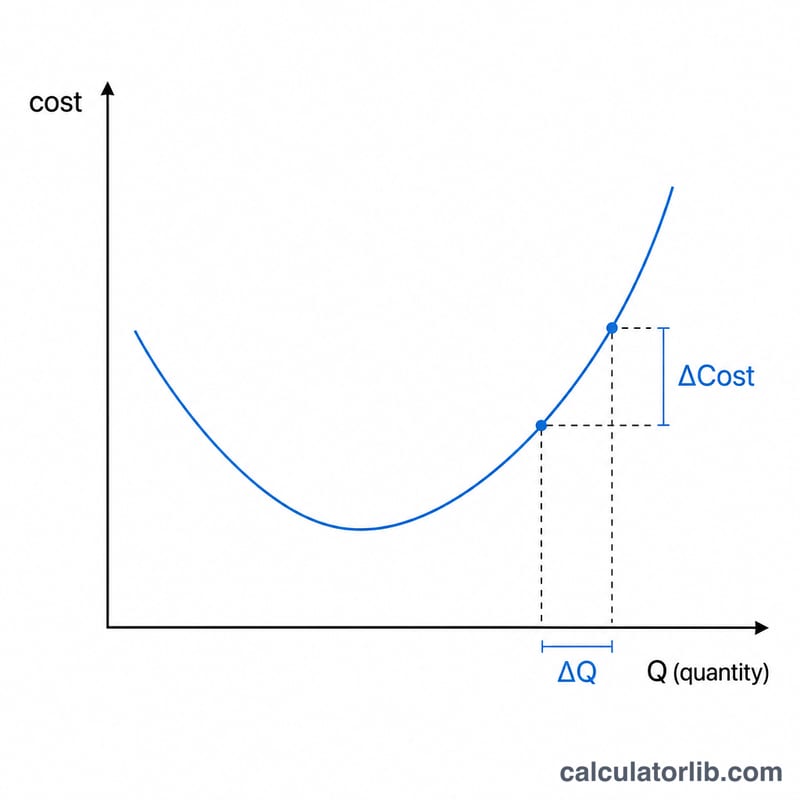
The formula is $$MC = \frac{\Delta \text{Total Cost}}{\Delta \text{Quantity}}$$ where \(\Delta TC = TC_2 - TC_1\) and \(\Delta Q = Q_2 - Q_1\). Only the change in cost driven by changing output matters — fixed costs that do not change cancel out, so marginal cost reflects variable costs at the margin.
Worked Example
Suppose producing 100 units costs $1,000 in total, and producing 150 units costs $1,400. The change in total cost is \(\$1{,}400 - \$1{,}000 = \$400\), and the change in quantity is \(150 - 100 = 50\) units. $$MC = \frac{\$400}{50} = \$8 \text{ per unit}$$ Each of those 50 extra units costs an average of $8 to make.
FAQ
How is marginal cost different from average cost? Average cost is total cost divided by total quantity, while marginal cost is the cost of just the next unit. They can differ sharply when costs rise or fall with volume.
Why might marginal cost rise as output grows? Because of diminishing returns — adding more input (labor, overtime, materials) eventually yields smaller output gains, pushing the cost of each extra unit higher.
Should I produce more if marginal cost is below price? Generally yes: if each extra unit costs less to make than it sells for, producing more increases profit, up to the point where marginal cost equals marginal revenue.