
What Is Net Operating Working Capital?
Net Operating Working Capital (NOWC) measures the capital tied up in a company's day-to-day operations. Unlike ordinary working capital (current assets minus current liabilities), NOWC strips out non-operating items — namely cash and cash equivalents on the asset side and short-term (interest-bearing) debt on the liability side. This gives a cleaner view of the funds genuinely required to run the business, which is essential when estimating free cash flow and enterprise value.
How to Use This Calculator
Enter four figures from the balance sheet: total current operating assets, cash and cash equivalents, total current operating liabilities, and short-term debt (such as notes payable or the current portion of long-term debt). The calculator subtracts cash from assets and debt from liabilities, then takes the difference to give NOWC.
The Formula Explained
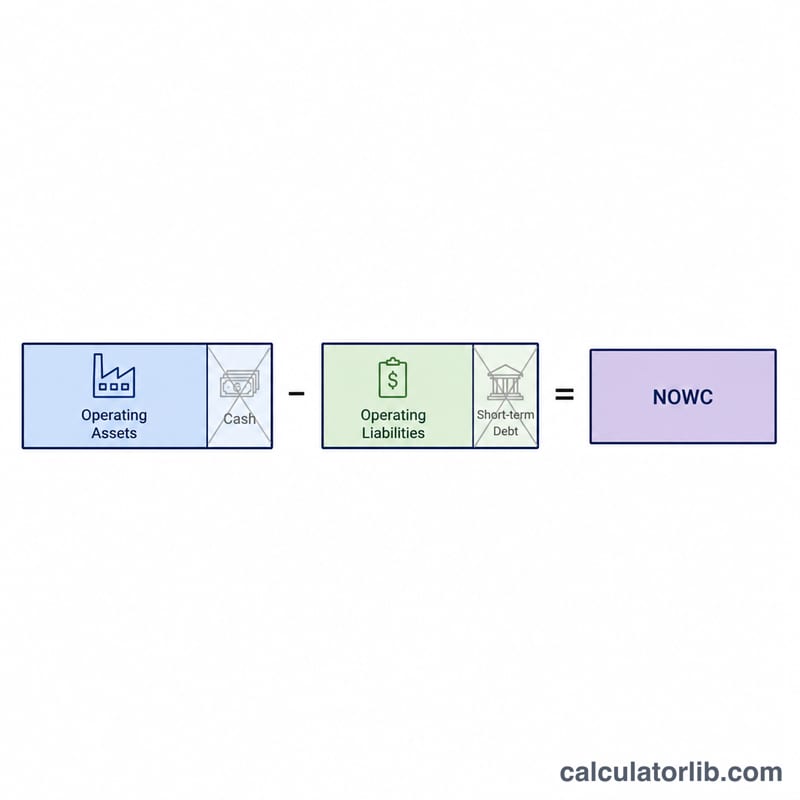
$$\text{NOWC} = \left(\text{Current Operating Assets} - \text{Cash}\right) - \left(\text{Current Operating Liabilities} - \text{Short-Term Debt}\right)$$ Cash is removed because it is generally not needed to support operations and is treated as a financing item. Short-term debt is removed because it carries interest and belongs to a company's financing structure rather than its operating cycle.
Worked Example
Suppose a firm has $500,000 in current operating assets, $50,000 of which is cash, and $300,000 in current operating liabilities, of which $80,000 is short-term debt. Operating assets \(= 500{,}000 - 50{,}000 = 450{,}000\). Operating liabilities \(= 300{,}000 - 80{,}000 = 220{,}000\). $$\text{NOWC} = 450{,}000 - 220{,}000 = \mathbf{230{,}000}$$
FAQ
How is NOWC different from working capital? Standard working capital includes all current assets and liabilities. NOWC excludes cash and short-term debt to isolate operating needs.
Can NOWC be negative? Yes. A negative NOWC means operating liabilities exceed operating assets, which can be a sign of efficient supplier financing or, sometimes, liquidity stress.
Why exclude cash? Cash is a financing/investing buffer rather than an operating requirement, so analysts remove it to focus on capital that actually funds operations.