
What Is the Optimal Price Calculator?
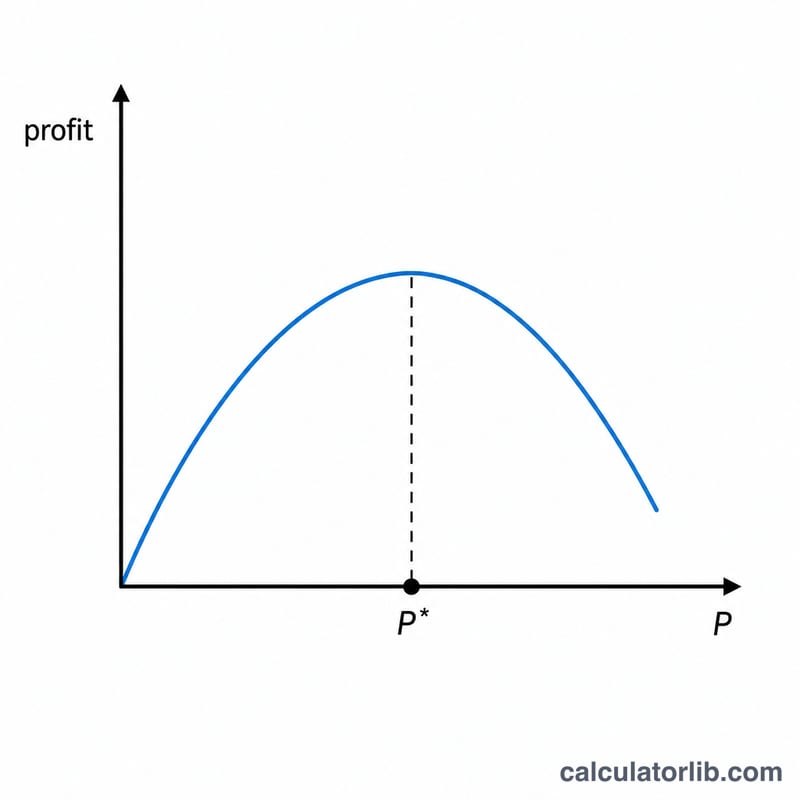
This calculator finds the profit-maximizing price for a product using the classic economic markup rule. It links your variable (marginal) cost per unit to the price elasticity of demand to reveal the price at which marginal revenue equals marginal cost — the point that maximizes profit for a price-setting business.
How to Use It
Enter two values: the variable cost per unit (the cost that increases with each additional unit sold, such as materials, packaging, or shipping) and the price elasticity of demand. Elasticity is normally a negative number because higher prices reduce quantity demanded — for example, an elasticity of -3 means a 1% price increase cuts demand by 3%. The calculator returns the optimal price, your contribution margin per unit, and the implied markup over cost.
The Formula Explained
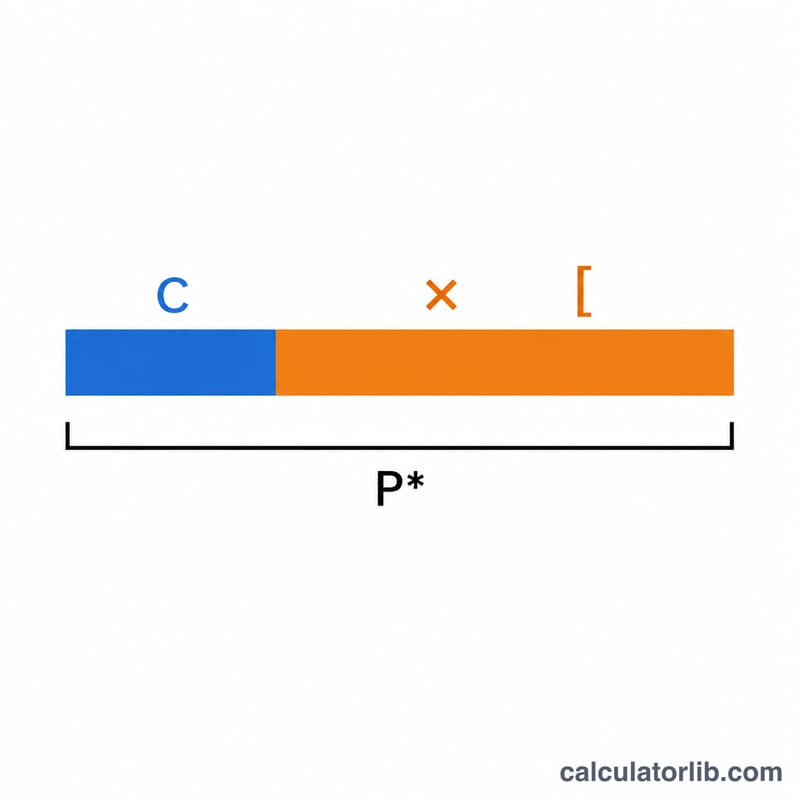
The profit-maximizing rule is $$P^{*} = \text{Variable Cost} \cdot \frac{\text{Elasticity}}{\text{Elasticity} + 1}$$ Because demand elasticity \(E\) is negative, the fraction \(E/(E+1)\) is greater than 1, producing a markup above cost. As demand becomes more elastic (\(E\) moves toward large negative numbers), the optimal markup shrinks toward cost; as demand becomes inelastic (\(E\) near \(-1\)), the optimal price rises sharply, reflecting customers' low price sensitivity.
Worked Example
Suppose your variable cost is $20 and price elasticity is -3. Then $$\frac{E}{E+1} = \frac{-3}{-2} = 1.5$$ so the optimal price is $$20 \times 1.5 = \$30$$ Your contribution margin is \(\$30 - \$20 = \$10\) per unit, a 50% markup over cost.
FAQ
Why must elasticity be negative? Demand curves slope downward — raising price lowers quantity sold — so price elasticity is conventionally negative.
What if elasticity is between 0 and -1? Demand is inelastic and there is no finite profit-maximizing markup under this rule; a profit-seeking firm would keep raising price, so verify your elasticity estimate.
Does this include fixed costs? No. The optimal-price rule uses only marginal (variable) cost. Fixed costs affect whether you should be in the market, not the profit-maximizing price.