
What Is Price Elasticity of Demand?
Price elasticity of demand (PED) measures how responsive the quantity demanded of a good is to a change in its price. It is one of the most important concepts in microeconomics, helping businesses set prices and helping economists understand market behavior. A high elasticity means buyers are very sensitive to price changes; a low elasticity means demand barely moves when price changes.
How to Use This Calculator
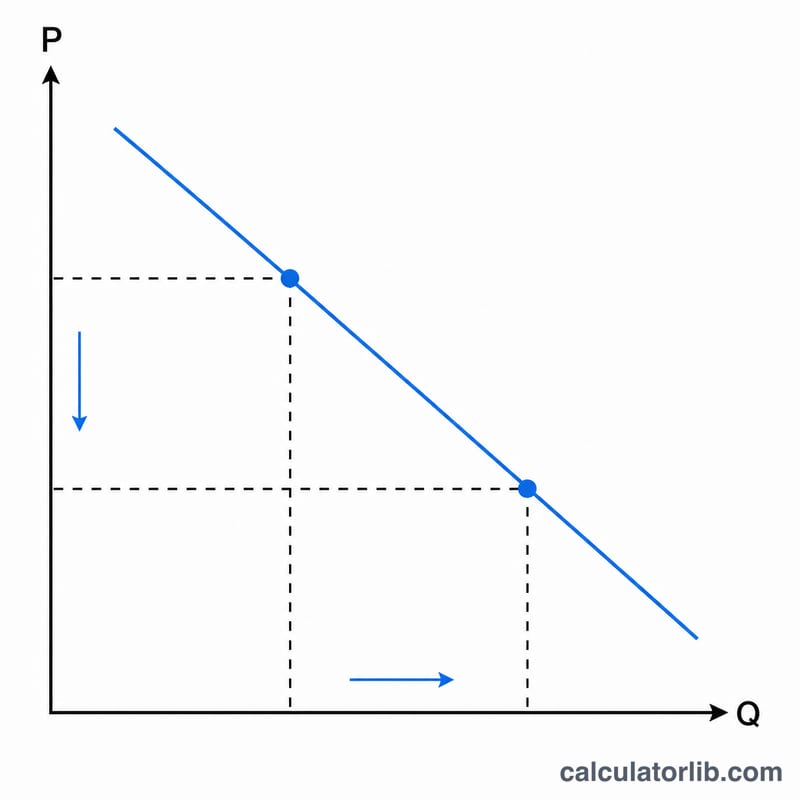
Enter the initial quantity demanded and the new quantity demanded, then the initial price and the new price. The calculator computes the percentage change in quantity, the percentage change in price, and divides them to find the PED. It also tells you whether demand is elastic, inelastic, or unit elastic based on the absolute value.
The Formula Explained
PED = (% change in quantity demanded) ÷ (% change in price). Each percentage change is calculated as (new − old) ÷ old × 100. Because price and quantity usually move in opposite directions, PED is normally negative; economists often interpret its absolute value. When |PED| > 1 demand is elastic, when |PED| < 1 it is inelastic, and when |PED| = 1 it is unit elastic.
$$\text{PED} = \dfrac{\%\,\Delta Q}{\%\,\Delta P}$$where
$$\begin{aligned} \%\,\Delta Q &= \dfrac{\text{New Quantity} - \text{Initial Quantity}}{\text{Initial Quantity}} \times 100 \\[0.6em] \%\,\Delta P &= \dfrac{\text{New Price} - \text{Initial Price}}{\text{Initial Price}} \times 100 \end{aligned}$$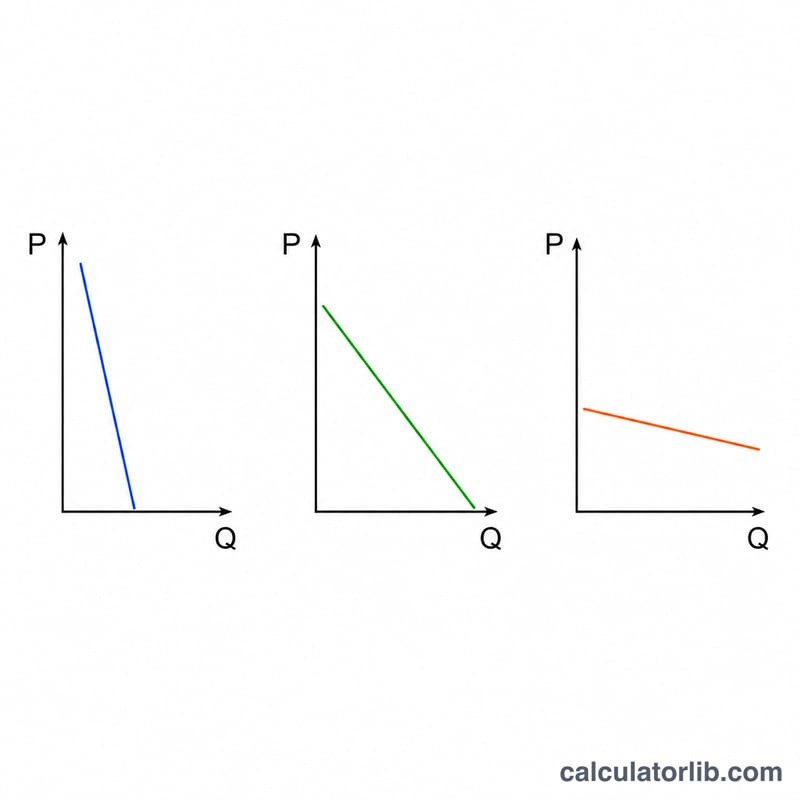
Worked Example
Suppose quantity demanded falls from 100 to 80 units when price rises from $10 to $12. The % change in quantity = \((80 - 100)/100 = -20\%\). The % change in price = \((12 - 10)/10 = +20\%\).
$$\text{PED} = \dfrac{-20\%}{20\%} = -1$$which is unit elastic.
FAQ
Why is PED usually negative? Because of the law of demand: when price goes up, quantity demanded goes down, so the two percentage changes have opposite signs.
What does elastic demand mean for pricing? If demand is elastic, raising prices reduces total revenue, while lowering prices can increase it. For inelastic goods, raising prices increases revenue.
What if I get a divide-by-zero? If the price does not change (no % change in price) or the initial value is zero, elasticity is undefined; this tool returns 0 in those edge cases.