
What Is Income Elasticity of Demand?
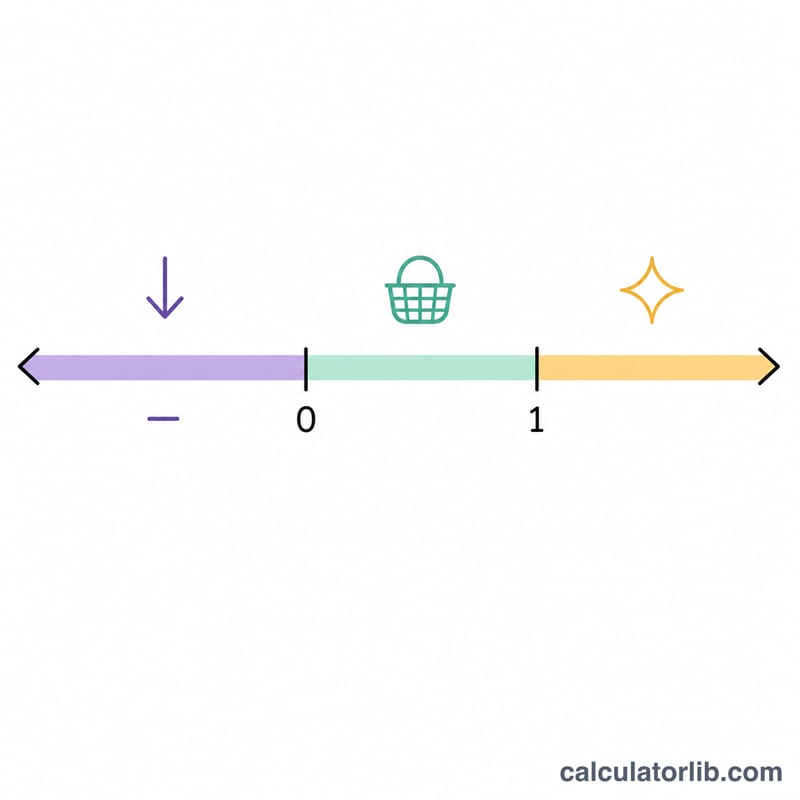
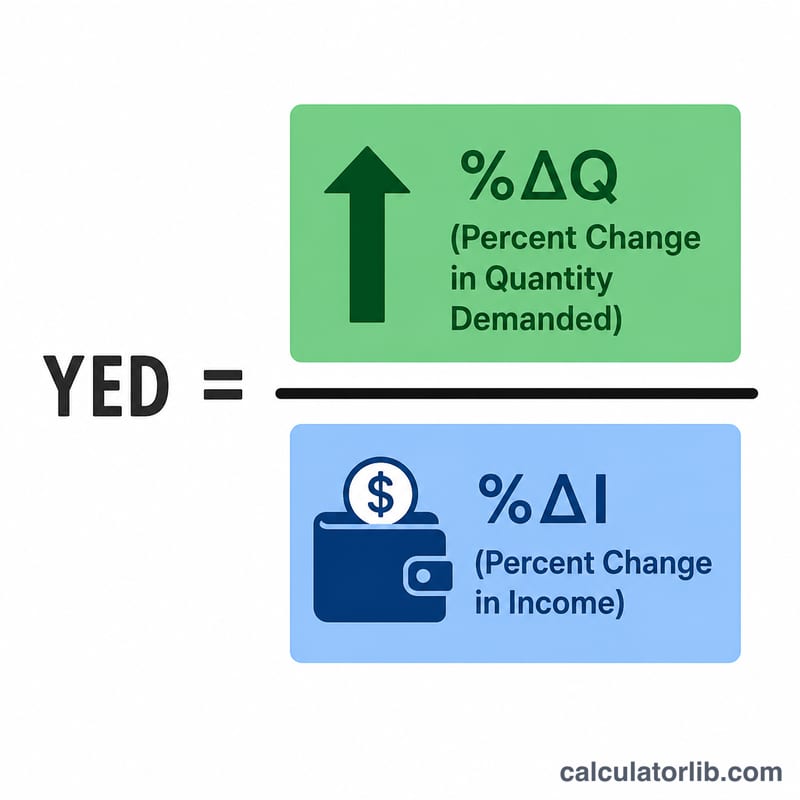
Income elasticity of demand (YED) measures how responsive the quantity demanded of a good is to a change in consumer income. It is a core concept in microeconomics that helps classify goods and predict how demand shifts as incomes rise or fall. A positive YED means demand grows with income (a normal good), while a negative YED means demand falls as income rises (an inferior good).
How to Use This Calculator
Enter the initial and new quantity demanded, then the initial and new income level. The calculator computes the percentage change in each variable and divides them to give the YED. All inputs use the same units consistently, so any currency or quantity measure works as long as you stay consistent.
The Formula Explained
YED equals the percentage change in quantity demanded divided by the percentage change in income: $$\text{YED} = \dfrac{\%\Delta Q_d}{\%\Delta \text{Income}}$$ Each percentage change is found by subtracting the initial value from the new value, dividing by the initial value, and multiplying by 100.
$$\text{YED} = \dfrac{\dfrac{\text{New Qty} - \text{Initial Qty}}{\text{Initial Qty}} \times 100}{\dfrac{\text{New Income} - \text{Initial Income}}{\text{Initial Income}} \times 100}$$
Worked Example
Suppose quantity demanded rises from 100 to 120 units while income rises from 2,000 to 2,500. The quantity change is \((120-100)/100 = 20\%\). The income change is \((2{,}500-2{,}000)/2{,}000 = 25\%\). $$\text{YED} = \frac{20\%}{25\%} = 0.8$$ — a normal good with inelastic income response.
FAQ
What does a YED greater than 1 mean? It indicates a luxury good: demand rises faster than income.
What is a negative YED? A negative value signals an inferior good — demand falls as income rises.
What if YED is between 0 and 1? The good is a necessity (income-inelastic normal good): demand rises but more slowly than income.