
What This Calculator Does
This tool estimates US federal income tax using the progressive bracket system set by the IRS, for the tax year you choose: 2026 (the default), 2025 or 2024. It supports Single and Married Filing Jointly statuses and reports your total tax, marginal rate, effective rate, and after-tax income. It applies to the United States only and applies that year's official bracket thresholds directly to taxable income (after deductions): Rev. Proc. 2025-32 for 2026, Rev. Proc. 2024-40 for 2025 and Rev. Proc. 2023-34 for 2024. In 2026 a single filer's 10% bracket ends at $12,400 and the 37% rate applies above $640,600 ($24,800 and $768,700 for married filing jointly).
How to Use It
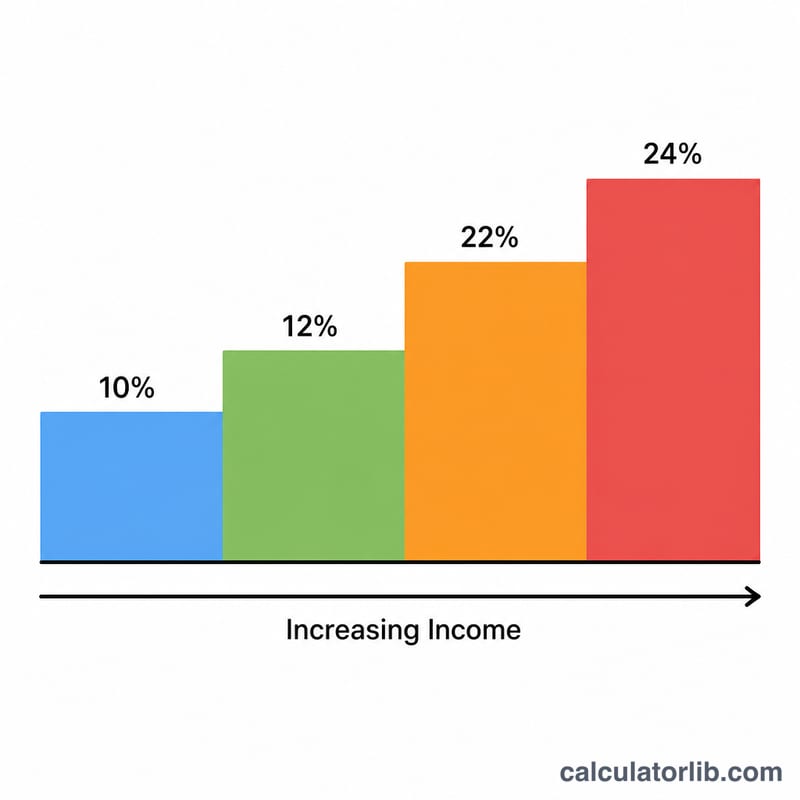
Enter your taxable income (income after deductions) and choose your filing status. The calculator walks through each tax bracket, taxing only the portion of income that falls inside that bracket, then sums the results.
The Formula Explained
Tax is computed bracket by bracket: $$\text{Tax} = \sum_{i} \left( \min(\text{Income},\, U_i) - L_i \right)^{+} \times r_i$$ Your marginal rate is the rate of your highest applicable bracket, while your effective rate is total tax \(\div\) total income — always lower than your marginal rate under a progressive system.
Worked Example
For a single filer with $75,000 of taxable income in 2026 (the default year): the first $12,400 is taxed at 10% = $1,240; the next $38,000 (from $12,400 to $50,400) at 12% = $4,560; the remaining $24,600 (from $50,400 to $75,000) at 22% = $5,412. Total = $$\$1{,}240 + \$4{,}560 + \$5{,}412 = \$11{,}212$$ The marginal rate is 22%, the effective rate = \(11{,}212 / 75{,}000 \approx 14.95\%\), and after-tax income = $63,788.
FAQ
Is this my total tax bill? No — it estimates federal income tax only and excludes state taxes, FICA/payroll taxes, and credits.
What income should I enter? Enter taxable income (after the standard or itemized deduction), not gross income.
Why is my effective rate lower than my bracket? Because only the income within each bracket is taxed at that bracket's rate, not all your income.