Weekly Weight Loss Calculator

Weekly Weight Loss Calculator

Growing AI Skill PRO

Enter Calculation

Formula

Target Intake=Maintenance (cal/day)−Loss (lbs/week)×35007\text{Target Intake} = \text{Maintenance (cal/day)} - \frac{\text{Loss (lbs/week)} \times 3500}{7}

Example

Target Intake=2000−1×35007=1,500\text{Target Intake} = 2000 - \frac{1 \times 3500}{7} = 1{,}500
Show calculation steps (1)
  1. Daily Calorie Deficit

    Daily Deficit=Loss (lbs/week)×35007\text{Daily Deficit} = \frac{\text{Loss (lbs/week)} \times 3500}{7}

    Each pound of fat is about 3500 calories; the weekly deficit is spread over 7 days

Usage stats

Advertisement

Results

Required Daily Calorie Deficit
500
calories below maintenance per day
Weekly calorie deficit 3,500 cal
Target daily intake 1,500 cal

Estimate from the 7,700 kcal per kg (3,500 kcal per lb) rule. Real weight loss slows over time as the body adapts, so it usually takes longer.

Report an error on this page

What This Calculator Does

The Weekly Weight Loss Calculator tells you the daily calorie deficit you need to maintain in order to lose a chosen number of pounds each week. It is based on the widely used estimate that one pound of body fat is equivalent to about 3,500 calories of stored energy. While individual results vary, this rule of thumb is a practical starting point for planning a diet and exercise routine.

How to Use It

Enter your target weight loss per week in pounds — most experts recommend a safe, sustainable rate of 1 to 2 lbs per week. Optionally, enter your daily maintenance calories (the amount you burn each day at your current weight). The calculator returns the daily deficit required and, if you provided maintenance calories, your suggested daily intake to hit that goal.

The Formula Explained

The math is straightforward. To lose X pounds in one week you need a weekly deficit of X × 3,500 calories. Spread evenly across 7 days, the daily deficit is:

$$\text{Daily Deficit} = \frac{\text{Loss (lbs/week)} \times 3500}{7}$$

Your target intake is simply your maintenance calories minus this daily deficit.
Advertisement
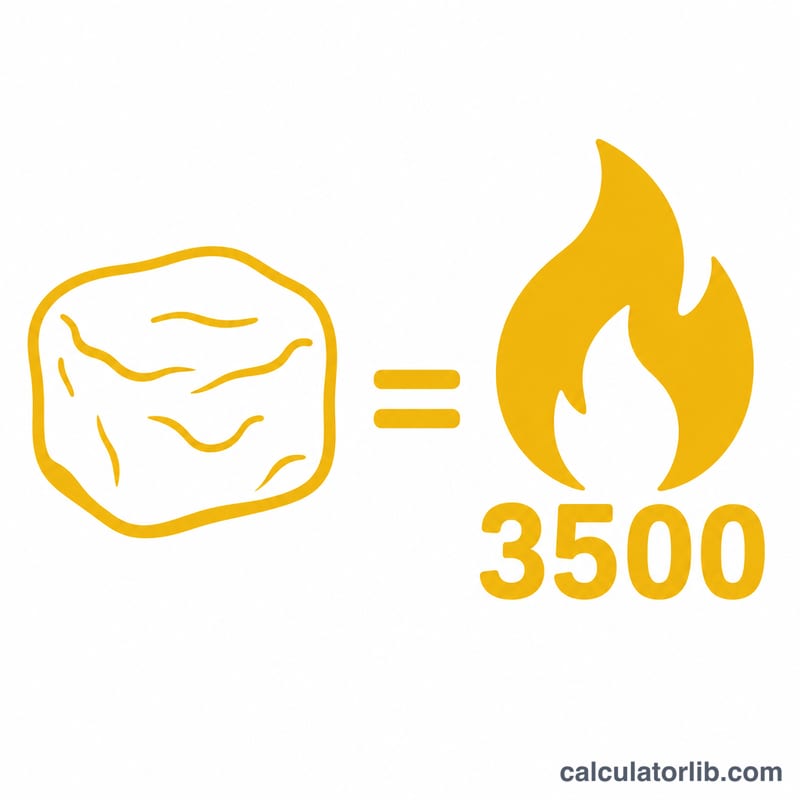
One pound of fat equals 3500 calories
The core rule: one pound of fat is treated as about 3,500 calories.

Worked Example

Suppose you want to lose 1.5 lbs per week with a maintenance level of 2,200 calories per day. The weekly deficit is \(1.5 \times 3500 = 5250\) calories. Dividing by 7 gives a daily deficit of 750 calories. Your target daily intake is \(2200 - 750 = 1450\) calories.
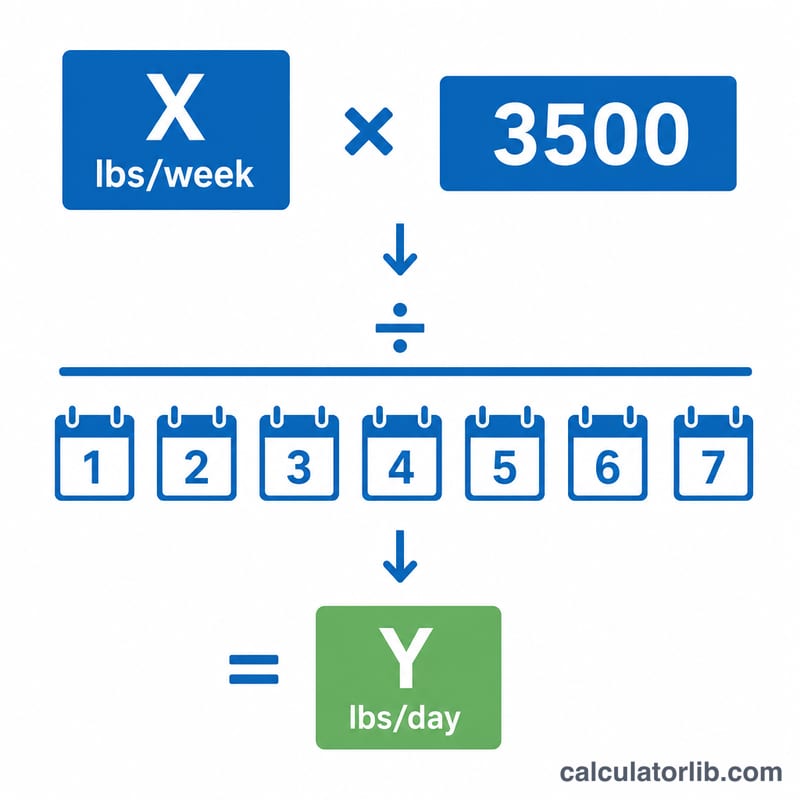
Weekly calorie target divided across seven days into a daily deficit
The weekly calorie total is spread across 7 days to find the daily deficit.

FAQ

Is 3,500 calories per pound exact? No. It is an approximation. Real fat loss depends on metabolism, water balance, muscle mass and hormones, so treat the result as a guide.

How fast should I lose weight? Most health authorities suggest 1 to 2 lbs per week. Faster rates can be hard to sustain and may cost muscle.

Should I eat below 1,200 calories? Very low intakes can be unsafe. If your target intake drops too low, choose a smaller weekly goal or add exercise to widen the deficit. Consult a professional before starting any diet.


Sources & References

  • Quantification of the effect of energy imbalance on bodyweight — Hall KD et al., Lancet 2011;378(9793):826-837, doi 10.1016/S0140-6736(11)60812-X (author manuscript PMC3880593). The 3,500 kcal per lb (about 7,700 kcal per kg) rule is a static estimate: real loss slows as the body adapts, so long timelines are optimistic. · Verified 2026-11-07
  • Obesity - Treatment — NHS (nhs.uk). Safe, steady rate of weight loss: 0.5 to 1 kg (1 to 2 lb) a week. · Verified 2026-11-07
  • 2013 AHA/ACC/TOS Guideline for the Management of Overweight and Obesity in Adults — Jensen MD et al., Circulation 2014;129(25 Suppl 2):S102-S138, doi 10.1161/01.cir.0000437739.71477.ee. Weight-loss diets usually 1,200-1,500 kcal/day (women) and 1,500-1,800 kcal/day (men) with a deficit of 500 kcal/day or more: basis of the intake floor. · Verified 2026-11-07

Checked against these sources on . Not reviewed by a clinician. For general information only, not medical advice or a diagnosis. Talk to a doctor about any health concern.

Last updated:

Most popular in Health and Fitness

View all Health and Fitness calculators