
What Is the Steps to Distance Calculator?
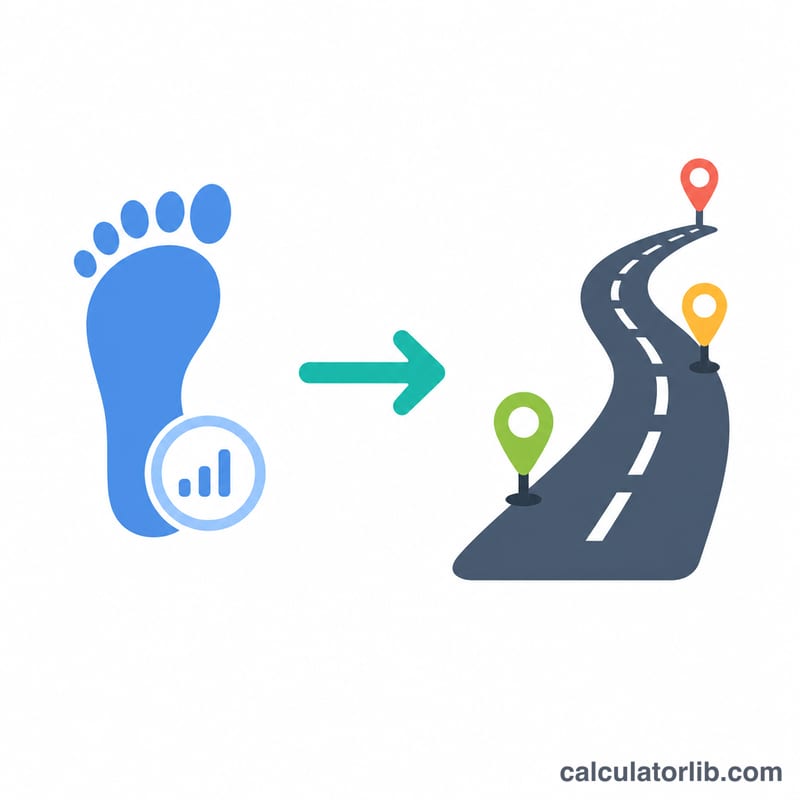
This calculator turns a raw step count from your phone, fitness tracker, or pedometer into a real-world distance in kilometers or miles. Because everyone's legs are different, it estimates your personal stride length from your height and gender, giving a far more accurate result than a generic "2,000 steps = 1 mile" rule of thumb.
How to Use It
Enter the number of steps you took, choose your gender (used for the stride coefficient), and type your height in centimeters. Pick whether you want the answer in kilometers or miles, then read your distance along with the estimated stride length used in the math.
The Formula Explained
The core relationship is simple: distance = steps × stride length. The hard part is the stride length, which we estimate from height using widely cited coefficients: stride \(\approx 0.415 \times \text{height}\) for men and \(0.413 \times \text{height}\) for women. With height in centimeters, the stride comes out in centimeters; dividing by 100 gives meters per step. Multiply by your steps for total meters, then convert: divide by 1,000 for kilometers, or by 1,609.344 for miles.
$$\text{Distance (km)} = \frac{\text{Steps} \times 0.415 \times \text{Height (cm)}}{100000}$$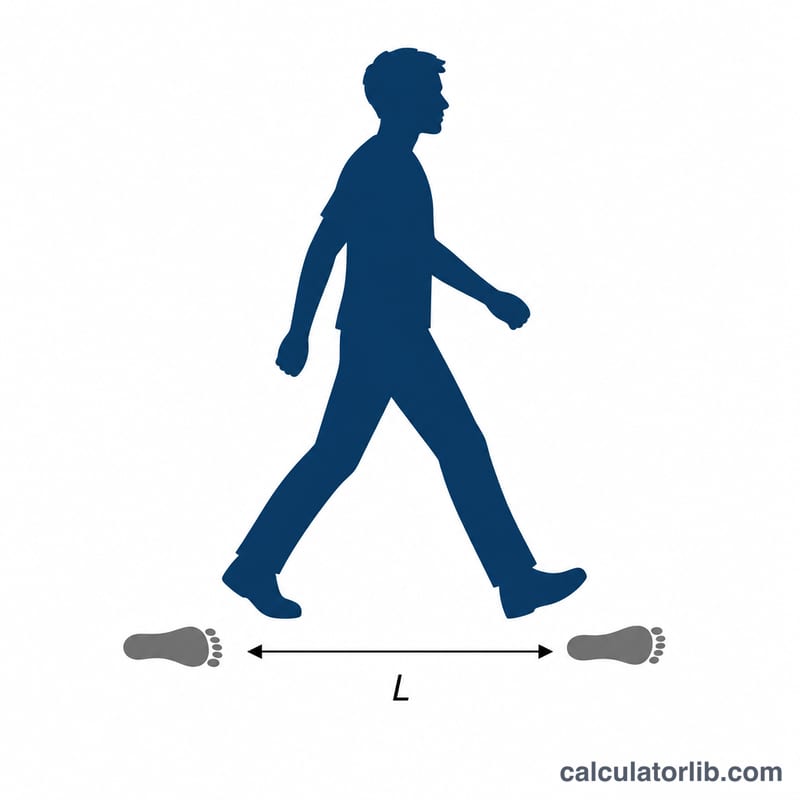
Worked Example
Suppose a man who is 180 cm tall walks 10,000 steps. His stride length is
$$0.415 \times 180 = 74.7 \text{ cm} = 0.747 \text{ m}$$Total distance =
$$10{,}000 \times 0.747 = 7{,}470 \text{ m} = 7.47 \text{ km}$$which is about 4.642 miles.
FAQ
Is stride length the same as step length? In everyday fitness usage they are treated the same here — the distance covered by one step. True biomechanical "stride" is two steps, but trackers and these coefficients use the per-step value.
Why does height matter? Taller people generally take longer steps, so scaling by height makes the estimate personal instead of a one-size-fits-all average.
How can I make it more accurate? Measure your actual stride by walking a known distance and dividing by your step count, then back-solve. The height-based estimate is a solid starting point when you don't have that measurement.