What This Calculator Does
The Time to Reach Goal Weight Calculator estimates how long it will take to reach a target weight given a consistent daily calorie deficit. It is built on the widely used rule of thumb that one pound of body fat is roughly equivalent to 3,500 calories. By dividing the total calorie gap to your goal by how many calories you cut each week, the tool gives a simple weeks-and-days projection.
How to Use It
Enter your current weight and goal weight in pounds, then enter the average daily calorie deficit you plan to maintain (the gap between calories burned and calories eaten). The calculator returns the estimated number of weeks and days to reach your goal, the total weight to lose, and your expected weekly loss.
The Formula
The core equation is:
$$\text{Weeks} = \frac{\left(\text{Current (lb)} - \text{Goal (lb)}\right) \times 3500}{\text{Daily Deficit} \times 7}$$The numerator is the total calorie deficit needed to lose all the target pounds (each pound \(\approx\) 3,500 calories). The denominator is your weekly deficit. A 500 cal/day deficit equals 3,500 cal/week, or about 1 pound per week.
Worked Example
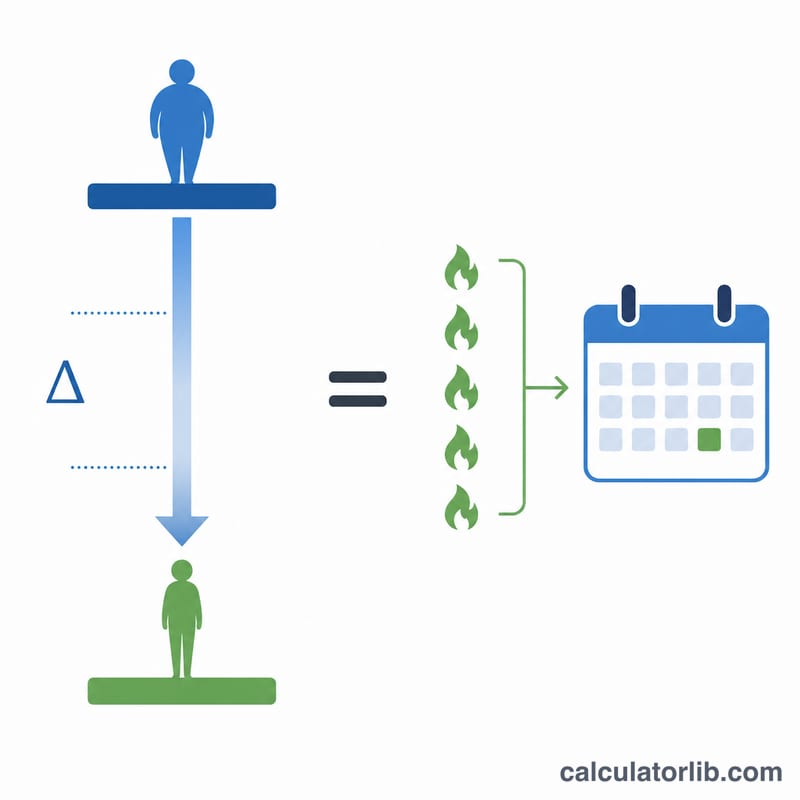
Suppose you weigh 180 lb and want to reach 160 lb with a 500 cal/day deficit. You need to lose 20 lb, or
$$20 \times 3{,}500 = 70{,}000 \text{ calories}$$Your weekly deficit is
$$500 \times 7 = 3{,}500 \text{ calories}$$So
$$70{,}000 \div 3{,}500 = 20 \text{ weeks (140 days)}$$losing about 1 lb per week.
Time to Goal at Different Daily Deficits
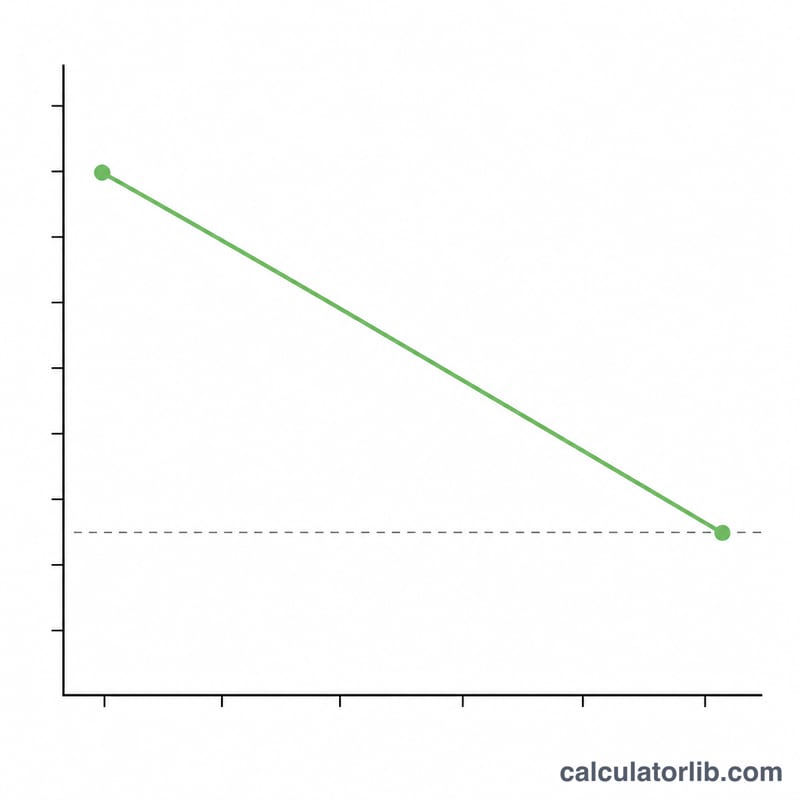
The table below uses a fixed 20 lb loss (for example, 180 lb down to 160 lb). It applies the 3,500 calories per pound rule, so the total energy deficit needed is 20 × 3,500 = 70,000 calories. Weeks are that total divided by the weekly deficit (daily deficit × 7).
| Daily deficit (cal/day) | Weekly deficit (cal) | Expected loss per week (lb) | Weeks to lose 20 lb | Approx. days |
|---|---|---|---|---|
| 250 | 1,750 | 0.5 | 40 | 280 |
| 500 | 3,500 | 1 | 20 | 140 |
| 750 | 5,250 | 1.5 | about 13.3 | about 93 |
| 1,000 | 7,000 | 2 | 10 | 70 |
Worked check for the 500 cal/day row:
$$\text{Weeks} = \frac{(180 - 160) \times 3500}{500 \times 7} = \frac{70000}{3500} = 20$$
Doubling the daily deficit halves the time, but larger deficits are harder to sustain and are more demanding on the body. These figures are simple arithmetic estimates, not predictions.
Interpreting Your Result
The number of weeks shown is a straight-line estimate. It assumes that your daily calorie deficit stays exactly the same for the whole period and that every 3,500 calories of deficit equals one pound of body weight lost. Real bodies are more complicated, and the result ignores several factors:
- Falling maintenance calories: As body weight drops, the body generally needs fewer calories each day. If your food intake stays the same, the deficit shrinks over time. For larger amounts of weight loss, the actual rate usually slows, so the real time to goal is often longer than the calculated one.
- Metabolic adaptation: Energy expenditure can fall by somewhat more than weight loss alone would predict, which narrows the deficit further.
- Water weight fluctuations: Day-to-day changes from sodium, carbohydrate intake, hormones, and hydration can mask or exaggerate fat loss over days or weeks.
- Lean mass loss: Not all weight lost is fat. Some may be muscle or other lean tissue, which changes the energy content per pound lost. This means the 3,500 calorie rule is only an approximation.
Public health guidance, such as that from the U.S. Centers for Disease Control and Prevention (CDC), often cites about 1 to 2 pounds per week as a gradual rate of weight loss. Compare your result with that range to see how aggressive the plan implied by your inputs is.
Treat the result as a rough planning figure and expect real progress to vary. This is general information, not medical or professional advice.
FAQ
Is the 3,500-calorie rule exact? No. It is a useful approximation; real weight loss slows as metabolism adapts, so treat the result as a planning estimate.
What is a safe deficit? Many guidelines suggest 500–1,000 cal/day for steady loss of 1–2 lb per week. Consult a professional for personal advice.
Can I use kilograms? This version uses pounds and the 3,500 cal/lb figure. Convert kg to lb (1 kg \(\approx\) 2.205 lb) before entering values.