
What This Calculator Does
This tool tells you how long it takes to reach a specific savings target when you start with a current balance, add a fixed monthly contribution, and earn compound interest along the way. Instead of guessing, you get the exact number of months (and years) until you hit your goal — perfect for planning a house deposit, emergency fund, vacation, or any other milestone.
How to Use It
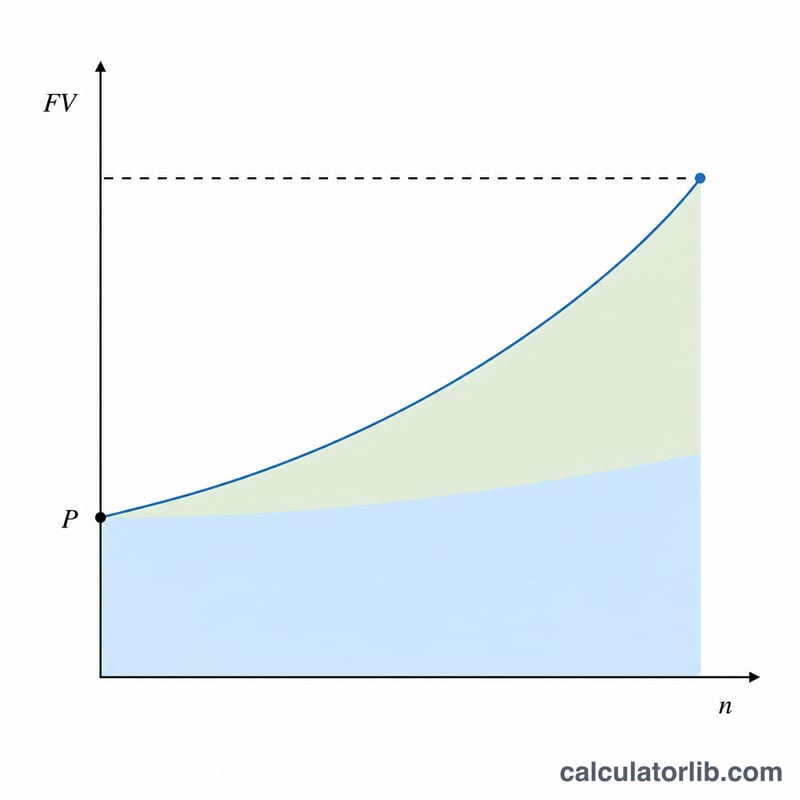
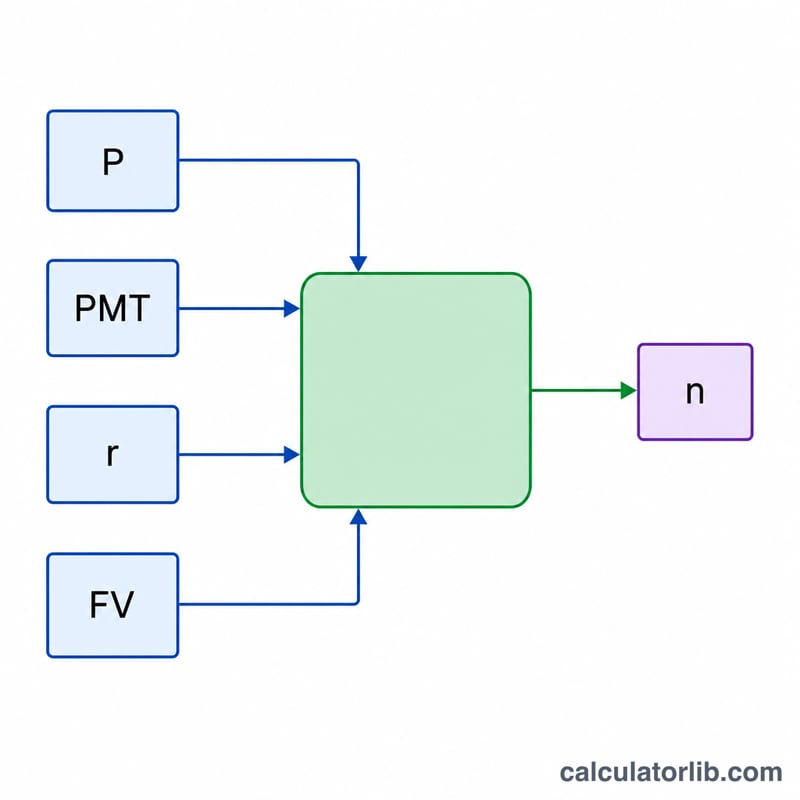
Enter four values: your savings goal (the future value you want), your current savings (the balance you have today), the monthly contribution you plan to add, and the annual interest rate your account earns. The calculator converts the annual rate to a monthly rate, applies monthly compounding, and returns the time needed.
The Formula Explained
The core equation is:
$$n = \frac{\ln\!\left(\dfrac{FV \cdot r + PMT}{P \cdot r + PMT}\right)}{\ln(1 + r)}$$Here n is the number of months, FV is the goal, P is the starting balance, PMT is the monthly deposit, and r is the monthly interest rate (annual rate ÷ 12 ÷ 100). The natural-log structure accounts for interest compounding on both your starting balance and every contribution. If the interest rate is 0%, the formula simplifies to \(n = \frac{FV - P}{PMT}\).
Worked Example
Suppose you want to save $50,000, you already have $5,000, you add $500 per month, and you earn 6% annually. The monthly rate is \(r = 0.06 / 12 = 0.005\). Then
$$n = \frac{\ln\!\left(\dfrac{50000 \cdot 0.005 + 500}{5000 \cdot 0.005 + 500}\right)}{\ln(1.005)} = \frac{\ln(750 / 525)}{\ln(1.005)} \approx \frac{0.3567}{0.0049875} \approx 71.5 \text{ months}$$or about 5.96 years.
FAQ
Does it assume monthly compounding? Yes — interest is applied each month and contributions are added monthly.
What if my goal is below my current balance? Then you've already reached it, and the result is effectively zero months.
Are taxes or inflation included? No. The result is a nominal pre-tax estimate; reduce your assumed rate to model after-tax or real returns.