
What This Calculator Does
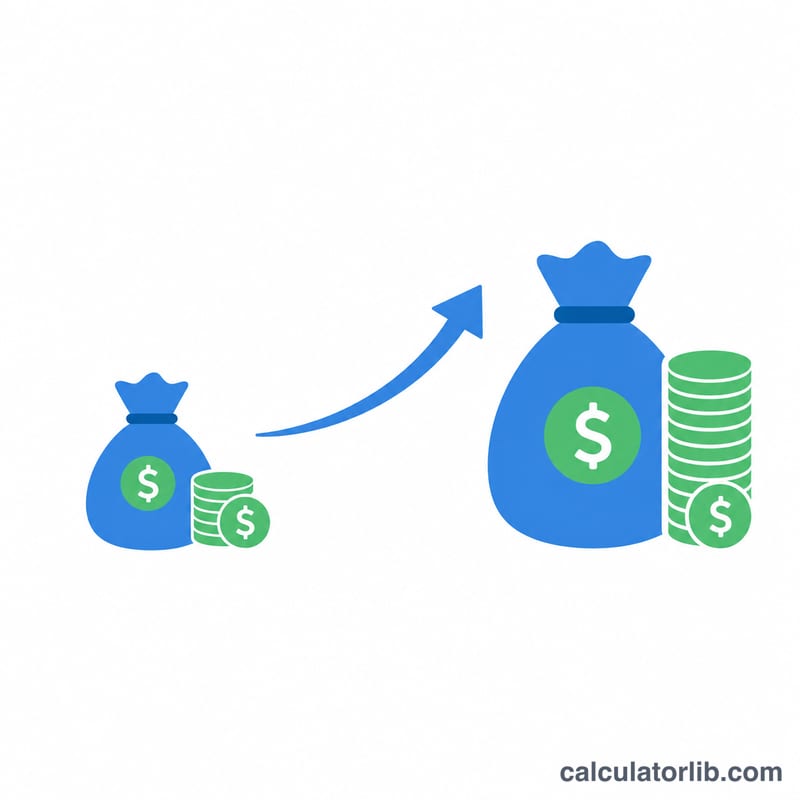
A savings target that sounds comfortable today may fall short years from now, because inflation steadily reduces what each dollar can buy. This calculator takes a goal expressed in today's money and projects how large that same goal must be in the future to preserve identical purchasing power. It is a universal time-value-of-money tool and is not tied to any particular country.
How to Use It
Enter three numbers: the goal amount in today's dollars (for example, the lifestyle or purchase you have in mind), the average annual inflation rate you expect, and the number of years until you reach the goal. The calculator returns the future amount you will actually need, the extra cushion inflation adds, and the cumulative growth factor.
The Formula Explained
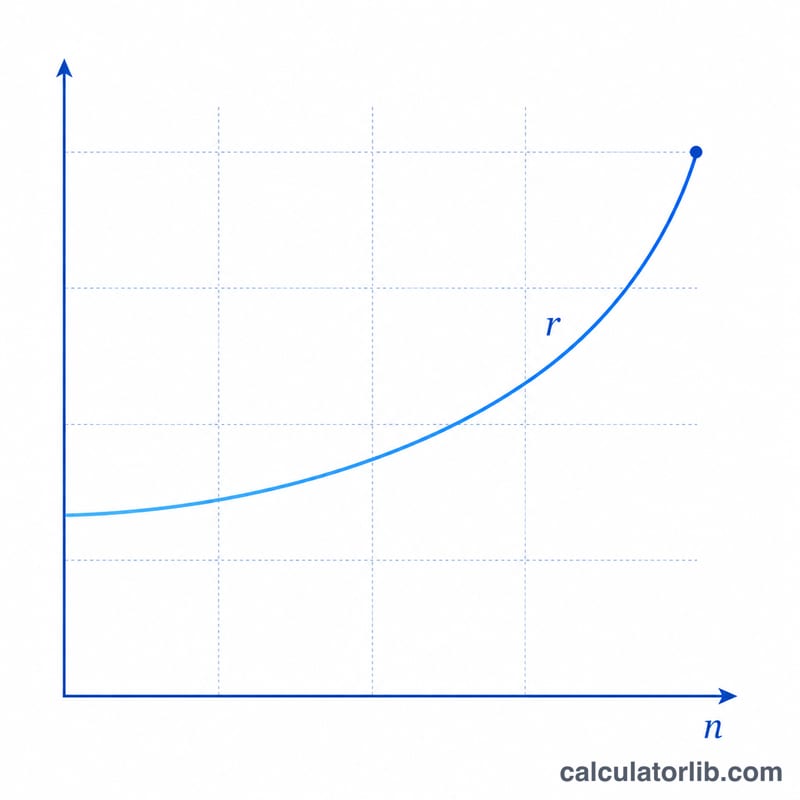
The core equation is $$\text{Future Goal} = \text{Goal Today} \times \left(1 + \frac{\text{Inflation \%}}{100}\right)^{\text{Years}}$$ where \(r\) is the inflation rate written as a decimal and \(n\) is the number of years. Because inflation compounds, the adjustment grows faster the longer your time horizon. For example, 3% inflation roughly doubles prices over 24 years.
Worked Example
Suppose you want $50,000 in today's money, expect 3% annual inflation, and have 20 years to go. The growth factor is \((1.03)^{20} \approx 1.8061\). Multiplying gives $$50{,}000 \times 1.8061 \approx \$90{,}306$$ So you would need about $90,306 in 20 years to enjoy what $50,000 buys today — roughly $40,306 of which is purely inflation.
FAQ
What inflation rate should I use? Many planners use a long-run average of 2–3%, but you can enter a higher figure to be conservative.
Does this account for investment returns? No — it isolates the inflation effect. To see whether your savings keep pace, compare this future goal against your projected investment balance.
Is this purchasing-power adjustment the same as a real return? They are related: this tool shows the nominal future dollars needed, which is the inverse of discounting future money back to today's value.