
What this calculator tells you
This tool estimates how many months pregnant you are based on your gestational age. Gestational age is counted from the first day of your last menstrual period (LMP), the standard clinical reference point. Because pregnancy is usually tracked in weeks, converting to months is helpful when sharing news with friends and family who think in months rather than weeks.
How to use it
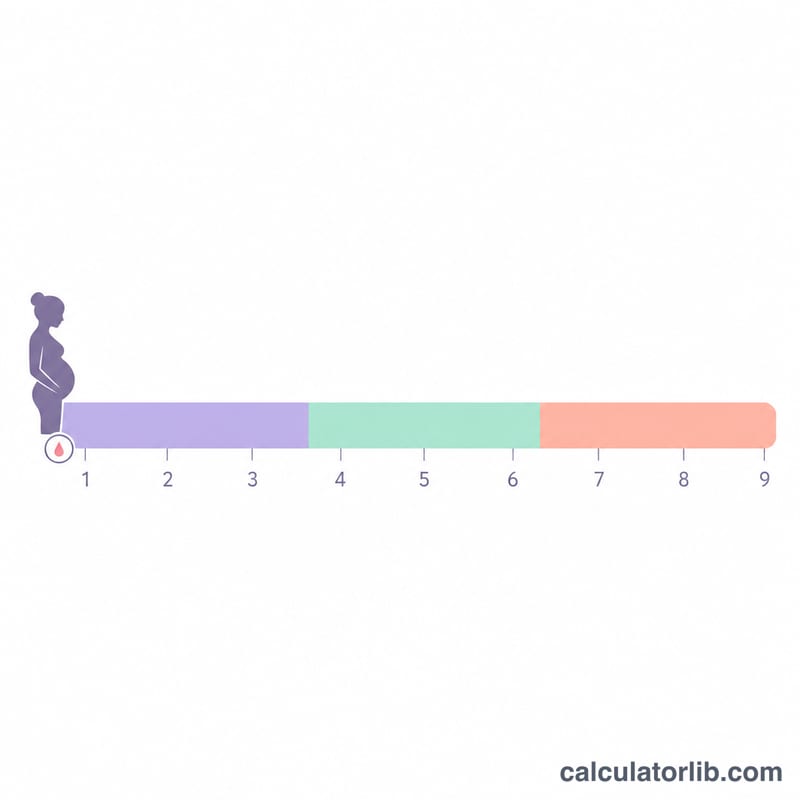
Enter the first day of your last menstrual period and today's date. The calculator counts the number of days between the two dates, then converts that figure into months, completed weeks, and extra days. A typical full-term pregnancy is about 40 weeks, or roughly 9.2 months by this calculation.
The formula explained
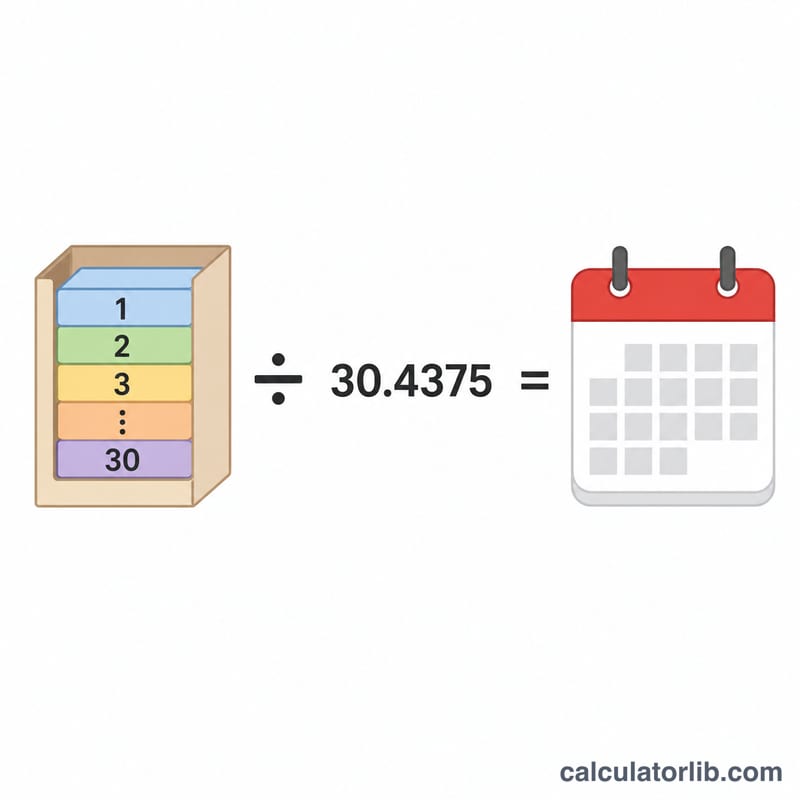
One calendar month is not exactly four weeks. The average month length is \(365.25 \div 12 = 30.4375\) days. So months pregnant = gestational age in days \(\div\) 30.4375. This gives a smooth, decimal value rather than rounding to whole calendar months.
$$\begin{gathered} \text{Months} = \frac{\text{Days}}{30.4375} \\[1.5em] \text{where}\quad \left\{ \begin{aligned} \text{Days} &= \text{Today} - \text{LMP} \\ \text{Today} &= \left(\text{Year},\ \text{Month},\ \text{Day}\right) \\ \text{LMP} &= \left(\text{Year},\ \text{Month},\ \text{Day}\right) \end{aligned} \right. \end{gathered}$$
Worked example
Suppose your LMP was January 1, 2024 and today is July 1, 2024. That is 182 days. Dividing $$182 \div 30.4375 \approx 5.98$$ months — so you are nearly 6 months pregnant, or 26 weeks.
FAQ
Is gestational age the same as how long ago I conceived? No. Gestational age is measured from your LMP, which is typically about two weeks before conception.
Why does my doctor say weeks instead of months? Weeks are more precise for monitoring development and due dates, so clinicians prefer them. Months are an everyday approximation.
Is this a medical diagnosis? No. This is an estimate for general guidance. Always confirm your dates and progress with your healthcare provider, who may adjust based on an ultrasound.