What this calculator does
The How Many Months Until a Date Calculator tells you how many whole months remain from today until any future date you choose. It is handy for counting down to a due date, a lease end, a mortgage milestone, a wedding, an exam, or any deadline measured in months rather than days.
How to use it
Pick the target year, month, and day, then submit. The tool compares your date with today's date and returns the number of complete months between them, along with a rough conversion to years. Because it counts whole months, a date that falls part-way through a month is rounded down to the last completed month.
The formula explained
The core calculation is simple: $$\text{months} = (y_2 - y_1)\times 12 + (m_2 - m_1)$$ where the subscript 1 is today and subscript 2 is the target date. Each calendar year contributes 12 months, and the month difference adds or removes the remainder. The day-of-month adjustment subtracts one month when the target day has not yet been reached in the final month, so the result reflects only fully elapsed months.
Worked example
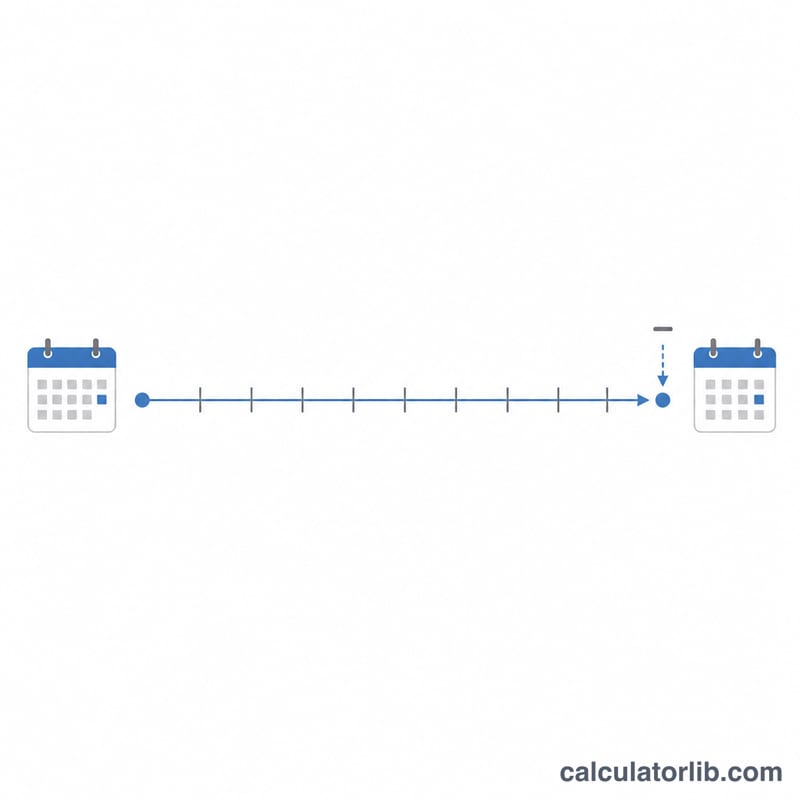
Suppose today is 15 January 2024 and your target date is 10 August 2025. The raw figure is $$(2025 - 2024)\times 12 + (8 - 1) = 12 + 7 = 19 \text{ months}.$$ Because the target day (10) is earlier in the month than today's day (15), we subtract one month, giving 18 whole months, or about 1.5 years.
Month Count Scenarios by Target Date
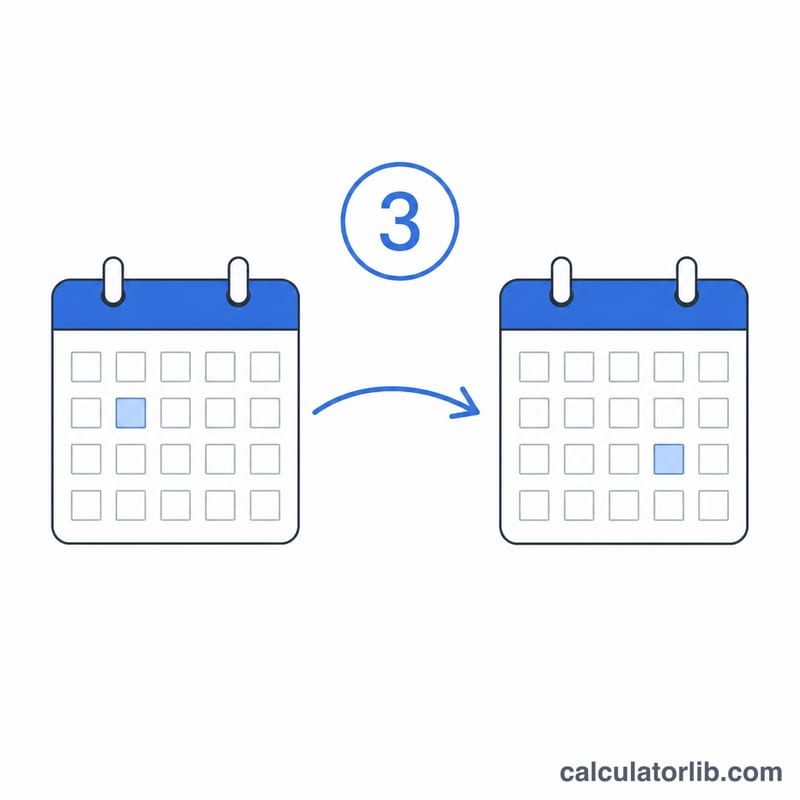
The calculator counts whole months with \(\text{Months} = (Y_{target} - Y_{now})\times 12 + (M_{target} - M_{now}) - \delta\), where \(\delta = 1\) if the target day of the month is earlier than the starting day, and \(\delta = 0\) otherwise. The table uses a fixed start of 15 January 2024 (except the month-end row). The years estimate is whole months ÷ 12, rounded to two decimals.
| Target date | Raw month difference | Day adjustment | Whole months | Approx. years |
|---|---|---|---|---|
| 15 July 2024 (same day of month) | 6 | 0 | 6 | 0.50 |
| 10 July 2024 (earlier day, 10 < 15) | 6 | −1 | 5 | 0.42 |
| 20 July 2024 (later day, 20 > 15) | 6 | 0 | 6 | 0.50 |
| 15 January 2025 (same day, next year) | 12 | 0 | 12 | 1.00 |
| 10 March 2025 (earlier day, next year) | 14 | −1 | 13 | 1.08 |
| 29 February 2024, starting from 31 January 2024 (month-end case) | 1 | −1 (29 < 31) | 0 | 0.00 |
| 15 October 2023 (past date) | −3 | 0 | −3 | −0.25 |
Worked check (10 July 2024): \((2024 - 2024)\times 12 + (7 - 1) - 1 = 0 + 6 - 1 = 5\) whole months, and \(5 \div 12 \approx 0.42\) years.
Month-end note: February 2024 has only 29 days, so from 31 January there is no "31 February". Under the simple day-of-month comparison, 29 February is one day-number short of 31, so no full month is counted. Some calendar conventions would treat the last day of February as completing one month, so results for month-end dates can differ between tools.
The calculator uses today's date as the start, so your own result depends on the date you run it.
Key Terms Explained
- Whole (completed) month
- A month counted only once the same day-of-month has been reached. Partial months are not rounded up, so 5 months and 25 days counts as 5.
- Raw month difference
- The difference in calendar month positions, ignoring days: \((Y_{target} - Y_{now})\times 12 + (M_{target} - M_{now})\). From January 2024 to July 2024 it is 6.
- Day-of-month adjustment (\(\delta\))
- A subtraction of 1 applied when the target's day number is smaller than the starting day number, because the last month is not yet complete. Otherwise it is 0.
- Calendar month vs 30-day month
- A calendar month runs from a given day in one month to the same day in the next, and varies from 28 to 31 days. A 30-day month is a fixed-length approximation. The two give different results over long spans, and this calculator uses calendar months.
- Years estimate
- Whole months divided by 12, for example \(18 \div 12 = 1.5\) years. It is only an approximation based on completed months, not an exact day count.
- Negative result for past dates
- If the target date is earlier than today, the formula gives a negative number, meaning the date has already passed by that many months.
Because months range from 28 to 31 days, month-end dates (29th, 30th, 31st) may behave differently: a short month may not contain the starting day number, which can reduce the count by one compared with what you expect.
FAQ
Does it count partial months? No. It returns completed months only and rounds the final partial month down.
Can the target be in the past? Yes — a past date simply returns a negative number of months.
Which "today" does it use? The calculator uses the current server date when you run it, so results update every day.