
What Is Mean Arterial Pressure (MAP)?
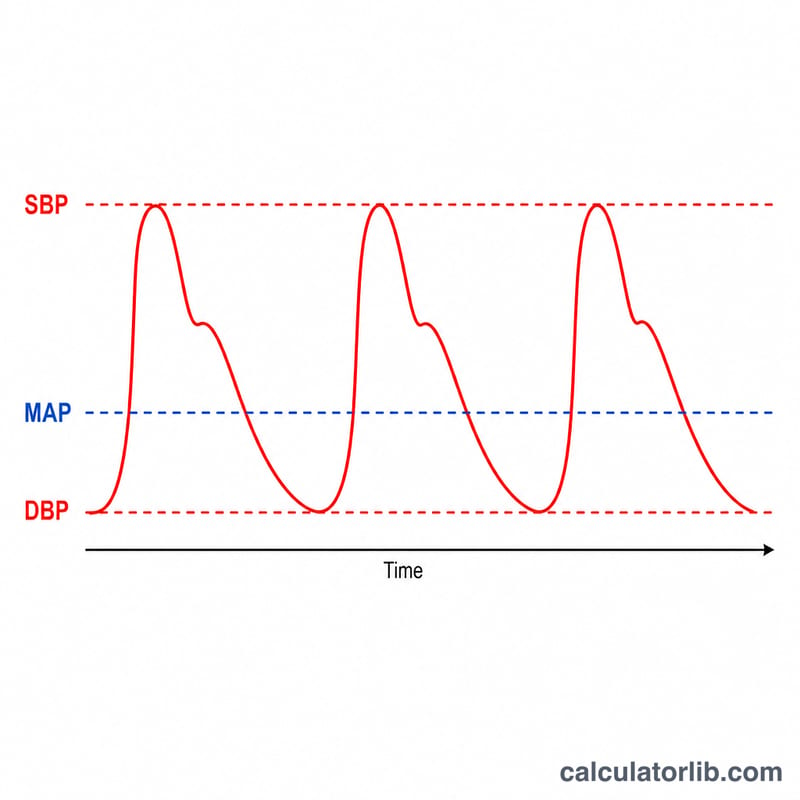
Mean Arterial Pressure (MAP) is the average pressure in your arteries during one cardiac cycle. It is a better indicator of organ perfusion than a single systolic or diastolic reading, because it reflects the pressure that actually drives blood to your tissues. A MAP of roughly 70–100 mmHg is generally considered adequate to perfuse the brain, kidneys, and other vital organs.
How to Use This Calculator
Enter your systolic blood pressure (SBP — the top number) and your diastolic blood pressure (DBP — the bottom number), both in mmHg. The calculator instantly returns your estimated MAP along with your pulse pressure. This tool is for general educational use and is not a substitute for clinical judgment or medical advice.
The Formula Explained
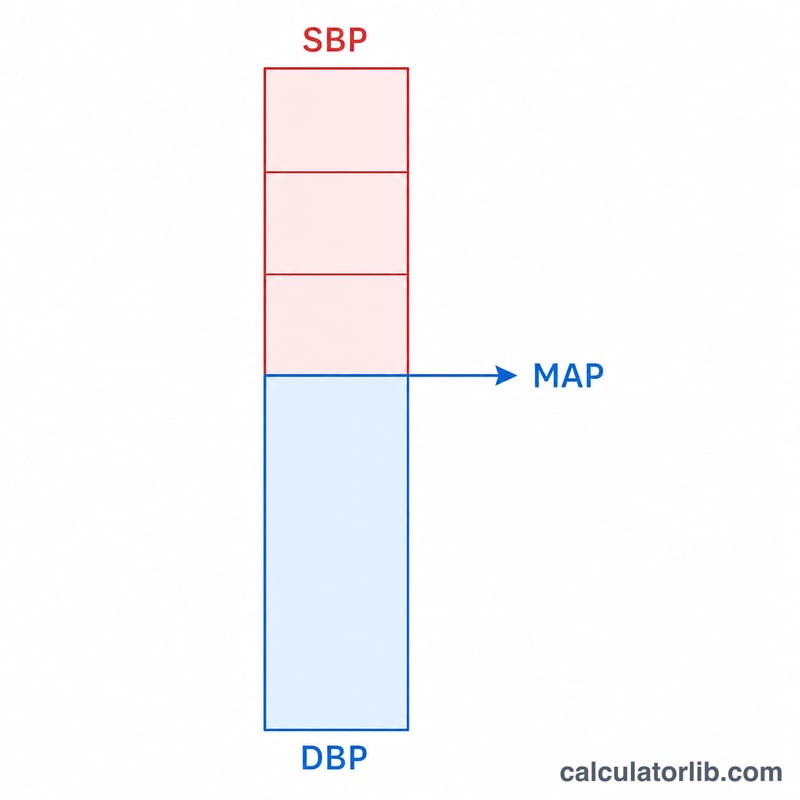
The standard estimate is $$\text{MAP} = \text{DBP} + \frac{\text{SBP} - \text{DBP}}{3}$$ The term \(\text{SBP} - \text{DBP}\) is the pulse pressure. Because the heart spends about two-thirds of each cycle in diastole and only one-third in systole, MAP is weighted toward the diastolic value — hence adding only one-third of the pulse pressure to the diastolic pressure.
Worked Example
Suppose a typical reading of 120/80 mmHg. Pulse pressure = \(120 - 80 = 40\) mmHg. $$\text{MAP} = 80 + \frac{40}{3} = 80 + 13.33 = 93.33 \text{ mmHg}$$ which falls comfortably in the normal range.
FAQ
What is a normal MAP? A MAP between about 70 and 100 mmHg is generally considered normal. Values below 60 mmHg may risk inadequate organ perfusion.
Why is diastole weighted more heavily? The heart rests (diastole) longer than it contracts (systole), so the arteries spend more time at the lower diastolic pressure, pulling the true average closer to it.
Is this exact? No — it is a widely used estimate. The formula assumes a normal heart rate; at very high heart rates the one-third weighting becomes less accurate.