
What is Mean Arterial Pressure?
Mean Arterial Pressure (MAP) is the average pressure in a person's arteries during one cardiac cycle. It is considered a better indicator of perfusion to vital organs than systolic blood pressure alone, because the heart spends roughly two-thirds of the cardiac cycle in diastole. A MAP of at least 60–65 mmHg is generally needed to maintain adequate blood flow to the brain, kidneys, and other organs.
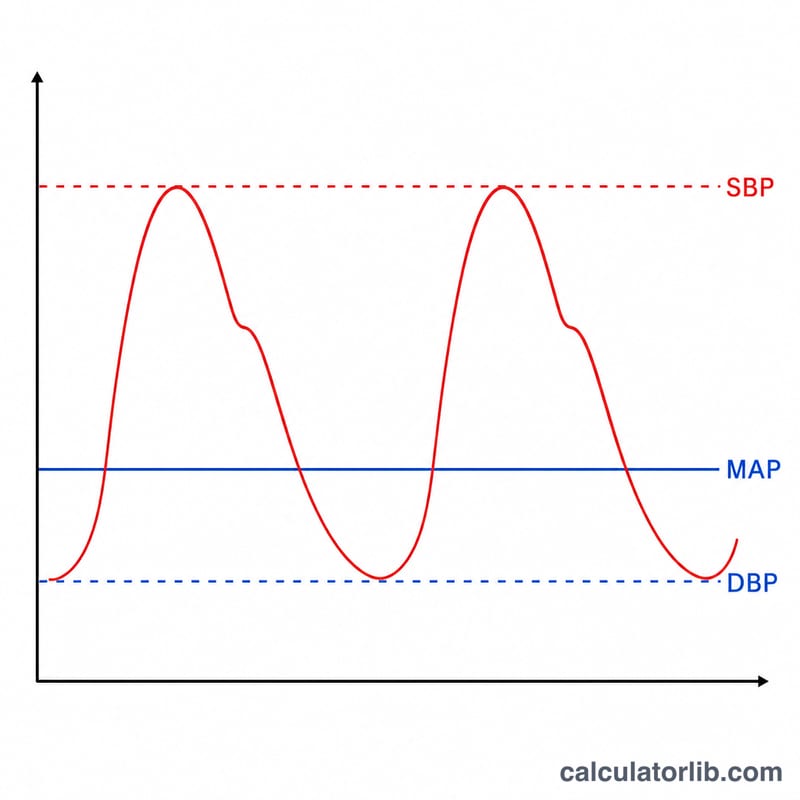
How to use this calculator
Enter your systolic blood pressure (the top number, SBP) and your diastolic blood pressure (the bottom number, DBP) in mmHg. The calculator instantly returns your estimated MAP along with your pulse pressure. For example, a reading written as 120/80 means SBP = 120 and DBP = 80.
The formula explained
The standard clinical estimate is $$\text{MAP} = \text{DBP} + \frac{\text{SBP} - \text{DBP}}{3}$$. The term \((\text{SBP} - \text{DBP})\) is the pulse pressure. Adding one-third of the pulse pressure to the diastolic value weights the average toward diastole, reflecting how the heart spends more time relaxed than contracting at normal resting heart rates.
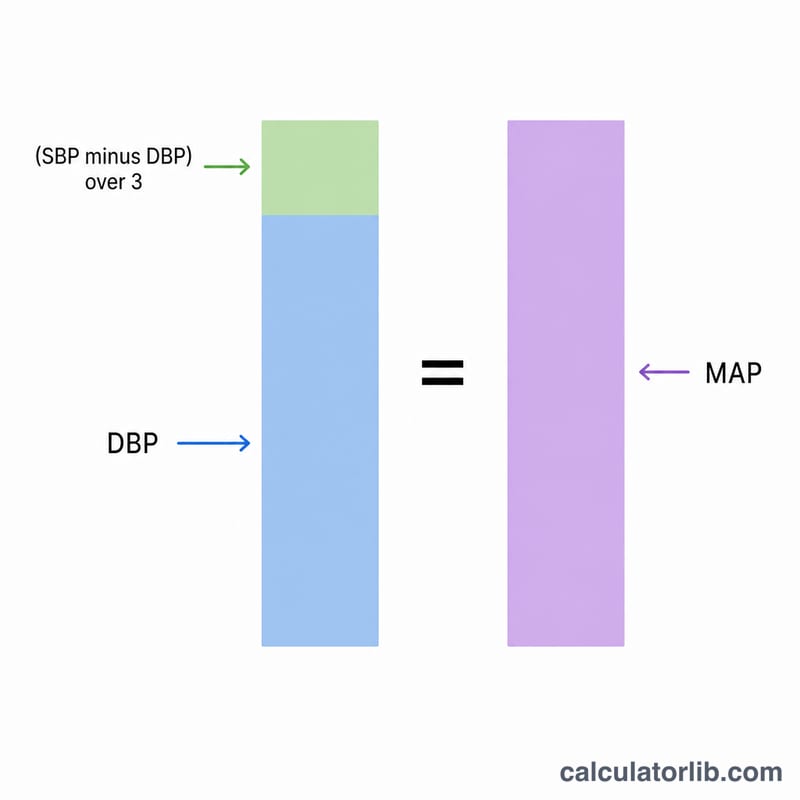
Worked example
For a blood pressure of 120/80 mmHg: pulse pressure = \(120 - 80 = 40\). $$\text{MAP} = 80 + \frac{40}{3} = 80 + 13.33 \approx 93.3 \text{ mmHg}$$ which falls within the normal range of about 70–100 mmHg.
FAQ
What is a normal MAP? A MAP between roughly 70 and 100 mmHg is typically considered normal for an adult at rest.
Why is MAP lower than the average of SBP and DBP? Because the formula weights diastole more heavily — the heart spends about two-thirds of each cycle in diastole at a normal heart rate.
Is this a substitute for medical advice? No. This tool is for educational estimation only. The simple formula is less accurate at high heart rates. Always consult a healthcare professional for diagnosis and treatment.